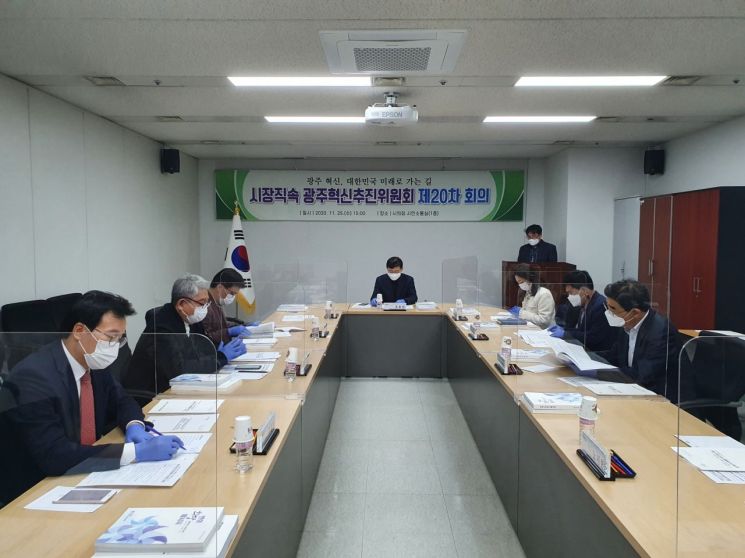
[Asia Economy Honam Reporting Headquarters Reporter Park Seon-gang] The Gwangju Innovation Promotion Committee (Chairman Ju Jeong-min, hereinafter referred to as the ‘Innovation Promotion Committee’), directly under the mayor, held its 20th plenary meeting on the 25th in the small conference room on the first floor of the City Council to review the ‘Innovation Promotion Committee’s 2-year administrative innovation recommendations and proposal implementation status’ and discuss the future direction of Gwangju’s innovation.
The Innovation Promotion Committee was launched in November 2018 to advise and propose on overall administrative innovation policies including discovering, implementing, and evaluating innovation policies, and to support the implementation of innovation policies in administrative sites, marking its 2nd anniversary.
The Innovation Promotion Committee started with 19 innovation experts from various fields as the innovation hub leading Gwangju’s change, and later operated with 25 members by additionally appointing youth committee members.
At the reporting session held that day, the committee reviewed the implementation status of 22 administrative innovation recommendations and proposals delivered to Gwangju City over the past two years and discussed plans for further concretization.
Since its launch, the Innovation Promotion Committee has formed 4 subcommittees and 4 special committees, held 20 plenary meetings, 101 special and subcommittee meetings, and 7 workshops and forums, totaling 128 sessions, gathering opinions from citizens, related organizations, groups, and public officials, and recommended and proposed 22 administrative innovation plans to Gwangju City in 14 rounds, checking the implementation status of 18 cases.
The Innovation Promotion Committee’s administrative innovation recommendations and proposals cover 74 fields and 390 tasks, of which 312 tasks have been reviewed, with 206 tasks, or 66.2%, completed or in progress.
First, in the public administration sector, which recommended and proposed 6 administrative innovations including city public institutions, integrity culture, service productivity, data-based administration, and transition to a with-COVID-19 administrative system, the committee introduced the nation’s first integrated recruitment for city public institutions, a three-stage (citizen, external, internal) management evaluation system, an anonymous proxy reporting public ombudsman system, on-site exemption deliberation committee, and a private consignment (subsidy) public recruitment document and announcement screening committee, strengthening transparency and fairness in the public sector.
It also proposed transitioning to a with-COVID-19 administrative system including an integrated mobile app for food service businesses’ service, reservation, and delivery, integrated Dong (neighborhood) administrative welfare centers for welfare and jobs, and an infectious disease comprehensive information center.
In the culture and arts sector, which recommended and proposed 5 administrative innovations including municipal art groups, media art creative city, library policy, private subsidies, and prompt implementation of Eodeungsan, the committee introduced joint performances and holiday performances among art groups, representative brand performances and evaluation systems, performance contracts for artistic directors and senior members, and a public contest system for cultural and artistic subsidies, laying the foundation for revitalizing culture and arts, including promoting the construction of the representative library at the site of the planned redevelopment of the Sangmu incineration plant (scheduled to open in 2023).
In the economy and industry sector, which recommended and proposed 6 administrative innovations including regulatory free zones, factory automation, industrial policy platforms, data-based administration, venture startups, and AI-centered cities, the unmanned low-speed special vehicle and green energy storage system (ESS) power generation were designated as regulatory free zones, the support target for factory automation was significantly expanded, support for win-win smart factory transformation (3 companies) was provided, and supercomputer policyization was introduced, indicating the direction of regional industrial structure innovation.
In the welfare and environment sector, which recommended and proposed 5 administrative innovations including the Gwangju-type welfare model, low birthrate measures, climate crisis response, and green ecosystems, the committee facilitated the establishment of a social service agency, spread of community care models, dementia-specialized community villages, the welfare total volume system (nation’s first), introduction of basic child-rearing income, and expansion of support for infertile couples, transitioning to a public welfare system that citizens can feel.
It also enabled proactive responses to the government’s Green New Deal, such as the announcement of the Gwangju-type AI-Green New Deal (energy self-reliant city) and declaration of a climate crisis emergency.
The Innovation Promotion Committee plans to conclude the activities of its first term of two years and appoint second-term members by supplementing youth and women based on recommendations from civic groups, the City Council, city departments, and committee members.
Chairman Ju Jeong-min emphasized, “The first Innovation Promotion Committee suggested the direction of Gwangju’s innovation and led change through recommendations and proposals for administrative innovation. Innovation must continue to create a happy Gwangju, and above all, the support and encouragement of citizens are crucial for a more innovative Gwangju.”
© The Asia Business Daily(www.asiae.co.kr). All rights reserved.
![Clutching a Stolen Dior Bag, Saying "I Hate Being Poor but Real"... The Grotesque Con of a "Human Knockoff" [Slate]](https://cwcontent.asiae.co.kr/asiaresize/183/2026021902243444107_1771435474.jpg)
















