Yeo, Expected to Process at Full Meeting on 27th
Joo Ho-young: "Saying They Won't Catch Spies"
Ha Tae-kyung: "Declaration to Become Civilian 5th Republic"
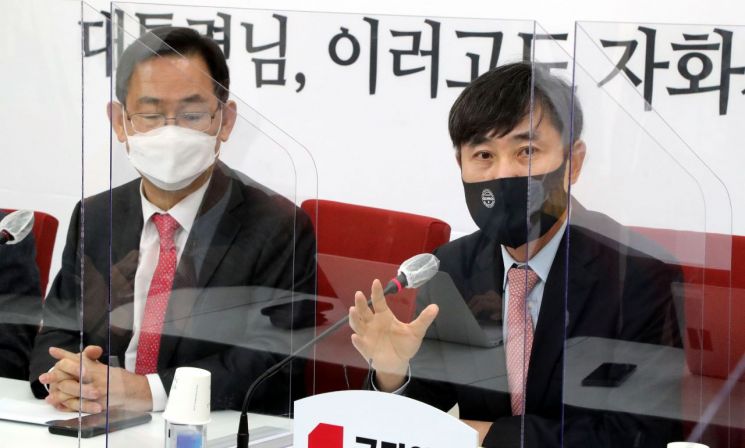
[Asia Economy Reporter Lim Chun-han] The Democratic Party of Korea has faced strong opposition from opposition parties after unilaterally passing the amendment to the National Intelligence Service Act, including the transfer of counterintelligence investigation authority, at the National Assembly Intelligence Committee's bill subcommittee. The People Power Party has labeled it a 'deterioration of the NIS Act' and launched a full-scale offensive, with floor leader Joo Ho-young and members of the Intelligence Committee holding an emergency press briefing on the amendment at the National Assembly on the 25th. The amendment is expected to be submitted and processed at the full Intelligence Committee meeting on the 27th.
Floor leader Joo criticized at the emergency press briefing that morning, saying, "The original purpose of the NIS is national security and catching spies. Abolishing the counterintelligence investigation authority is tantamount to eliminating the reason for the NIS's existence." He added, "Transferring it to the Security Investigation Bureau, which will be staffed with personnel who have almost no experience in counterintelligence investigations, is no different from saying they will not catch spies." The People Power Party proposed establishing an independent security investigation agency with dedicated personnel and budget to handle counterintelligence investigations.
Ha Tae-kyung, the People Power Party's secretary of the Intelligence Committee, wrote on Facebook the day before, "They are weakening the prosecution that does not obey well, worsening the NIS Act in a new way, and shifting the power center of the Moon Jae-in administration's authoritarian rule to the police." He added, "This is a declaration of becoming a civilian version of the Fifth Republic and a public declaration of a pro-Moon coup d'?tat similar to the December 12 coup."
Ha said, "Article 4, Paragraph 1 of the NIS Act amendment includes a clause on disturbing the economic order. Simply put, it means conducting surveillance on real estate and companies. The Moon Jae-in government's big plan is to turn the police into a Fifth Republic Security Headquarters to be used as a tool of political dictatorship, and to include economic surveillance clauses in the NIS Act to use the NIS as an economic dictatorship agency." He added, "This is not just a matter of investigative authority but a pro-Moon coup turning democracy into the Fifth Republic dictatorship, changing the Moon Jae-in administration into the Moon Du-hwan administration."
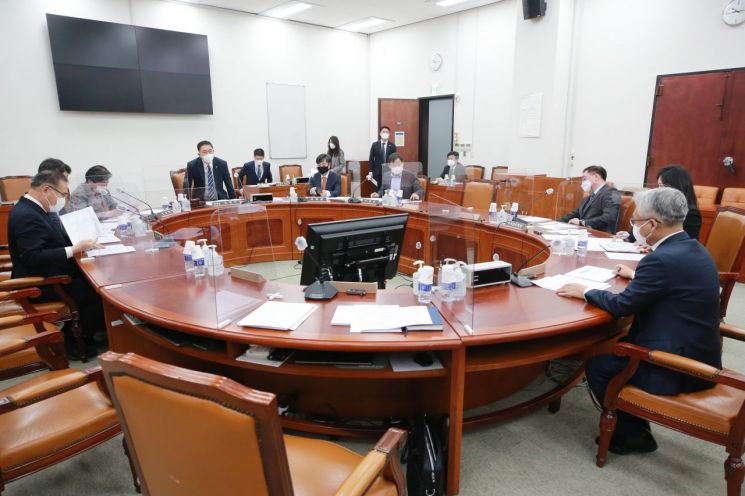
The Democratic Party's amendment to the NIS Act centers on transferring counterintelligence investigation authority, removing 'domestic intelligence' from the NIS's scope of duties, and defining its role as counterespionage and counterterrorism. New security areas such as infectious diseases, natural disasters, and climate change were not included in the scope of duties. It also clarifies prohibited political involvement by NIS employees and requires the provision of related information if two-thirds of the National Assembly Intelligence Committee members specify and request it.
The main point of contention between the ruling and opposition parties is the transfer of counterintelligence investigation authority to an independent investigative agency such as the government-proposed National Investigation Headquarters. The Democratic Party proposed transferring the authority with a three-year grace period, but the People Power Party opposed the transfer itself. On the morning of the 24th, People Power Party members left the subcommittee meeting saying, "We cannot agree." In response, the Democratic Party resumed the subcommittee session alone in the afternoon and passed the amendment including the three-year grace period.
Kim Byung-gi, the Democratic Party's secretary of the Intelligence Committee, told reporters after the bill subcommittee meeting, "We reached agreement with the People Power Party on all provisions and even proposed a three-year grace period, so there was some progress, but (we) failed to reach an agreement. I regret that we had to process it unilaterally." He added, "The bill must be passed on the 27th for it to be approved at this year's plenary session." He continued, "After reaching the three-year grace period proposal, we ran parallel for more than a week," and said, "Both parties acknowledged that no further narrowing of differences was possible."
© The Asia Business Daily(www.asiae.co.kr). All rights reserved.


















