Completion of Diplomatic and Security Team Appointments Excluding Defense Minister Position
Emphasis on US Leadership Through Alliance Restoration... Blinken: "Will Unite Allies as One"
Learning from 4 Years Ago Election Defeat, Difficult 'Erasing Trump Traces'
Defense Minister Appointment Excluded
[Asia Economy Reporter Naju-seok] President-elect Joe Biden declared the return of the United States' traditional diplomatic policy that values alliances, stating, "America is stronger when we stand with our allies." However, pessimistic views suggest that the restoration of Biden administration's foreign policy will be challenging, given the changes in the U.S. and the world over the past four years.
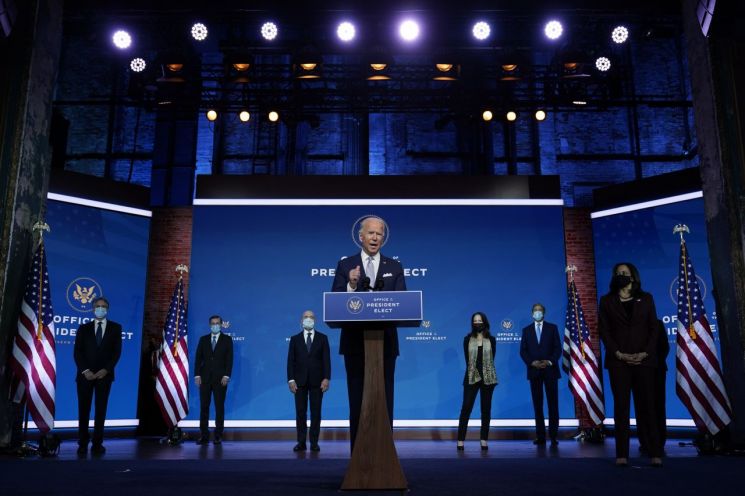
On the 24th (local time), at the Queen Theater in Wilmington, Delaware, Biden introduced six nominees for his foreign and security team, including Tony Blinken, the nominee for Secretary of State. He said, "America is ready to lead, not retreat from the world." He added, "This reflects the belief that America is strongest when standing with its allies," and stated, "Once again, America will take a seat at the head of the table, face our adversaries, not reject alliances, and be prepared to defend our values."
At the event, all top foreign and security officials except for the Secretary of Defense were introduced, including nominee Tony Blinken, Jake Sullivan for National Security Advisor, Avril Haines for Director of National Intelligence (DNI), Alejandro Mayorkas for Secretary of Homeland Security, Linda Thomas-Greenfield for U.S. Ambassador to the United Nations, and John Kerry for Presidential Climate Envoy.
Foreign media interpreted Biden's remarks and the introduction of the new foreign and security team as signaling the U.S. re-entering a new era of multilateralism. It marks a departure from the Trump era's unilateralism and emphasis on power, returning to a diplomatic approach that stresses multilateralism and diplomacy. CNN described the appointments as a "fundamental rejection of Trumpism," with foreign and security experts analyzing that the administration will follow the traditional U.S. approach emphasizing alliances.
In particular, nominee Thomas-Greenfield stated at the event, "America is back. Multilateralism and diplomacy are back," highlighting the core of the Biden administration's diplomatic stance. Vice President-elect Kamala Harris also emphasized the need to "renew America's alliances and rebuild and strengthen the national security and foreign policy apparatus."
Strengthening alliances means restoring American leadership. To solve the numerous global problems, someone must lead, and the U.S. intends to take on that role. Tony Blinken, Biden's closest confidant and nominee for Secretary of State, stressed that the U.S. cannot solve global issues alone and emphasized cooperation and partnerships with other countries. He said, "We will proceed with humility and confidence equally," and "America has the ability to bring other countries together to face the challenges of our time better than any other nation on Earth."
Jake Sullivan, nominee for National Security Advisor, said, "We will not let our guard down against persistent threats ranging from nuclear weapons to terrorism," while Thomas-Greenfield listed international challenges such as the pandemic, economy, climate change, poverty, and justice, stating, "These are issues that cannot be solved unless America leads." John Kerry, nominee for Presidential Climate Envoy responsible for climate change response, emphasized global cooperation, stating that the U.S. must rejoin the Paris Climate Agreement, which President Trump withdrew from, and demonstrate leadership.
However, concerns remain that the challenges facing Biden's foreign and security team are not simple. The policies Biden advocates were the underlying reasons for Trump's victory in the 2016 election. According to The Washington Post (WP), Sullivan and others acknowledged in a September report that past trade agreements like the Trans-Pacific Partnership (TPP) overlooked the negative impact on American jobs. They are clearly aware that Trump's election victory was based on the anger of the American people at that time.
Former Deputy Secretary of State Thomas Shannon said, "Biden's foreign and security team is painfully aware of the changes over the past four years," adding, "They want to restore America's meaningful role in the world, but the process of restoration is necessary. This is not just about opening the door and shouting loudly."
U.S. media such as The New York Times (NYT) noted that the absence of a Secretary of Defense nominee at the introduction of the foreign and security team was notable. Michelle Flournoy, who served as Deputy Secretary of Defense during the Obama administration, is mentioned as a candidate for the first Secretary of Defense in the Biden administration, but she was not included in this announcement.
Meanwhile, as the transition process accelerates, President-elect Biden has become able to receive daily presidential intelligence briefings. The Trump administration had delayed briefings to the president-elect, citing the uncertainty of the election results, but with the General Services Administration (GSA) approving the transition process, Biden's transition team can now access classified materials and liaise with intelligence agencies.
© The Asia Business Daily(www.asiae.co.kr). All rights reserved.
![Clutching a Stolen Dior Bag, Saying "I Hate Being Poor but Real"... The Grotesque Con of a "Human Knockoff" [Slate]](https://cwcontent.asiae.co.kr/asiaresize/183/2026021902243444107_1771435474.jpg)
















