Busan Haeundae and Daegu Suseong
All areas without housing price increases also designated as regulated zones
Ministry of Land considers 'Eup, Myeon, Dong unit' designation
[Asia Economy Reporter Lee Chun-hee] "Many residents are not convinced. There is a sentiment that we should at least start a petition to be excluded from the adjusted target areas." (Representative of real estate agency A in Bansong-dong, Haeundae-gu, Busan)
The appropriateness of designating real estate regulation areas is once again under debate. This is because some neighborhoods with little to no increase or even a decline in housing prices were included when the government recently designated major areas in Gimpo-si, Gyeonggi Province, and Busan and Daegu as adjusted target areas.
According to the industry on the 25th, residents in areas such as Bansong-dong in Haeundae-gu and Yongdang and Uam-dong in Nam-gu, Busan, have been expressing opposition to the designation of adjusted target areas as unfair. Earlier, on the 19th, the government designated Haeundae, Suyeong, Dongnae, Yeonje, and Nam-gu in Busan as adjusted target areas. Gimpo-si in Gyeonggi Province and Suseong-gu in Daegu were also included in the adjusted target areas along with these regions.
In the case of Haeundae-gu, Busan, the background for the designation as an adjusted target area is the sharp increase in transaction volume and the rising proportion of purchases by non-residents and corporations. According to the Korea Real Estate Board's monthly apartment sales price index, housing prices in Haeundae-gu rose 12.6% over the past year from October last year to last month. In particular, the actual transaction price of an 84㎡ unit in Daewoo Marina 1st Complex in U-dong nearly doubled from about 700 million KRW in October last year to 1.29 billion KRW last month, continuing a rapid rise.
However, some areas in Haeundae-gu show completely different trends. For example, an 84㎡ unit in Samhan Green Town 1st Complex in Bansong-dong changed hands for 197.5 million KRW on the 11th. Since it was traded at 208 million KRW in March 2018, it has never been traded above 200 million KRW, maintaining a stable price in the mid-to-high 190 million KRW range for two years and nine months. Nearby complexes with 84㎡ units have shown similar stable trends without significant fluctuations.
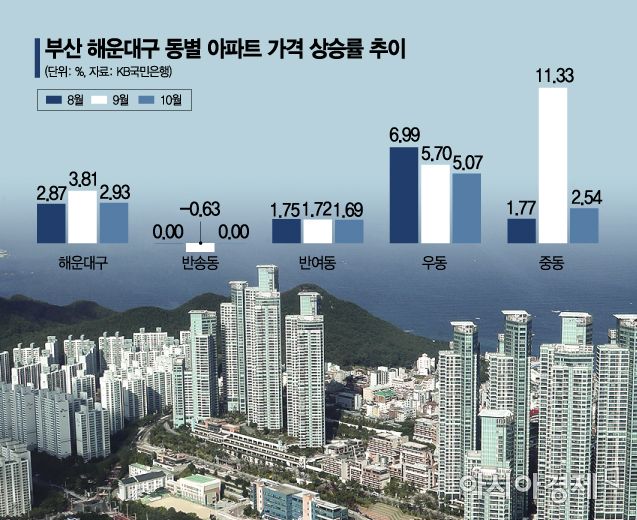
Data from KB Kookmin Bank, which surveys and publishes average apartment prices per unit area by neighborhood, also shows that while apartment prices in Haeundae-gu rose 9.9% over three months from August to October, prices in Bansong-dong actually fell by 0.6%. This is in stark contrast to the core areas of Haeundae-gu, U-dong and Jung-dong, which surged 18.8% and 16.2%, respectively.
A representative of real estate agency B in Bansong-dong said, "This is not an area where speculative demand from outsiders is coming in, nor is it a place where prices are soaring," adding, "I question whether it is necessary to include areas that continue to show price stability in the regulation zones."
This phenomenon is not unique to Haeundae-gu. In Nam-gu, Busan, where housing prices rose 4.29% over the past three months, areas like Daeyeon-dong, where large-scale redevelopment projects are underway along Suyeong-ro and the residential landscape is changing, saw a 5.52% increase, whereas Yongdang-dong and Uam-dong, adjacent to Busan Port, saw no change in housing prices over the same period. The Yongdang Hyundai I-Park 84㎡ unit has maintained a price in the high 200 million KRW range since 2016.
Daegu's Suseong-gu has also been embroiled in similar controversy. Neighborhoods close to downtown such as Jisan-dong (10.55%), Beommul-dong (8.94%), and Manchon-dong (8.55%) saw sharp increases in housing prices over three months, but areas farther from downtown like Sawol-dong (-0.35%), Maeho-dong (0.75%), and Nobyeon-dong (1.37%) showed little to no price movement or even declines.
This controversy first arose when Jung-gu, Incheon, was designated as an adjusted target area under the June 17 measures, including the uninhabited Silmi Island.
Both the National Assembly and the government are aware of these criticisms and are considering measures to address them. Currently, in the National Assembly, in July, Kim Gyo-heung of the Democratic Party proposed a partial amendment to the Housing Act to specify the designation unit for speculative overheated districts as 'eup, myeon, dong' (township, town, neighborhood). In September, a similar amendment was submitted to designate adjusted target areas by 'eup, myeon, dong' units.
Minister of Land, Infrastructure and Transport Kim Hyun-mi also stated at the October National Assembly audit, "We are accumulating data by subdividing statistics at the eup, myeon, dong level, and we will consider measures to further subdivide the designation and cancellation of regulation areas." Currently, the Korea Real Estate Board is conducting a detailed survey of housing price trends at the eup, myeon, dong level. It is expected that once the survey is completed within the year, the Ministry of Land, Infrastructure and Transport will review the readjustment of regulation areas.
© The Asia Business Daily(www.asiae.co.kr). All rights reserved.


















