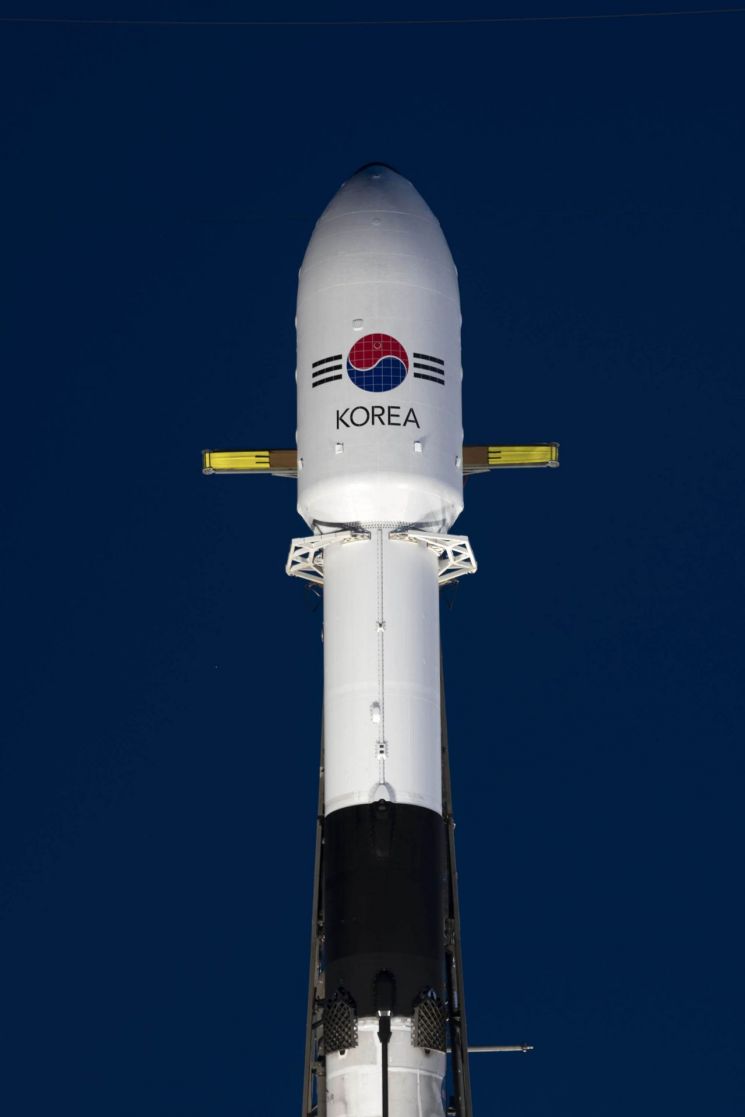
[Asia Economy Yang Nak-gyu, Military Specialist Reporter] The military communications satellite ANASIS-II, launched last July, has been handed over to our military. Until now, ANASIS-II was owned by the U.S. company Lockheed Martin and underwent operational test and evaluation in space, receiving a final combat suitability certification, after which ownership was transferred to our military.
According to the military on the 25th, ANASIS-II received a combat suitability certification during operational test and evaluation conducted in space following ground tests on the 29th of last month. On the 9th of this month, the Republic of Korea Command, Control, Communications, Computers, and Intelligence Command (ROK C4I Command) took delivery of ANASIS-II and began full-scale operations. With this, our military not only possesses the first dedicated military satellite with improved information processing speed, anti-jamming capabilities, and communication range, but also became the 10th country in the world to own a military-exclusive satellite.
The ROK C4I Command plans to utilize ANASIS-II using about 500 existing ANASIS-I satellite terminals. The terminals function similarly to mobile phones. If ANASIS-I is considered 3G, then ANASIS-II corresponds to LTE-level communication. The terminals are compatible. The Ministry of National Defense stated, "Next year, after reflecting the budget for dedicated terminals, we plan to operationalize them by the end of the year," adding, "Until then, we will use the currently employed terminals and prototype equipment to ensure no disruption in mission performance."
The ROK C4I Command plans to complete the final operational test and evaluation of ANASIS-II by the end of this month and begin full-scale missions from next month in geostationary orbit (36,000 km above the Earth). The military expects that ANASIS-II will enhance its capability to conduct independent operations. Until now, our military has operated its communications system using the dual-use satellite Mugunghwa-5, which was vulnerable to radio interference attacks because it was not exclusively military. ANASIS-II addresses these shortcomings in the communication system. Currently, the military is establishing communication systems between units via satellite, between units and soldiers, and among soldiers themselves. When individual soldiers carry satellite terminals during operations, communication becomes possible anytime and anywhere.
ANASIS-II began production as an offset trade agreement following the September 2014 contract with U.S. Lockheed Martin to purchase 40 F-35A aircraft for 7.4 trillion won. Offset trade is a method where the arms seller provides counter-benefits such as technology transfer to the buyer. Our military chose the F-35A stealth fighter as the next-generation fighter, and Lockheed Martin agreed to provide one military communications satellite. Lockheed Martin subsequently subcontracted Airbus to manufacture the military communications satellite. Airbus produced ANASIS-II based on its communications satellite 'Eurostar E3000'.
© The Asia Business Daily(www.asiae.co.kr). All rights reserved.

















