Multilateral-Based Iranian-Style Nuclear Deal Engagement
"Role of Korean Government Expected to Become More Important"
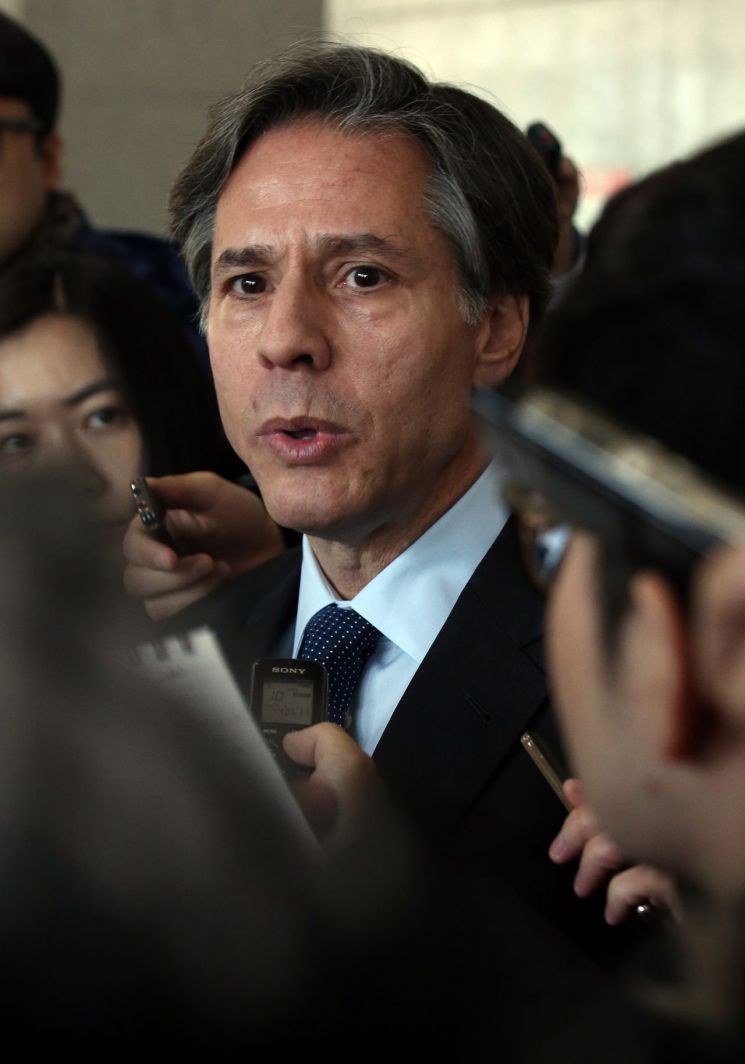 President-elect Joe Biden plans to nominate former Deputy Secretary of State Tony Blinken as the first Secretary of State in the new administration, according to major U.S. media outlets including Bloomberg and The New York Times (NYT) on the 22nd (local time).
 The photo shows Deputy Secretary Blinken leaving the Ministry of Foreign Affairs building in Doryeom-dong, Jongno-gu, Seoul, in February 2015.
Attention is focused on whether the Biden administration's inaugural foreign and security team in the United States will resume North Korea-U.S. talks using the so-called 'Iran-style solution.' Instead of the 'second Libya model,' which North Korea opposes, the 'reward-denuclearization parallel model' is emerging as a likely approach.
President-elect Joe Biden nominated Tony Blinken, former Deputy Secretary of State and his right-hand man in foreign and security affairs, as the first Secretary of State, and appointed Jake Sullivan, former National Security Advisor to the Vice President, as White House National Security Advisor, lending credibility to this analysis. Both nominees are experts deeply involved in the multilateral 'Iran nuclear deal (JCPOA - Joint Comprehensive Plan of Action)'.
With a foreign and security team that prefers a practical, step-by-step approach, North Korea's stance of demanding sanctions relief as a precondition for denuclearization negotiations, similar to Iran, is expected to determine the future direction of denuclearization on the Korean Peninsula.
The Iran nuclear deal, signed in July 2015 during the Barack Obama administration, involved easing economic sanctions in exchange for Iran's restraint on nuclear weapons development and international inspections. The agreement was signed by Iran, the United States, the United Kingdom, France, Germany, Russia, China, and the European Union (EU). The participation of various countries ensured the binding nature of the agreement's implementation, which is also seen as a positive factor in overcoming mutual distrust between North Korea and the U.S.
During the Donald Trump administration, North Korea-U.S. negotiations failed to find common ground due to conflicting denuclearization processes. Following the approach of former White House National Security Advisor John Bolton, the U.S. insisted on 'denuclearization first, then rewards,' while North Korea demanded the opposite. However, there is growing analysis that the Biden administration's early foreign and security policy will likely emphasize 'gradual denuclearization' and 'international cooperation' solutions.
In a September interview on CBS, nominee Blinken referred to the Iran nuclear deal from the Obama administration and said, "I think there is an opportunity to move in the same direction with North Korea." Earlier, on June 11, 2018, a day before the first North Korea-U.S. summit, he wrote in a New York Times op-ed that "the best model for nuclear negotiations with North Korea is Iran." Nominee Sullivan also stated in a May 2016 policy speech at the Asia Society in New York, while serving as the foreign policy chief for Hillary Clinton's presidential campaign, that "we plan to employ a strategy similar to what was done with Iran regarding North Korea."
Moves to revert to the 'Iran-style solution' have already begun. According to the British daily The Guardian on the 23rd (local time), the three European countries that signed the Iran nuclear deal? the United Kingdom, France, and Germany?have started working with the incoming U.S. administration to restore the Iran nuclear agreement. The Guardian reported that German Foreign Minister Heiko Maas, French Foreign Minister Jean-Yves Le Drian, and British Foreign Secretary Dominic Raab held talks in Berlin to discuss easing U.S. sanctions in exchange for Iran's compliance with the nuclear deal.
Accordingly, there is analysis that the role of the South Korean government will become more important than ever. This is based on the judgment that the Biden administration is likely to steer foreign relations toward strengthening alliances based on the Democratic Party's value-centered diplomacy. Professor Jeong Dae-jin of Ajou University explained, "Blinken is likely to pursue alliance-centered diplomacy within the Democratic Party that does not engage in denuclearization against U.S. national interests," adding, "Since they believe the Singapore summit and others were flawed, they are likely to ask for South Korea's position and approach the matter practically based on that, making South Korea's stance more important than ever."
However, concerns have also been raised that amid U.S.-China tensions, pressure on China may favor multilateralism over bilateralism, potentially demanding greater contributions from South Korea. Professor Hwang Jae-ho of Hankuk University of Foreign Studies analyzed, "The U.S. Democratic Party is in a situation where it must completely change the game by promoting value-centered alliance diplomacy," and "while continuously pressuring China based on multilateralism, it may actually demand more contributions from South Korea than the Trump administration did."
© The Asia Business Daily(www.asiae.co.kr). All rights reserved.

















