Insurance Company DSR Up to 60%
Lower Threshold Than Banks
Minimum Interest Rates Similar to Banks
Delinquency Rates Surge Due to Loan Increase
Secondary Financial Sector Annual Rate 0.99%→1.44%
[Asia Economy Reporter Jo Gang-wook] Kwon Doo-soon (42, pseudonym), an office worker who owned an apartment worth 1.1 billion KRW in Gangseo-gu, Seoul, recently switched his mortgage loan from a bank to an insurance company loan. At the bank, his mortgage loan limit was 250 million KRW with an interest rate of 3.3%, but by using an insurance company loan, the interest rate dropped to 2.52% and the limit increased to 350 million KRW. Kwon said, "I searched for insurance company mortgage loan interest rates on internet portal sites and found them cheaper than banks, so I looked into it and switched." A representative from insurance company A hinted, "As insurance company mortgage loan interest rates have decreased, the number of people switching from bank loans has sharply increased recently."
Although the government has tightened mortgage loans at commercial banks to curb soaring real estate prices, a balloon effect is occurring where mortgage loan demand is instead flowing into secondary financial sectors such as insurance companies and savings banks. Some insurance companies and savings banks are even offering interest rates that are cheaper or similar to those of banks. However, delinquencies caused by failure to repay loans on time are also rising sharply, raising concerns about the 'aftershock' of loan defaults.
According to the financial sector on the 24th, the outstanding balance of jeonse loans at the five major commercial banks?KB Kookmin, Shinhan, Hana, Woori, and NH Nonghyup?exceeded 100 trillion KRW for the first time at the end of last month. These banks have begun to tighten real estate-related loans in earnest by temporarily suspending new loans or housing guarantee financial products or limiting increases in loan limits to slow down loan growth.
Hana Bank stopped selling mortgage loan products such as Gagahoho Mortgage Loan (MCI), One-Click Mortgage Loan (MCI), Variable Interest Mortgage Loan (MCG), Mixed Interest Mortgage Loan (MCIㆍMCG), Apartment Loan (MCIㆍMCG), and Fixed Monthly Repayment Mortgage Loan (MCIㆍMCG) from the 16th. Additionally, fixed-rate qualified loans will be suspended from the 30th. Woori Bank recently stopped issuing MCI and MCG guarantees and plans to restrict handling of apartment jeonse loans and Woori Jeonse Loan until the end of the year. NH Nonghyup Bank stopped accepting new fixed-rate qualified loans secured by houses priced at 900 million KRW or less from the 2nd, with a maximum loan amount of 500 million KRW.
As bank loan regulations tighten, visits to secondary financial institutions are increasing. With interest rates also decreasing, switching to secondary financial institutions, which have relatively lower thresholds than commercial banks, has become easier. The Debt Service Ratio (DSR), which determines loan limits, is 40% for commercial banks but can be up to 60% for insurance companies.
According to the Life Insurance Association, as of August this year, the outstanding balance of mortgage loans by life insurance companies was 47.2653 trillion KRW, a 9.3% increase compared to the beginning of the year (43.2628 trillion KRW). In particular, as of October, the lowest interest rates (fixed and variable) for installment repayment apartment mortgage loan products of each life insurance company ranged from 2.43% to 3.08%, falling to levels similar to banks. The lowest interest rates (fixed and variable) for apartment mortgage loan products in the non-life insurance industry ranged from 2.03% to 2.91%. If preferential conditions such as maintaining insurance contracts are met, it is even possible to obtain mortgage loans at rates lower than banks.
Domestic savings banks, which traditionally had mortgage loan minimum interest rates 2-3 percentage points higher than commercial banks, have also lowered rates to the 2% range annually. As of this month, among 31 mortgage loans handled by 79 savings banks, Star Savings Bank's '6-month variable interest ART Loan' has interest rates ranging from 2.80% to 5.30% annually. Domestic savings banks continued their growth trend by achieving record performance in the third quarter of this year, driven by increased interest income from loan growth.
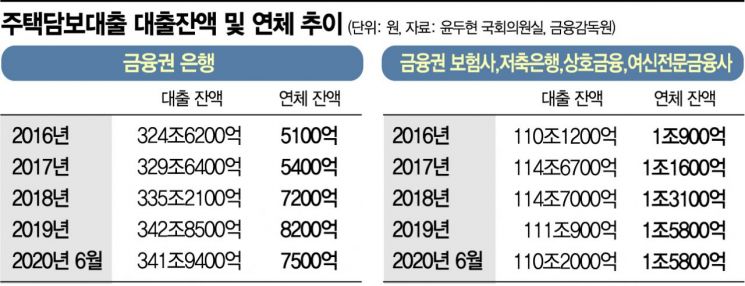
Despite government regulatory policies, loan growth has not slowed, and delinquency rates are also surging. According to the office of Yoon Doo-hyun, a member of the National Assembly's Political Affairs Committee from the People Power Party, as of the end of June this year, the outstanding balance of mortgage loan delinquencies in the first financial sector (banks) and the second financial sector (insurance companies, savings banks, mutual finance, and specialized credit finance companies) increased by more than 40% compared to the end of 2016. In particular, while the delinquency rate in the first financial sector rose from 0.16% to 0.22% during the same period, the second financial sector jumped from 0.99% to 1.44%. With increasing mortgage loan delinquencies, concerns are emerging that the number of defaulting borrowers unable to manage their debts may further increase in the future.
A financial sector official said, "Despite government regulations, the 'panic buying' phenomenon caused by soaring real estate prices seems to be driving the increase in mortgage loans," adding, "It is worrisome not only that delinquencies are rising in the first and second financial sectors but also that mortgage loans from third financial sector lenders, such as loan companies, are increasing."
© The Asia Business Daily(www.asiae.co.kr). All rights reserved.

















