Social Distancing Raised to Level 2... Opposition and Lee Jae-myung "3rd Disaster Relief Payment Needed"
Ruling Party "Budget Approval for Next Year Comes First" Drawing a Line
Four Supplementary Budgets for 1st and 2nd Disaster Relief Payments... National Debt Ratio Nears 44%
Experts "Selective Payment Needed Considering National Finances"
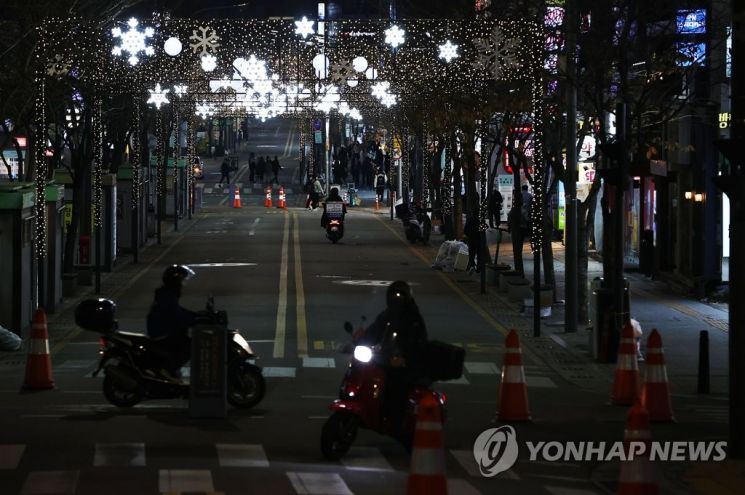 On the evening of the 22nd, ahead of the planned increase to Level 2 social distancing measures in the Seoul metropolitan area, Sinchon Yeonsero was completely empty despite it being weekend dinner time.
 Photo by Yonhap News
[Asia Economy reporters Han Seung-gon and Kim Seul-gi] As social distancing in the Seoul metropolitan area was raised to Level 2, economic damage to self-employed individuals and others became inevitable, sparking active discussions in the political sphere about the issuance of a third disaster relief fund. However, some express concerns about the national fiscal burden, citing increased strain on public finances due to the first and second rounds of disaster relief payments.
At midnight on the 24th, the government elevated the social distancing level in the metropolitan area to Level 2. With the escalation, five business types?including hunting pubs, emotional pubs, danran pubs, entertainment pubs, and colatecs?were ordered to close.
Karaoke rooms, indoor standing concert halls, door-to-door sales and direct sales promotion centers, and indoor sports facilities must cease operations after 9 p.m. Restaurants are only allowed to offer takeout and delivery services after this time, and cafes are restricted to takeout and delivery only, with no seating permitted.
Given this situation, there are concerns about the economic impact on small business owners and the self-employed. Especially for restaurants, the period from late November to early December is a peak season with frequent gatherings, making a decline in sales unavoidable.
Consequently, discussions about a third disaster relief fund are underway in the political arena. Gyeonggi Province Governor Lee Jae-myung and opposition parties have expressed support for issuing disaster relief payments.
On the 20th, Governor Lee posted on his Facebook, stating, "There was a significant difference statistically and perceptually in the economic revitalization effects between the government's first and second disaster relief funds," and argued, "The third disaster relief fund must be distributed to all citizens in the form of non-refundable local currency."
The People Power Party has also initiated discussions on the third disaster relief fund. On the 23rd, Kim Jong-in, the party's emergency committee chairman, said at a committee meeting, "With the third wave of the COVID-19 crisis, the issue of a third disaster relief fund is already being raised," adding, "If the main budget is passed in December and supplementary budget issues arise again next year, it will undermine the government's credibility."
Chairman Kim further stated, "If the COVID-19 situation worsens, the survival of self-employed individuals will be at stake, naturally leading to calls for disaster relief payments. I believe it is appropriate to anticipate and prepare for this in advance."
On the same day, Kang Eun-mi, floor leader of the Justice Party, said at a leadership meeting, "We urgently need to discuss the third nationwide disaster relief fund and government’s active fiscal policies such as employment income insurance," emphasizing, "Selective execution like the second disaster relief fund had limited effects and even led to income declines among lower-income groups, so drastic measures are necessary."
The problem is that the government has already placed a heavy burden on national finances by executing supplementary budgets four times and issuing government bonds to fund previous disaster relief payments.
Previously, the government allocated a supplementary budget of 12.2 trillion won in April to provide the first disaster relief fund of 400,000 to 1 million won per household to all citizens. Then, in mid-August, it allocated an additional 7.8 trillion won supplementary budget to distribute the second disaster relief fund to self-employed individuals and vulnerable employment groups.
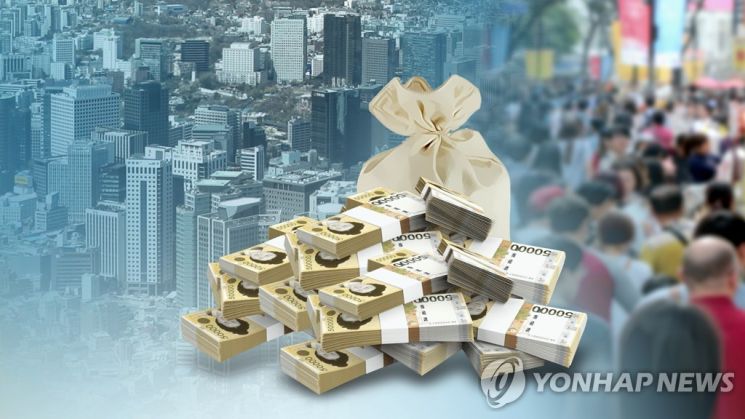
As a result, the national debt ratio has approached 44% of GDP (Gross Domestic Product), and the managed fiscal balance deficit has reached 6.1%, worsening fiscal soundness.
On the 10th, Hong Nam-ki, Deputy Prime Minister and Minister of Economy and Finance, stated at a National Assembly Budget and Accounts Committee meeting, "It is true that the national debt ratio will rise to 44% this year and 47% next year due to four rounds of supplementary budgets."
In this context, the Democratic Party appears cautious about issuing additional relief funds, citing the already heavy fiscal burden and prioritizing the passage of next year’s budget.
On the 24th, Kim Young-jin, senior deputy floor leader of the Democratic Party, said in an interview with MBC Radio’s 'Kim Jong-bae’s Focus,' "I believe it is practically difficult to decide the matter within a week and include it in next year’s main budget."
Deputy Floor Leader Kim added, "I agree with the general idea of overcoming the economic crisis through disaster relief funds, but if the main budget is quickly passed by the 2nd and discussions on disaster relief funds proceed thereafter, there should be no major difficulties."
Experts recommend that the third disaster relief fund be selectively distributed mainly to vulnerable groups, considering national finances.
Professor Kim Tae-gi of Dankook University’s Department of Economics explained, "The issuance of a third disaster relief fund seems inevitable. However, it should be given in the form of 'selective payments' targeting economically vulnerable groups. It is better to provide the funds without drastically reorganizing next year’s budget, which was prepared without considering the 'second pandemic.'"
He added, "Organizations like the IMF and World Bank foresee COVID-19 potentially leading to a financial crisis because debt is increasing too rapidly in each country. We need to conserve national finances, and to do so, disaster relief funds should be paid by reorganizing the existing budget. There are struggling low-income citizens who cannot even pay utility bills in winter. Payments should be focused on these groups."
© The Asia Business Daily(www.asiae.co.kr). All rights reserved.


















