8 out of 10 Office Workers Unable to Report Harassment
Since Law Enactment, Only 19.5% of 4,975 Reports Led to Improvement Guidance or Prosecution
Experts Say Workplace Harassment Prohibition Law Has Narrow Scope and No Punishment Provisions
 The number of people who report workplace bullying to their companies but do not receive adequate protection is increasing. Photo by Yonhap News
[Asia Economy Reporter Kim Suwan] Although the "Workplace Harassment Prohibition Act" (Workplace Gapjil Prohibition Act) has been in effect for 1 year and 4 months, abusive behaviors in the workplace remain prevalent. The amended Labor Standards Act, which prohibits acts that cause physical or mental suffering to other workers by exploiting workplace status or relational superiority, was enforced on July 16 last year. However, since there are no punitive provisions for harassment itself, concerns about its effectiveness have been raised, sparking ongoing controversy. Experts have pointed out that the Workplace Harassment Prohibition Act has a narrow scope of application and lacks punishment clauses, which is problematic.
The labor rights organization Workplace Gapjil 119 recently announced that among 882 reports received and verified from July 1 to October 31 over four months, 442 cases (50.1%) involved workplace harassment issues.
Notably, only 86 of these cases, or 19.5%, were formally reported as workplace harassment. This means that 8 out of 10 people did not even report the harassment.
Furthermore, there were 66 reports (76.7%) indicating that mandatory measures such as victim protection and disciplinary action against perpetrators were not implemented despite the harassment being reported. In addition, 24 cases (36.4%) involved "disadvantages after reporting," such as dismissal, disciplinary action, or ostracism due to the report.
This shows that most workers endure workplace harassment silently or leave their jobs. It is difficult to prove harm unless it involves work exclusion, transfer, or reassignment as work-related disadvantages.
This trend is also clearly reflected in official government statistics. Although about 5,000 reports of workplace harassment were filed last year, fewer than one in five received substantial remedial actions such as improvement guidance or referral to prosecution. According to data submitted by Rep. Noh Woong-rae of the National Assembly's Environment and Labor Committee from the Ministry of Employment and Labor, a total of 4,975 reports were filed in the year following the enforcement of the Workplace Harassment Prohibition Act in July last year through July this year. However, most of these cases did not receive practical relief. Excluding 374 cases currently being processed, about half of the remaining 4,600 cases?2,156?were withdrawn without any administrative action. Improvement guidance was issued in 848 cases (18.2%), and 53 cases (1.2%) were referred to prosecution, resulting in an actual relief rate of only 19.4%.
This highlights the reality that victims of workplace harassment often cannot report their experiences. Kim (29), an office worker at a company in Seoul, said, "I have been deliberately harassed and ostracized by my superior at work for two years," adding, "When I tried to find out about the reporting process, I was told that without clear evidence, it is difficult to even file a report."
Kim continued, "Harassment includes physical and verbal violence that leaves evidence, but deliberately ostracizing someone or excluding them from work does not leave clear evidence. In such situations, I was afraid that reporting would lead to disadvantages, so I couldn't report it," expressing frustration, "If the law is made so lax that perpetrators can easily escape, I don't understand why the law was enacted in the first place."
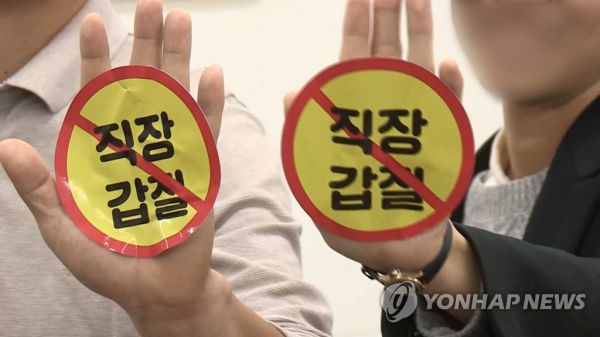 Due to the limitations in the scope of application of the "Workplace Bullying Prohibition Act" and the inadequacy of its penalty provisions, abuse of power within companies remains widespread. Photo by Yonhap News
Consequently, there is a growing call among workers to strengthen the Workplace Gapjil Prohibition Act by including punitive provisions for perpetrators and employers to enhance its effectiveness. Recently, a petition titled "Please strengthen the law with enforceable punitive provisions for perpetrators to eradicate workplace harassment and violence, and transfer perpetrators to other departments" was posted on the Blue House's public petition board.
Experts point out that even after harassment occurs, employers still fail to conduct investigations, inadequately protect victims, and secondary harm occurs.
Labor attorney Kim Han-ul said in a July interview on cpbc Catholic Peace Broadcasting radio program "Open World Today," regarding the Workplace Harassment Prohibition Act, "It is better than nothing, but there is still a long way to go," adding, "Currently, businesses with fewer than four employees or cases where the representative directly commits gapjil are not protected institutionally, so the law has limitations."
He continued, "Since the employer is the party receiving the report, they must fulfill appropriate duties such as conducting investigations, but problems like failure to investigate and inadequate victim protection occur," and "Even so, these are not violations of the law, showing institutional limitations."
He also noted, "Secondary harm during the evidence-gathering process is serious," explaining, "Unlike other labor law issues, harassment cases often rely on recordings, photos, personal records, or colleagues' testimonies rather than clear written evidence. Collecting and reconstructing these materials to testify about the harm is a difficult process for the victim."
There are also views that current laws need improvement for effectiveness. Rep. Noh, who conducted an investigation into the status after the enforcement of the Workplace Harassment Act, urged, "For the law to be effective, stricter application from the victim's perspective and active consideration of expanding the scope of applicable companies are necessary."
© The Asia Business Daily(www.asiae.co.kr). All rights reserved.


















