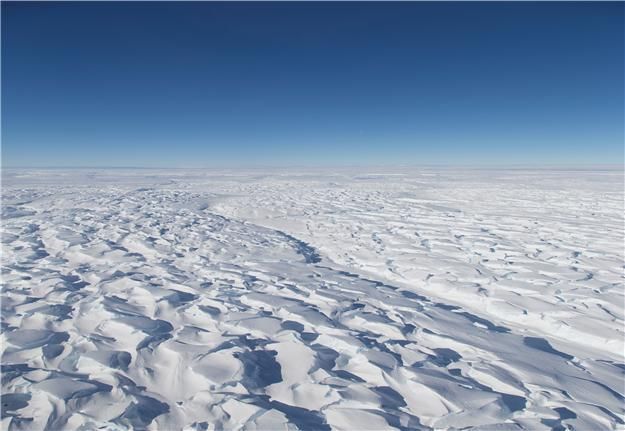
[Asia Economy Reporter Junho Hwang] A recent study revealed that about 30% of the Antarctic ice loss over the past decade is due to reduced snowfall. While the primary issue is the melting of glaciers caused by warming oceans due to global warming, the decrease in snowfall has also had a significant impact. The Korea Polar Research Institute announced this on the 24th, based on joint research with Seoul National University and the University of Texas. The results of this study were recently published in the international academic journal Scientific Reports.
30% of Lost Antarctic Ice Disappeared Due to Reduced Snowfall
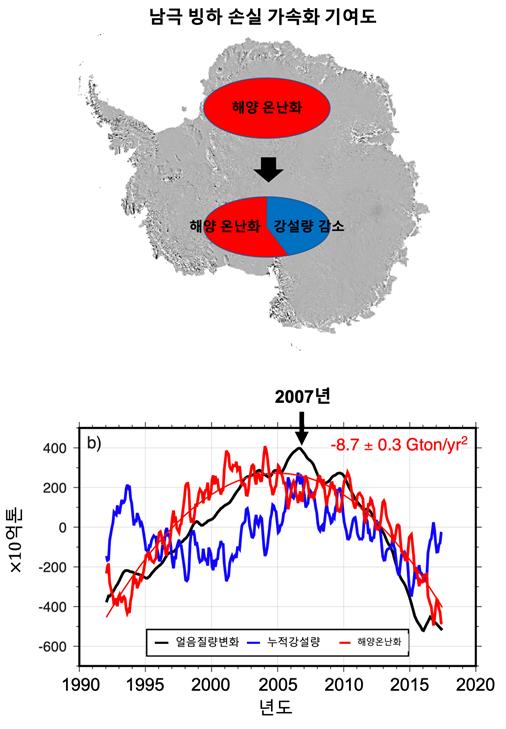
The research team analyzed variables affecting the amount of Antarctic ice by combining data from the gravity observation satellite GRACE and Antarctic atmospheric observations. The results showed that changes in the amount of Antarctic ice are determined by the amount of snowfall accumulation and the amount of ice flowing into the sea. If snowfall increases or glacier movement stops, Antarctic ice thickens, but if snowfall decreases or glacier movement accelerates, Antarctic ice gradually thins.
Over the past 25 years (1992?2017), an average of 110 billion tons of Antarctic ice has disappeared annually. During the same period, global sea levels rose by about 7.6 mm. The rate of loss has steeply increased recently. Since 2007, the annual average decrease of Antarctic ice has been 194 billion tons, more than four times the 47 billion tons before that. Starting in 2007, the annual loss of Antarctic ice increased by 147 billion tons (194 billion minus 47 billion tons).
Reduced Snowfall Due to Antarctic Oscillation
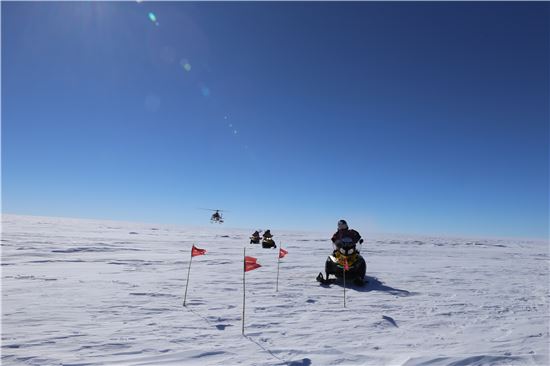 ▲Last year, researchers from the K-Route Project Team arrived at the candidate site of Lake Bingjeo through a preliminary survey. [Photo provided by the Korea Polar Research Institute, unrelated to the article]
The research team analyzed that about 40 billion tons of this loss was caused by a reduction in newly accumulated snowfall. They identified the strengthening of the Antarctic Oscillation as the cause of decreased snowfall. The Antarctic Oscillation blocks moisture inflow from mid-latitudes, preventing sufficient snow formation.
Snowfall in Antarctica decreases as the Antarctic Oscillation strengthens and increases with rising temperatures. This study revealed that the Antarctic Oscillation had a greater impact than temperature, reducing snowfall and contributing to glacier loss. The Antarctic Oscillation is a phenomenon where the size of the pressure belt surrounding Antarctica periodically changes, affecting wind strength and direction.
Won-Sang Lee, Head of the Glacier Environment Research Division at the Korea Polar Research Institute, said, "Rising global sea levels can cause social and economic damage such as coastal flooding," and added, "We will focus our research capabilities to more accurately understand the movements of Antarctic glaciers, which are directly linked to sea level rise."
© The Asia Business Daily(www.asiae.co.kr). All rights reserved.
![Clutching a Stolen Dior Bag, Saying "I Hate Being Poor but Real"... The Grotesque Con of a "Human Knockoff" [Slate]](https://cwcontent.asiae.co.kr/asiaresize/183/2026021902243444107_1771435474.jpg)












