[Asia Economy Reporter Junho Hwang] A stable cathode material contributing to the commercialization of calcium-ion batteries, which are gaining attention as next-generation secondary batteries, has been developed.
The research team led by Professor Seungtae Hong from the Department of Energy Engineering at Daegu Gyeongbuk Institute of Science and Technology announced on the 24th that they developed a cathode material for calcium-ion batteries with secured structural stability, and the related research results were published in the international journal Chemistry of Materials, specializing in materials chemistry.
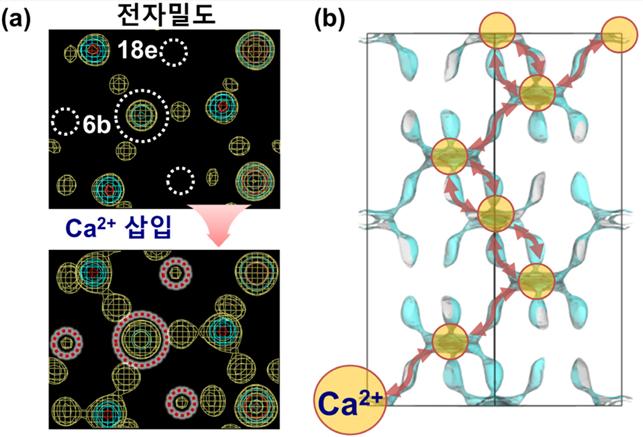
Considering the characteristics of calcium ions, the research team developed a NASICON-structured cathode material, NaV2(PO4)3, which has high structural stability. They also used powder X-ray diffraction techniques to elucidate the structural changes occurring during the insertion and extraction of calcium ions in this cathode material structure and demonstrated that it can achieve high capacity and operating voltage.
Professor Hong stated, "We developed a cathode material for calcium-ion secondary batteries based on insertion and extraction and identified the operating mechanism for the first time," adding, "Applying this operating principle will serve as a benchmark for developing cathode materials for calcium-ion batteries that can achieve even higher energy density."
Meanwhile, calcium is a divalent cation capable of transferring two electrons per ion, and when configured as a secondary battery, it can provide twice the capacity of lithium-ion batteries and realize high energy density. It is also economical as it is an abundant element on Earth.
© The Asia Business Daily(www.asiae.co.kr). All rights reserved.

















