Trump Administration's Last Visit to South Korea as Special Envoy for North Korea... Analysis of China's Containment Amid Wang Yi's Visit as Foreign Minister
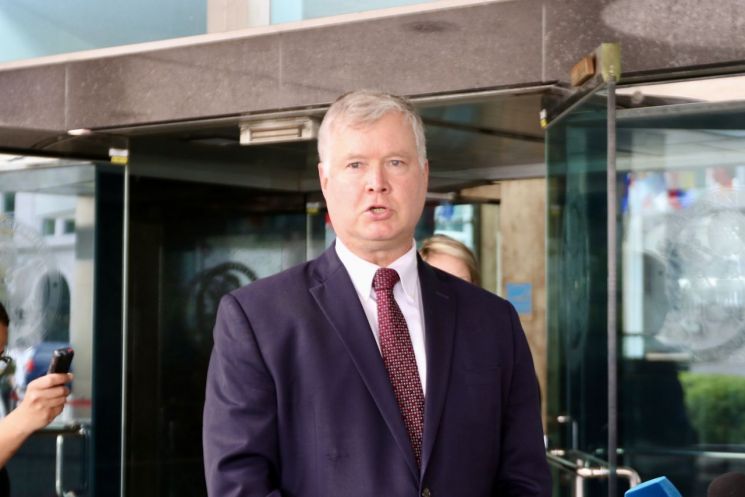
[Asia Economy Reporter Lim Cheol-young] Steven Biegun, the U.S. Deputy Secretary of State who has overseen practical negotiations with North Korea in coordination with the South Korean government as the U.S. Special Representative for North Korea since August 2018 under the Donald Trump administration, is reportedly planning a visit to South Korea in December. Some analysts suggest that this visit aims to counter China's resumption of face-to-face diplomacy with South Korea amid the transition of the U.S. administration.
According to diplomatic sources in Washington on the 23rd (local time), Deputy Secretary Biegun, along with Alex Wong, the U.S. Deputy Special Representative for North Korea, is planning visits to South Korea and other Asian countries in early next month. If the visit to South Korea materializes, it will be the first in five months since July, and as the Trump administration continues until January 20 next year, it is expected to be effectively the last.
This visit by Deputy Secretary Biegun is interpreted as a move to manage the situation on the Korean Peninsula during the U.S. administration transition period. North Korea has scheduled the 8th Congress of the Workers' Party in January next year ahead of the inauguration of the new Joe Biden administration. Given the high possibility that the Biden administration will seek a completely different approach from the Trump administration, North Korea's strategy toward the U.S. is also likely to be revised. Notably, North Korea has frequently engaged in provocations such as missile launches and nuclear tests around the time of the new U.S. administration's inauguration.
With Wang Yi, China's State Councilor and Foreign Minister, visiting South Korea and Japan until the 27th and engaging in face-to-face diplomacy, there is also an interpretation that this visit aims to counter China. Professor Jung Dae-jin of Ajou University explained, "The U.S. seems to be acting on the judgment that a honeymoon period between South Korea and China could become visible if Wang Yi's visit to South Korea is followed by a concrete visit by President Xi Jinping and a trilateral summit among South Korea, China, and Japan, with Premier Li Keqiang also moving. Since the alliance dialogue scheduled for October has not been held, this visit is interpreted as a reciprocal visit following the September visit to the U.S. by First Vice Foreign Minister Choi Jong-geun to counter China and address issues in the South Korea-U.S. alliance."
Deputy Secretary Biegun has maintained the title of Special Representative for North Korea even after his promotion to Deputy Secretary of State over the past two years and three months, leading practical North Korea-U.S. negotiations. After the North Korea-U.S. summits, he led the "South Korea-U.S. Working Group," raising expectations for the peace process on the Korean Peninsula. He was reportedly deeply disappointed by the breakdown of the second North Korea-U.S. summit held in Hanoi, Vietnam, in February last year, where he had invested considerable effort, including visiting Pyongyang for negotiations.
Subsequently, as North Korea-U.S. relations rapidly deteriorated and the South Korea-U.S. Working Group failed to perform its role, criticism within South Korea increased, narrowing his room for maneuver. Despite the spread of the novel coronavirus (COVID-19), Deputy Secretary Biegun visited South Korea for a two-night, three-day trip in July but failed to achieve meaningful progress toward improving North Korea-U.S. relations.
© The Asia Business Daily(www.asiae.co.kr). All rights reserved.

















