Starting from the 23rd, Comprehensive Real Estate Tax Notices Sent
Tax Rates Unchanged but Increased Tax Burden Due to Higher Market Price Reflection Rate
Comprehensive Real Estate Tax Amount Expected to Rise from 3.3471 Trillion KRW Last Year to 3.5 Trillion KRW
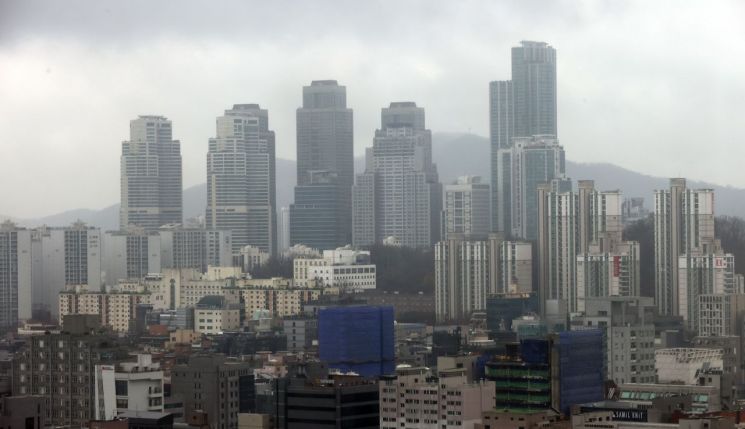 On the afternoon of the 19th, in the apartment complex area of Gangnam-gu, Seoul. / Photo by Yonhap News
[Asia Economy Reporter Lim Juhyung] "I was almost shocked when I received the bill.", "It seems to have increased at least tenfold compared to last year."
As the comprehensive real estate tax (종부세) for the 2020 tax year has been sent out, some taxpayers are voicing complaints. This is because the recent rise in real estate prices, along with higher official price market reflection rates and fair market value ratios, has increased the tax burden. However, some argue that since the official prices are in the process of being adjusted to reflect reality, a temporary increase in taxes is inevitable.
The National Tax Service announced on the 23rd that it has started sending out the 2020 종부세 tax bills. Taxpayers must pay the 종부세 between December 1 and 15.
The 종부세 is a tax levied annually on June 1 based on the combined official prices of nationwide houses and land owned by individuals. If the official price exceeds a certain threshold, the excess amount is taxed. For houses, the official price threshold for 종부세 is 600 million KRW (900 million KRW for a single household with one house).
This year, although the tax rates have not changed, the tax burden is expected to increase for some houses due to rising real estate prices, higher official price market reflection rates, and an increase in the fair market value ratio (from 85% to 90%). Additionally, as real estate prices have risen recently, especially in the metropolitan area, the number of households subject to 종부세 has also increased.
According to the 'Status of Apartment Official Prices in Seoul' (as of June 1 each year) submitted by the Ministry of Land, Infrastructure and Transport to Representative Bae Hyunjin of the People Power Party, among the total 2.53 million apartment households in Seoul this year, 281,033 households have houses priced at 900 million KRW or more, exceeding 10%. Accordingly, the tax revenue from 종부세 is expected to surpass 3.5 trillion KRW, up from 3.3471 trillion KRW last year.
While households experiencing more than a tenfold increase in taxes compared to the previous year are rare, the perceived tax burden may increase.
Given this situation, more and more netizens are expressing their struggles with the sharply increased 종부세 burden on social networking services (SNS) and real estate-related internet communities.
A netizen living in a luxury brand apartment in Seocho-gu, Seoul, calculated the expected tax amount and said the tax to be paid has increased by more than 90% compared to last year, lamenting, "My labor income remains the same, but the tax burden suddenly increased. I am at a loss as to how to handle the taxes."
Another netizen said, "Life is already tough, but the taxes suddenly jumped in a short period," adding, "They say it will increase even more in the future; it's really driving me crazy."
However, some argue that this is an unavoidable phenomenon due to the official prices being adjusted to reflect reality. One netizen said, "I was nervous because they said holding taxes would rise significantly, but it doesn't seem to be as much as I expected," adding, "The official prices were significantly lower than apartment market prices, so the increase in taxes is just part of the normalization process."
Meanwhile, the 종부세 burden is expected to increase further next year due to a rise in tax rates. According to the 종부세 law amendment passed by the National Assembly last August, the 종부세 rate for multi-homeowners will increase up to a maximum of 6.0%.
The government also plans to maintain a policy of strengthening taxation on real estate income. On the 4th, at the National Assembly Budget and Accounts Committee plenary session, Prime Minister Chung Sye-kyun emphasized, "Holding taxes must be raised," adding, "Houses should be for residential purposes, and must never become objects of investment or, even more so, speculation."
© The Asia Business Daily(www.asiae.co.kr). All rights reserved.


















