Social Distancing Raised to Level 2 Starting Tomorrow
Third Disaster Relief Fund Proposed to Revitalize Economy for Small Business Owners
Experts Say "Disaster Relief Fund Has Little Effect on Economic Revival... Preventing Spread Is Crucial"
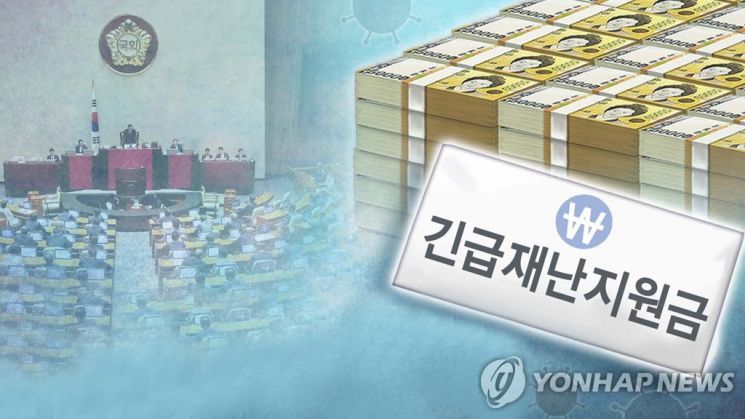
[Asia Economy reporters Han Seung-gon and Kim Young-eun] As the novel coronavirus infection (COVID-19) shows signs of spreading and is expected to lead to a large-scale outbreak, opinions are divided over the payment of the third disaster relief fund. While some argue that preventing the spread and prioritizing quarantine measures are essential, others insist that the third disaster relief fund must be paid to revitalize the economy.
COVID-19 is rapidly spreading nationwide, especially in the metropolitan area. According to the quarantine authorities, as of midnight on the 23rd, the number of new domestic COVID-19 cases was 271. Although the increase, which had been in the 300s for five consecutive days until the previous day, slightly slowed down, the decrease in the number of tests conducted over the weekend means the situation cannot be taken lightly.
In response to this situation, the quarantine authorities announced that to proactively block the spread, the metropolitan area's "social distancing" will be raised to Level 2 starting at midnight on the 24th, and the Honam region will be raised to Level 1.5.
With the strengthening of social distancing measures, including another ban on gatherings at entertainment facilities and restrictions on the operation of major facilities such as restaurants and cafes, opinions clashed over the third disaster relief fund: some argue it should be paid to support small business owners and economic revitalization, while others believe consumption should be halted for now to focus on quarantine efforts.
Previously, the government paid disaster relief funds twice to minimize the economic damage caused by the COVID-19 outbreak. The first disaster relief fund, amounting to 14.3 trillion won, was prepared through an additional supplementary budget in May and was paid to all citizens.
The second disaster relief fund, unlike the first which was paid to all citizens, was selectively paid starting at the end of September, focusing on special employment workers and freelancers. It was also paid to small business owners with annual sales under 400 million won, businesses subject to gathering bans, and businesses with gathering restrictions in the metropolitan area. The payment scale was about half of the first, totaling 7.8 trillion won.
Regarding this, the government has emphasized prioritizing quarantine measures. Prime Minister Chung Sye-kyun stated at the National Assembly Budget and Accounts Special Committee on the 4th, "The government's attitude at this point should be to actively strive to reduce economic wrinkles through successful quarantine," emphasizing proactive success in quarantine over post-disaster relief payments. Deputy Prime Minister Hong Nam-ki also mentioned on the 19th, "Quarantine is the vaccine; now the people and government must unite to respond with full-scale quarantine efforts."
Even if disaster relief funds are paid due to the COVID-19 impact, the government is expected to consider a "selective support" method rather than payment to all citizens. Prime Minister Chung mentioned at the National Assembly Budget Committee plenary session on August 25, when discussions on the second disaster relief fund were underway, "It would be great to give disaster relief funds to those struggling, but we must also consider the state of national finances."
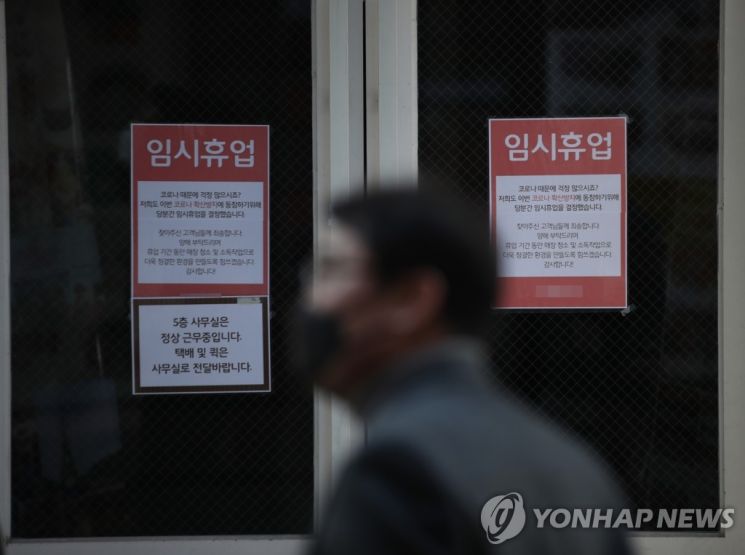 On the 23rd, a temporary closure notice was posted at a cafe in Myeongdong, Seoul. As the spread of COVID-19 intensifies, the 'social distancing' level in the Seoul metropolitan area will be raised to Level 2 starting at midnight on the 24th, allowing cafes to offer only takeout and delivery services. Photo by Yonhap News Agency
On the other hand, there are opinions that disaster relief funds should be paid to all citizens. Gyeonggi Province Governor Lee Jae-myung emphasized on his Facebook on the 20th, "There was a significant difference statistically and perceptually in the economic activation effect between the government's first and second disaster relief funds," and added, "Considering the economic effect, the third disaster relief fund must be paid to all citizens in the form of non-refundable local currency."
He further argued, "Countries around the world have directly supported citizens with at least 1 million won per person. Our country only supported about 400,000 won per person, and since citizens' lives will clearly worsen for the time being, future third and fourth consumption support are inevitable."
In response, netizens have expressed opinions such as "Thorough quarantine is the priority," "It's money my children will have to repay through taxes anyway," and "If we go out to consume with that money again, COVID-19 won't end. It's like a hamster wheel."
There is also ongoing controversy over the effectiveness of the disaster relief funds. According to Statistics Korea, after the period of the first disaster relief fund payment to all citizens in May and June, consumption sharply decreased, and retail sales in the industrial activity trend for July fell by 6.0% compared to the previous month. This is the largest decline in five months since February this year.
Experts point out that the payment of disaster relief funds only has a temporary effect on economic revitalization.
Professor Kim Tae-gi of Dankook University's Department of Economics said, "Even looking at the Statistics Korea results, the lowest income group saw their income decrease further, while paradoxically, the highest income group saw an increase in income," adding, "It cannot be said that disaster relief funds have a significant direct effect on economic stimulus, and even if there is an effect, it is only temporary." He added, "In fact, COVID-19 cannot be significantly countered, and for now, preventing the spread and transmission itself is the most important."
© The Asia Business Daily(www.asiae.co.kr). All rights reserved.
![Clutching a Stolen Dior Bag, Saying "I Hate Being Poor but Real"... The Grotesque Con of a "Human Knockoff" [Slate]](https://cwcontent.asiae.co.kr/asiaresize/183/2026021902243444107_1771435474.jpg)












