Joint Ownership by Couples Excluded from Long-Term Holding Special Deduction
Government: "Advantages and Disadvantages Exist for Both Sole and Joint Ownership... Must Acknowledge"
Market Says "Need to Consider Social Significance of Joint Ownership"
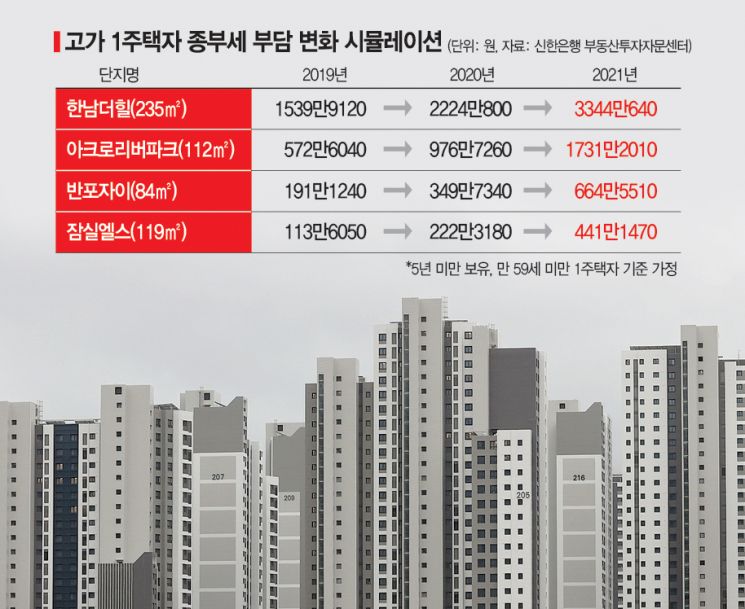
[Sejong=Asia Economy Reporter Kim Hyunjung] As the comprehensive real estate tax (종합부동산세) notices begin to be issued this year, attention is focused on whether there will be market changes due to the perceived tax burden. Due to the surge in real estate prices, the increase in official property prices, and the upward adjustment of the fair market value ratio, the tax amount stated on the notices has more than doubled over the past three years. Accordingly, there are calls to relax the conditions for the "long-term holding special deduction," which legally reduces the tax burden, compared to the current standards.
According to data from Shinhan Bank's Real Estate Investment Advisory Center calculating the comprehensive real estate tax, the owner of Acro River Park (exclusive area 112㎡), who paid about 5.72 million won in comprehensive real estate tax last year, saw their tax burden surge to about 9.76 million won this year. This amount is expected to rise to about 17.31 million won next year, which, if realized, represents a 302% increase over two years. However, this assumes a single-homeowner who did not receive long-term holding or senior citizen deductions.
Under the same conditions, the owner of Banpo Xi (84㎡) will pay 1.91 million won in 2019, 3.49 million won this year, and 6.64 million won next year in comprehensive real estate tax. If owning Jamsil Els (119㎡), the tax will increase from 1.13 million won last year to 2.22 million won this year and 4.41 million won next year.
For multi-homeowners, the perceived increase in tax burden is even steeper. Businessman A, who owns homes in Gangnam-gu and Seocho-gu, said, "Compared to 2018, the tax burden has increased by more than 300% in the past three years," adding, "The comprehensive real estate tax, which was around 7 million won, exceeded 20 million won this year, and I couldn't believe my eyes when I saw the notice." He continued, "My elderly parents, who currently reside in the house, gifted it several years ago, and not only did they pay all the gift taxes properly, but they can also prove that owning multiple homes is impossible. After consulting with a tax accountant, I was told that the payment amount could increase to 70 million won around 2025, which is a big concern."
According to the comprehensive real estate tax law amendment passed by the National Assembly last August, the tax rate for multi-homeowners will increase up to 6.0%. The tax rate, which was previously applied at 0.6?3.2% by taxable standard brackets for owners of three or more homes or two homes in regulated areas, will be adjusted to 1.2?6.0%. The tax rates for single-homeowners and owners of two or fewer homes will also be raised from 0.5?2.7% to 0.6?3.0% by taxable standard brackets.
To alleviate this tax burden, the government provides differentiated reduction rates for seniors and long-term holders. However, houses jointly owned by spouses are excluded from these deductions, which has recently become controversial. Especially as the rapid rise in real estate prices and government adjustments to standard values have sharply increased the tax burden, there are growing calls to extend deduction benefits to jointly owned homes as well. Currently, single-homeowners receive a long-term holding special deduction (장기보유특별공제, Jangteukgongje) that reduces comprehensive real estate tax by up to 70% (for those aged 70 or older and holding the property for 15 years). From next year, this rate will increase to 80%.
The basis for excluding jointly owned homes by spouses is the taxable standard specified in Article 8 of the comprehensive real estate tax law. The law states that the taxable standard applies when "one person solely owns the relevant property." From an interpretative perspective, the government argues that joint ownership effectively raises the exemption amount from the current 900 million won to 600 million won per person, totaling 1.2 billion won, so taxpayers should be aware of the advantages and disadvantages beforehand. Kwon Gwangwook, Director of Property Taxation at the Ministry of Strategy and Finance, explained, "Sole owners are more likely to be subject to higher tax rates compared to joint owners and have 300 million won less in exemption amounts. However, in return, they can receive senior and long-term holding deductions."
However, the market argues that social changes must be carefully considered. It is not only a tax issue but also a matter of social phenomena and changing meanings. Park Won-gap, Senior Real Estate Specialist at KB Kookmin Bank, explained, "Owning a home jointly between spouses is not simply about tax savings. It is intertwined with social changes such as increased female workforce participation, where both spouses directly contribute to wealth formation." As this issue has been continuously raised, Yoon Hee-sook, a member of the National Assembly's Planning and Finance Committee from the People Power Party, proposed a related law amendment to ease the tax burden on single-homeowners with joint spousal ownership.
© The Asia Business Daily(www.asiae.co.kr). All rights reserved.


















