Four New Regional Incinerators Established and Modernization of Two in Songdo and Cheongna
Self-operated Landfill Site to be Created on Yeongheungdo by 2024
Eco-friendly Construction and Bold Incentives Promised Amid Resident Opposition
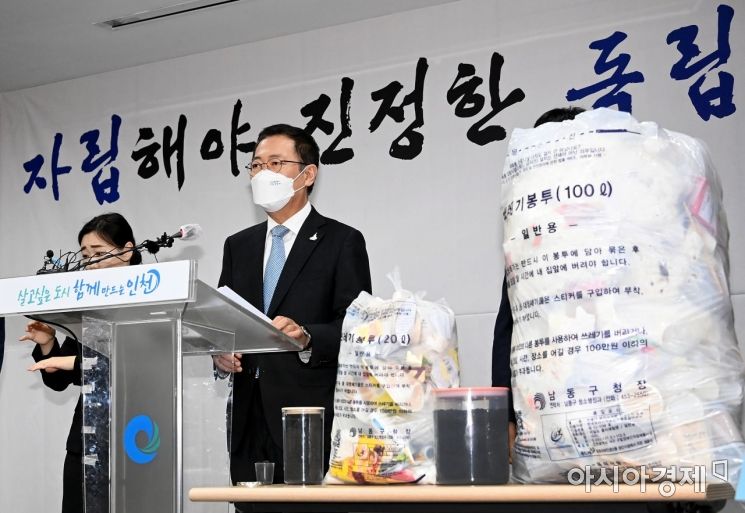 Incheon Mayor Park Nam-chun is announcing plans to promote the eco-friendly Eco Land and the Metropolitan Resource Circulation Center. 2020.11.12 [Photo by Incheon City]
[Asia Economy Reporter Park Hyesook] Incheon City is accelerating its 'eco-friendly resource circulation' policy. The core of the plan is to install incineration facilities (Metropolitan Resource Circulation Centers) to drastically reduce waste generation and landfill waste, and to create eco-friendly self-landfill facilities that bury only minimal incineration residue.
The city will first build four new Metropolitan Resource Circulation Centers by region and modernize two of the three existing metropolitan incinerators in Songdo and Cheongna by downsizing them.
Three candidate sites for the new centers, to be shared by 2-3 districts/counties, have been decided: Sinheung-dong in Jung-gu, Gojan-dong in Namdong-gu, and Yongjeong-ri in Ganghwa-gun. The site for the center to be shared by Bupyeong and Gyeyang-gu has not yet been determined. A resource circulation center with a processing capacity of 45 tons will be built in Ganghwa, and centers with capacities of 250 to 350 tons will be established in the other areas.
The city plans to strengthen design standards beyond legal requirements to minimize legally regulated harmful substances within normal levels and perfectly control odors and chimney smoke to build comfortable facilities. To this end, it will soon form a site selection committee and begin a 'Feasibility Study on Candidate Sites for Metropolitan Resource Circulation Centers.'
Incheon City is also stepping up efforts to create its own landfill site in preparation for the end of use of the metropolitan landfill site in Seo-gu, Incheon, in 2025, and in line with the Ministry of Environment's ban on direct landfill of metropolitan household waste starting in 2026.
The tentatively named 'Incheon Eco Land' will landfill only incineration residue and non-combustible waste that have been reduced through metropolitan incinerators from household waste generated in Incheon.
The city predicts that by increasing household waste separation and strengthening the recycling of bricks and paving blocks made from sewage sludge incineration ash, the daily intake will be only 161 tons (about 8 trucks of 20 tons each). At this rate, Eco Land can be used for about 40 years.
Eco Land is designed in an eco-friendly way to minimize environmental damage, with the landfill space created 40 meters underground and a dome-shaped building constructed above ground to isolate it from the outside.
The candidate site for Eco Land has been decided as Oeri, Yeongheung-myeon, Ongjin-gun. The city plans to build Eco Land on a 148,500㎡ site owned by a private corporation, investing 140 billion KRW, aiming for completion in 2024.
However, self-landfill sites and waste incineration facilities are still perceived as nuisance facilities, so there is considerable resident opposition.
Residents of Yeongheung-myeon have been holding daily protests in front of Incheon City Hall, and the county council issued a statement pointing out that "If another nuisance facility is built on Yeongheung Island, which has already suffered from a thermal power plant, it will cause environmental destruction and severe traffic congestion, adversely affecting the residential environment."
Michuhol-gu also issued a statement demanding the immediate withdrawal of the incinerator installation plan and renegotiation of the planned site, and opposition to the construction plan of nearby incineration facilities is growing in online community groups of residents in Nonhyeon-dong, Namdong-gu, and Songdo-dong, Yeonsu-gu.
The city plans to persuade local residents by emphasizing that the metropolitan incinerators and Eco Land will be built as eco-friendly facilities with no environmental pollution or harm to residents, and will offer exceptional incentives.
In the Yeongheung area, the city will provide an annual development fund worth 5.8 billion KRW, create resident convenience facilities such as sports facilities and neighborhood parks worth 10 billion KRW, and prioritize local residents for employment during Eco Land operations. For districts/counties without metropolitan incinerators, waste import fees will be increased, while those with incinerators will receive strengthened incentives such as resident fund support.
Mayor Park Namchun stated, "Eco-friendly resource circulation is a historical mission that must be implemented to realize environmental justice based on the principle of processing at the source of generation and to pass on a green environment to our children," adding, "We will create Korea's best 'Special Environmental City' by establishing Eco Land and incinerators as eco-friendly and citizen-friendly facilities."
Mayor Park emphasized, "Incheon citizens have endured environmental and economic damage from the metropolitan landfill site for the past 33 years, but the Ministry of Environment, Seoul City, and Gyeonggi Province have made no efforts over five years since the four-party agreement to minimize landfill site use or introduce eco-friendly landfill methods, which should have preceded the search for alternative landfill sites," and stressed, "To end the use of the metropolitan landfill site in 2025, Eco Land and incinerators must be established."
On the 15th of last month, on 'Incheon Citizens' Day,' Mayor Park declared 'Incheon City's Waste Independence,' announcing the end of metropolitan landfill site use in 2025. He warned Seoul City and Gyeonggi Province not to rely on Incheon's land any longer, as Incheon citizens have suffered for 28 years by processing waste from Seoul and Gyeonggi Province.
© The Asia Business Daily(www.asiae.co.kr). All rights reserved.

















