Government to Implement Proactive Social Distancing for Public Officials from the 23rd
Disciplinary Action for Infected Officials
Experts Emphasize Importance of Guidelines Aligned with Quarantine Standards
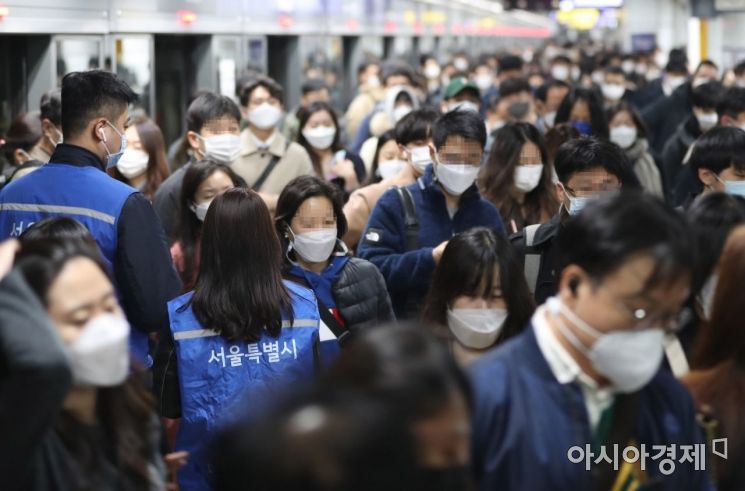 On the morning of the 13th, at Gwanghwamun Station in Seoul, citizens are walking./Photo by Jinhyung Kang aymsdream@
[Asia Economy reporters Han Seung-gon and Kang Joo-hee] The government has issued special guidelines banning face-to-face meetings, events, and dinners among public officials, and decided to hold accountable any public official who violates these rules and contracts COVID-19, sparking controversy.
Although the spread of the novel coronavirus infection (COVID-19) in South Korea is becoming serious, there are concerns that the government is excessively controlling public officials' personal schedules under the pretext of quarantine. There is also criticism that the guideline to hold public officials accountable if infected with COVID-19 is too harsh.
Experts emphasized that it is more important for the government to issue guidelines that align with quarantine standards.
The Central Disaster and Safety Countermeasure Headquarters (CDSCH) announced on the 22nd that starting from the 23rd, one day before the social distancing measures in the metropolitan area take effect, the 'Strengthening Quarantine Management Measures in the Public Sector' guidelines will be applied first to all public officials, public institutions, and public enterprises nationwide.
According to the guidelines, each institution will implement telecommuting for one-third of all personnel to reduce density, and those who come to work will stagger their arrival and lunch times. Masks must be worn indoors at all times, and unnecessary business trips, except for public safety and other essential reasons, are basically prohibited.
The government also prepared 'Special Guidelines on Meetings, Events, Dinners, and Conferences in the Public Sector.' Regardless of work-related or personal matters, all unnecessary gatherings in the public sector must be canceled or postponed. If meetings are necessary, they should be held online or through other non-face-to-face methods, and face-to-face meetings should avoid meals as much as possible.
If an employee under the public sector violates the guidelines by holding face-to-face meetings, events, or dinners and contracts or spreads COVID-19, the public official involved will be held accountable.
Park Neung-hoo, the first deputy head of the CDSCH (Minister of Health and Welfare), emphasized at a regular briefing held at the Government Seoul Office on the same day, "Since infections are spreading through meetings and dinners recently, all unnecessary gatherings, regardless of work-related or personal matters, must be canceled or postponed according to the special guidelines," and added, "We also request active participation from the private sector."
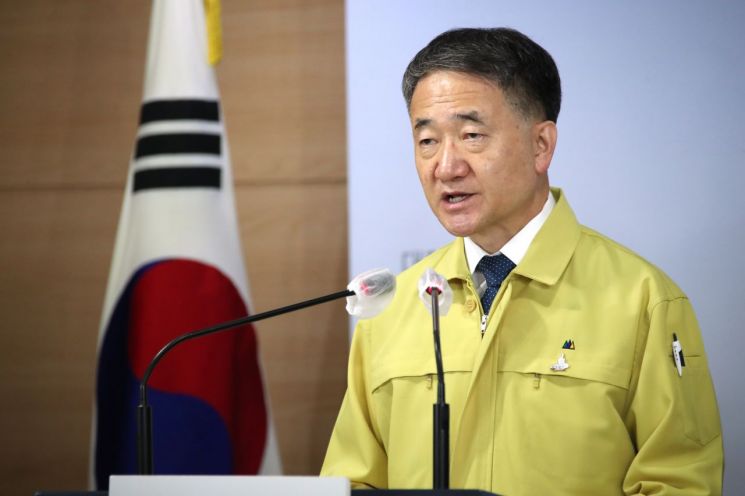 Park Neung-hoo, the 1st Deputy Head of the Central Disaster and Safety Countermeasures Headquarters (Minister of Health and Welfare), is giving a briefing after concluding a meeting of the Central Disaster and Safety Countermeasures Headquarters at the Government Seoul Office Building on the afternoon of the 25th of last month.
 [Image source=Yonhap News]
However, there have been continuous criticisms that the government's guidelines are excessive. Critics argue that the government is excessively controlling public officials' personal schedules under the pretext of COVID-19 quarantine.
A public official in Seoul, identified only as Kim (28), said, "It seems too harsh for public officials who work for the people," and expressed frustration, saying, "There are many projects where people gather during the COVID-19 period, but is it reasonable to hold public officials accountable if they get infected?"
Among citizens, there are also criticisms that holding public officials accountable is excessive. Office worker Jung (29) said, "It is true that public officials should be cautious, but no one wants to get COVID-19, and they get infected without knowing why," and added, "Even during social distancing, as long as quarantine guidelines are followed, shouldn't it be possible to meet family and close acquaintances? How can people live if they are not allowed to carry out basic daily activities?"
Jung further added, "Getting infected with COVID-19 is already unfortunate enough, but holding them responsible for it seems too much."
On the other hand, some opinions suggest that such measures are necessary to raise awareness about quarantine given the severity of the COVID-19 situation. One netizen said, "At the end of the year, there are many workplaces with frequent dinners and gatherings recently," and added, "If the government takes such measures first in public institutions, it will strengthen awareness about social distancing."
Experts also suggested that it is more important for the government to issue guidelines that comply with quarantine standards.
Kim Woo-joo, a professor of infectious diseases at Korea University Guro Hospital, pointed out, "I think this is a measure to show that the government is working hard on quarantine amid the economic difficulties faced by citizens who have lost jobs and self-employed people, but holding people accountable is excessive."
He continued, "While people can be criticized for violating quarantine rules, there can be unavoidable situations," and emphasized, "In a national emergency, the important thing is not to hold public officials accountable but to appropriately issue guidelines that meet quarantine standards."
© The Asia Business Daily(www.asiae.co.kr). All rights reserved.
![Clutching a Stolen Dior Bag, Saying "I Hate Being Poor but Real"... The Grotesque Con of a "Human Knockoff" [Slate]](https://cwcontent.asiae.co.kr/asiaresize/183/2026021902243444107_1771435474.jpg)

















