Including 316.6 Billion KRW in Earthquake Damage Relief Funds... Issuance of Local Bonds Worth 80 Billion KRW Considering Sharp Revenue Decline
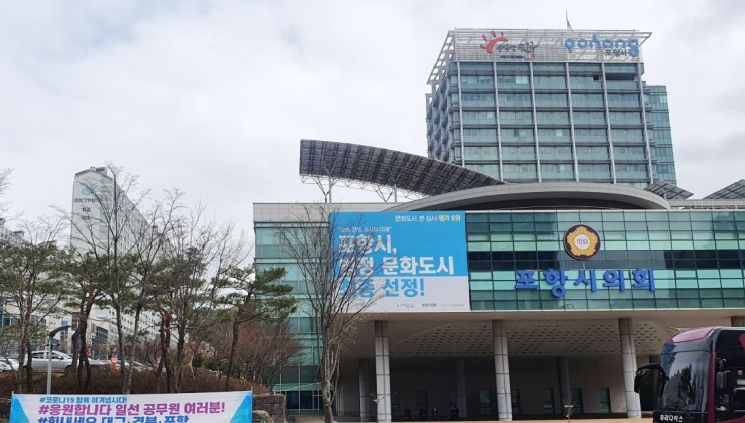
[Asia Economy Yeongnam Reporting Headquarters Reporter Park Dong-wook] Pohang City, Gyeongbuk announced on the 22nd that it has prepared and submitted to the city council the initial budget plan for 2021 totaling 2.4329 trillion won, an increase of 423.6 billion won (21.1%) compared to the original 2020 budget.
This budget plan consists of 2.169 trillion won for the general account and 263.9 billion won for the special account. The increase of 423.6 billion won despite difficult conditions is due to the inclusion of 316.6 billion won in earthquake damage relief support funds.
This year, about 100 billion won was invested in overcoming COVID-19 and proactively responding to disasters such as typhoons and heavy rains. Next year, however, revenues are expected to sharply decline due to decreases in local allocation tax caused by the economic downturn in the steel complex, including POSCO.
On the other hand, due to the city's financial burden for increasing national and provincial subsidy projects and expansionary fiscal policy for regional economic recovery investments related to COVID-19, a budget shortfall of 80 billion won will be covered by issuing local bonds.
Pohang City plans to invest 575.3 billion won in stabilizing low-income households and urban vitality, 132 billion won in Pohang-type New Deal and future growth infrastructure, 241.4 billion won in ecological and cultural city sectors, and 352 billion won in building a safety net and a citizen-safe city next year.
Looking at the major budget items by sector, 316.6 billion won is allocated for earthquake damage relief support funds, 36.2 billion won for issuing 300 billion won in local currency, 4.3 billion won for small business card fee support and special guarantees and interest subsidies, and 4.8 billion won for traditional market environment improvement.
Additionally, 13 billion won is allocated for rural hub revitalization projects and basic living base development projects, and 12.7 billion won for fishing village New Deal projects, totaling 153 billion won for agricultural and fishing village revitalization projects. The goal for next year is to reduce 100 taxis, with an initial budget of 5.1 billion won.
Other projects to secure Pohang-type New Deal and future growth engines include 40 billion won for the development of Yeongilman 4th General Industrial Complex, 6.8 billion won for the Pohang Convergence Technology Industrial Zone, 10.8 billion won for the ecological restoration of Haksancheon and Gumucheon streams, 16.7 billion won for old downtown urban regeneration projects, and 15 billion won for purchasing long-unexecuted park sites such as Duho, Okmyeong, and Buksong Parks.
Furthermore, 3.9 billion won will be invested in establishing an infectious disease prevention system and installing a respiratory specialty clinic, 20 billion won for implementing full free meals in kindergartens and elementary and middle schools, 13 billion won for building a multi-purpose complex center, and 10.5 billion won to complete the disabled-friendly national sports center.
Mayor Lee Kang-deok of Pohang explained, "Despite difficult financial conditions, we have prepared an expansionary budget through local bond issuance to respond to the post-COVID era, build future growth infrastructure, ensure sustainable development, stabilize livelihoods, and revitalize the local economy."
Meanwhile, the initial budget plan for next year submitted this time will be finalized on the 21st of next month after deliberation at the 279th regular meeting of the Pohang City Council starting on the 30th.
© The Asia Business Daily(www.asiae.co.kr). All rights reserved.

















