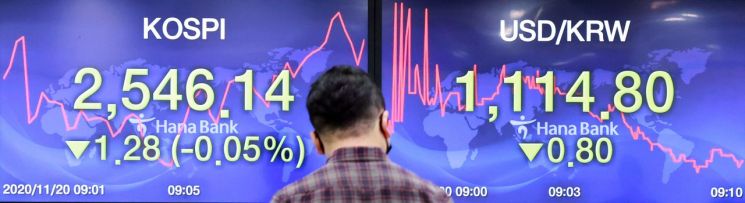
[Asia Economy Reporter Kim Eun-byeol] Supported by the weak dollar trend and foreign investors' net purchases of Korean stocks, the won-dollar exchange rate continues its downward trend. As concerns over the rapidly falling exchange rate have persisted recently, the government has expressed a strong commitment to stabilizing the exchange rate and has shown signs of hesitation, but experts predict that the won-dollar exchange rate decline will continue for the time being.
According to the Seoul foreign exchange market on the 21st, the won-dollar exchange rate closed at 1,114.3 won, down 1.3 won from the previous trading day. The exchange rate, which started the day at 1,115.0 won, down 0.6 won, rose to the 1,117 won level in the early session but then widened its decline again.
On the 19th, the foreign exchange authorities verbally intervened, limiting the weak dollar trend. Deputy Prime Minister and Minister of Economy and Finance Hong Nam-ki and First Vice Minister of Strategy and Finance Kim Yong-beom consecutively engaged in verbal interventions, causing the exchange rate, which had been declining, to surge by more than 11 won in just one day.
Earlier this year, as the novel coronavirus disease (COVID-19) spread, the won-dollar exchange rate rose to as high as 1,285.73 won, but the U.S. Federal Reserve (Fed) increased the absolute supply of dollars worldwide through currency swaps and other measures.
The won's strength compared to other currencies besides the dollar is analyzed to be influenced by foreign investment movements. Recently, while the economic damage in the U.S. and Europe remains significant, Asian countries have relatively succeeded in COVID-19 prevention and experienced less economic shock, attracting investment funds to Asia. Consequently, the won-dollar exchange rate fell sharply. The exchange rate, which was around the 1,600 won level in early October, dropped by nearly 50 won in about two months. Foreign investors' continued net purchases in the domestic stock market have further strengthened the won.
Although the authorities' intervention has caused some hesitation, many expect the weak dollar trend to continue for the time being. The foreign exchange market anticipates that the U.S. presidential election will conclude and additional stimulus measures will be passed in the U.S. There are even opinions that the dollar may weaken further, causing the won-dollar exchange rate to fall below 1,100 won.
Oh Chang-seop, an analyst at Hyundai Motor Securities, said, "I judge that factors causing the won-dollar exchange rate to decline, such as the weak dollar, will remain dominant next year," adding that the global economic recovery phase and the stimulus package issue after the U.S. presidential inauguration in the first half of next year could strengthen the weak dollar trend. He also noted that if the exchange rate approaches the lower bound of the fluctuation range since 2010, around 1,050 won, the speed of the exchange rate decline will significantly slow due to the exchange rate burden on export companies.
© The Asia Business Daily(www.asiae.co.kr). All rights reserved.
![Clutching a Stolen Dior Bag, Saying "I Hate Being Poor but Real"... The Grotesque Con of a "Human Knockoff" [Slate]](https://cwcontent.asiae.co.kr/asiaresize/183/2026021902243444107_1771435474.jpg)
















