‘Dae-Star Problem Solver Platform’ Part 2, AI Championship Final Pitch
30 Million KRW Prize for 1st Place, Up to 2.5 Billion KRW in Policy Support Linked
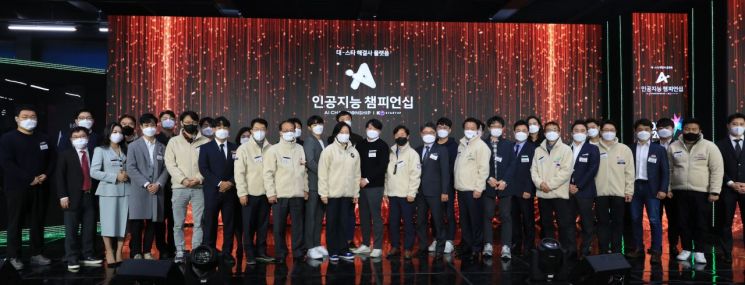
[Asia Economy Reporter Kim Heeyoon] Eight startups have emerged that solved problems faced by large corporations and senior ventures using artificial intelligence (AI).
The Ministry of SMEs and Startups announced on the 20th that it has finally selected eight winning teams of the ‘AI Championship’ held as a special event of ‘ComeUp 2020.’
This AI Championship was promoted as the second phase of the ‘Large-SME Solver Platform.’ It is distinguished from other AI competitions in that eight AI challenges, which large corporations and senior ventures found difficult to solve on their own, were presented, and big data helpful for solving these challenges was disclosed for collaboration with startup companies.
In the finals, 22 companies selected through document and face-to-face evaluations from 112 applicants participated. These companies presented algorithms that solved the challenges and additional commercialization plans.
The evaluation involved four AI technology experts, two commercialization experts, and actual representatives from large corporations, who conducted in-depth assessments to determine the eight winning teams.
First, RTM, which won the LG Science Park challenge, is a well-prepared startup recognized for both technological capability and business potential, having been founded in 2018 and received investments from Bluepoint Partners, Kingsley Ventures, and selected for the TIPS program.
Dingbro, which won the Hankook Tire & Technology challenge, was founded by four young developers from KAIST and is a startup that has solved problems difficult for domestic research institutes based on solid technological expertise.
SpiderCore, which won the Kosin University Gospel Hospital challenge, presented an AI diagnostic service that analyzes walking data in real time to predict falls in advance.
Violet, which won the KDX Korea Data Exchange challenge, developed AI that automatically recognizes and analyzes characters, objects, and backgrounds in videos and automatically recommends suitable backgrounds and music, winning the challenge.
Algorima, which won the Naver challenge, is a startup providing AI-based education and proposed a real-time captioning service for non-face-to-face conversations as an additional commercialization plan.
Mofle, which won the BC Card challenge, is a startup that solves real economy problems by predicting the timeliness and appropriateness of supply and demand based on AI, attracting attention by proposing a financial product design exclusively for small business owners along with a BC Card customer growth commercialization model.
Prediction, which won the Woowa Brothers challenge, is a solution company currently detecting fake reviews in the online market and providing consumers with objective and accurate information. They stated they took on the challenge due to the similarity between their own concerns and the challenge.
Finally, DeltaX, which won the Wemakeprice challenge, is a solid technology startup with an average age of 32 and 14 technical researchers, winning by achieving excellent technical scores.
The eight winning teams will receive prize money of 30 million KRW and policy support of up to 2.5 billion KRW. Second place will receive 7 million KRW, and third place will receive 5 million KRW.
Kang Sang-ki, head of Samsung Electronics’ AI group and the lead developer of ‘Bixby,’ who is also the director of Hanyang University AI Solution Center, served as the chair of the evaluation committee and announced the final evaluation.
Director Kang said, “It was an opportunity for large corporations and other challenge institutions to provide their data to startups and reflect the voices from the frontlines of the AI field,” adding, “The AI Championship left many achievements and significance in cooperation and coexistence between large corporations and startups.”
© The Asia Business Daily(www.asiae.co.kr). All rights reserved.

















