Lee In-young "We must share when lacking rather than when abundant..."
North Korea refuses COVID aid, emphasizes external blockade
"How many public officials were shot?" "Who takes care of our people?" criticism
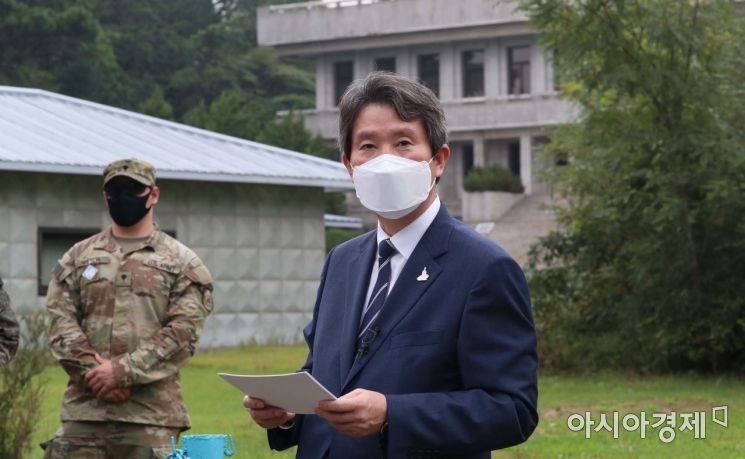 Minister of Unification Lee In-young is conducting an interview during his visit to Panmunjom last September. Photo by Joint Press Corps
[Asia Economy reporters Han Seung-gon and Kang Joo-hee] Minister of Unification Lee In-young's statement that "sharing when in need is true sharing" to express the intention of supporting North Korea with COVID-19 vaccines has sparked strong criticism.
Although the government is accelerating efforts to secure COVID-19 vaccines, critics argue that the remark was inappropriate at a time when the vaccine's effectiveness has not been fully verified and it is expected to take considerable time before distribution. Especially in the aftermath of the 'North Korean military shooting incident involving a South Korean official' that occurred last September, when public sentiment has worsened, mentioning North Korea itself was seen as a reckless statement.
Earlier, Minister Lee appeared on KBS 'News9' on the 18th and emphasized inter-Korean cooperation and solidarity amid the COVID-19 situation, saying, "North Korea has endured significant economic sacrifices due to COVID-19."
He continued, "If we can cooperate on treatments and vaccines, North Korea might find an opportunity to alleviate some of the economic sacrifices it has endured due to its COVID-19 prevention system," adding, "True sharing is sharing together when resources are scarce rather than sharing because we have plenty."
On the 20th, at the Inter-Korean Health and Medical Cooperation Council meeting, Minister Lee reiterated his willingness to cooperate with North Korea, stating, "We need to discuss now the establishment of an infectious disease information exchange and response system agreed upon by the inter-Korean leaders in 2018."
However, despite the government's message, North Korea has expressed a stance of refusing any external assistance related to COVID-19. On the 19th, the North Korean Rodong Sinmun published an editorial titled "Emergency Epidemic Prevention is the Party and State's Most Important Matter," emphasizing quarantine and external blockade.
The editorial stated, "Now, all of us face a fateful choice: whether to risk our children’s lives by seeking goods beyond the border that we can live without, or to endure and protect our children," and added, "Many countries are experiencing worsening quarantine situations due to a second wave of the malignant epidemic."
It further argued, "If we do not live and fight with the spirit of defending our homeland, the fate of our country and people will be toyed with by the dreadful disease." This editorial drew attention as it was published shortly after Minister Lee's remark about 'sharing even when scarce.'
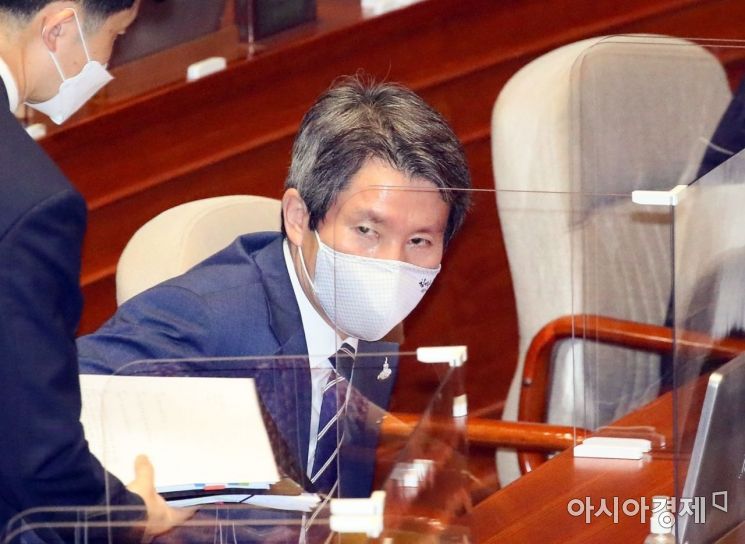 Minister of Unification Lee In-young is attending the government questioning session on diplomacy, unification, and security held at the National Assembly plenary session last September. Photo by Yoon Dong-joo doso7@
Minister Lee's remarks have triggered a flood of criticism. Critics point out that suggesting aid to North Korea when vaccine safety has not been proven and distribution methods for the public have not been decided is inappropriate. Especially, mentioning North Korea at a time when public sentiment is negative due to the killing of a South Korean official by North Korean soldiers just two months ago in September was considered reckless.
Jo, a 30-something office worker, expressed frustration, saying, "Even among our own people, we are struggling with who to share with first, so mentioning North Korea is absurd. How can there be talk of supporting vaccines to North Korea, which burned our official alive and blew up the inter-Korean joint liaison office?"
Criticism also poured in from the political sphere. Kim Geun-sik, the People Power Party's Songpa-byeong district committee chairman in Seoul, wrote on his Facebook on the 20th, "Suggesting sharing with the North when vaccines have not even been secured yet is more fitting for a leading civic group representative or a clergy of sacrifice and love than a government minister," and criticized, "If you want to show love to the North at all costs, resign as minister and do it."
Kim further questioned, "Moreover, the North brutally killed our citizens citing COVID-19 and claims zero confirmed cases itself. Isn't it rejecting external support?"
Jang Jin-young, the same party's Dongjak-gap district committee chairman, lamented on Facebook, "Even if the Minister of Unification thinks about North Korea day and night, who thinks about our people?"
Meanwhile, the government is negotiating with major overseas vaccine developers to secure COVID-19 vaccines and plans to announce a 'proportion plan' this month on how to distribute 30 million doses.
Son Young-rae, head of the Strategic Planning Division at the Central Disaster and Safety Countermeasures Headquarters and spokesperson for the Ministry of Health and Welfare, said in an interview with TBS Radio's 'Kim Eo-jun's News Factory' on the 19th, "We are negotiating with leading vaccine companies," and added, "We plan to finalize and announce this month the plan regarding which vaccines and how to allocate the 30 million doses."
Lee Sang-won, head of the Epidemiological Investigation and Analysis Team at the Central Disease Control Headquarters, explained at the regular briefing on the same day, "Vaccines require more time for verification than development, and once decided, it is a national project affecting the health of the entire population," adding, "We are rushing to secure vaccines but will not make hasty decisions." He also stated, "The vaccination schedule is planned for the second half of next year, considering approval and delivery preparation processes."
© The Asia Business Daily(www.asiae.co.kr). All rights reserved.


















