Citizens Increasingly Frustrated by Inability to Travel Due to COVID-19
66.6% of Survey Respondents Report Discomfort from Travel Restrictions
Experts: "Anxiety Arises Amid Uncertainty Over End of COVID-19"
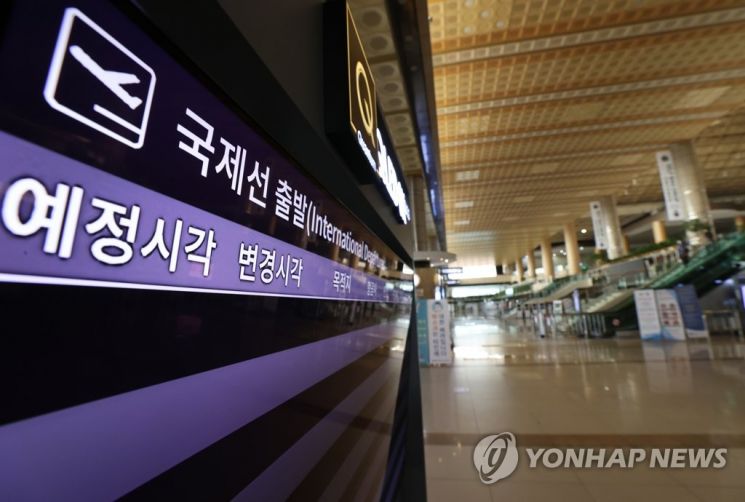 On the 7th of last month, the departure flight status board inside the international terminal of Gimpo Airport in Gangseo-gu, Seoul, was completely empty. Photo by Yonhap News
[Asia Economy reporters Seunggon Han and Seulgi Kim] #Choi Seongcheol (alias), a man in his 30s, planned an overseas trip with his parents, who turned 60 this year, but canceled all plans due to the COVID-19 pandemic. Choi said, "Travel was a source of joy for our family. At the beginning of this year, we hoped that 'COVID-19 would calm down by the end of the year,'" adding, "But seeing the daily increase in confirmed cases, I feel very disappointed, thinking that we might not be able to travel even next year."
As the COVID-19 situation prolongs and personal quarantine guidelines such as 'social distancing' are further strengthened, more people are expressing frustration over being unable to travel.
According to a survey conducted last August by Embrain Trend Monitor, a market research firm, targeting 1,000 adults aged 19 to 59 nationwide on changes in attitudes and perceptions toward travel in the COVID-19 era, 66.6% of respondents expressed discomfort about not being able to travel freely due to COVID-19.
Additionally, 66.9% of all respondents felt that the inability to travel freely due to COVID-19 made daily life difficult. Particularly, younger age groups responded more strongly (20s 72%, 30s 68.8%, 40s 69.2%, 50s 57.6%) that travel restrictions made everyday life harder.
Many also regarded travel as an essential part of life. The survey showed that 6 out of 10 people (59.8%) said they "cannot imagine life without travel." Among them, women (men 56.6%, women 63%) and younger generations in their 20s and 30s (20s 64%, 30s 69.6%, 40s 55.6%, 50s 50%) emphasized the importance of travel more strongly.
Park Gyeongjin (alias), a college student in his 20s, said, "Whenever the semester ended, I used to take short trips with friends using money I saved from part-time jobs during the semester," explaining, "Even just going on those trips recharged my tired mind and helped me prepare for the new semester with renewed energy."
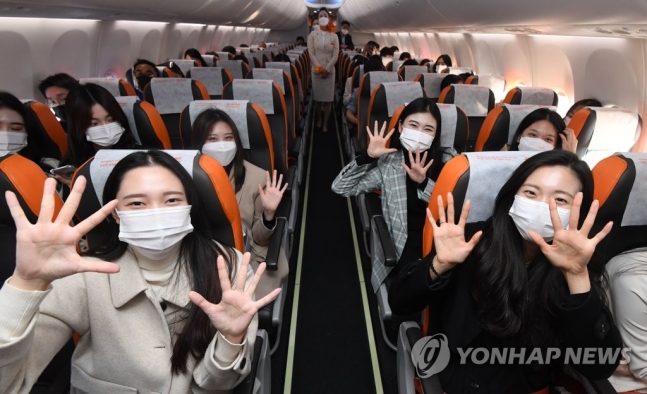 Jeju Air 'Incheon to Incheon' sightseeing flight passengers are showing their boarding passes and enjoying themselves before taking off on a B737-800NG aircraft at Incheon International Airport Terminal 1 on October 23./Photo by Yonhap News
Given this situation, the travel industry is promoting products such as 'virtual departure trips' aimed at people frustrated by their inability to travel.
Earlier in September, the Korea Tourism Organization announced that its 'virtual departure trip' product, launched for those thirsty for overseas travel, sold out within four minutes of release.
On the 19th, related government ministries including the Ministry of Economy and Finance and the Ministry of Land, Infrastructure and Transport announced that international sightseeing flights passing through foreign airspace without landing would be permitted for one year.
Hong Namgi, Deputy Prime Minister and Minister of Economy and Finance, explained at a meeting of the Central Disaster and Safety Countermeasure Headquarters and the Korean New Deal related ministers held at the Government Seoul Office that day, "We will promote the introduction of a new tourism form called 'non-landing international sightseeing flights' to support the aviation industry affected by the pandemic and to stimulate consumer sentiment."
He added, "By temporarily allowing international flights without foreign entry or exit for one year, passengers will be exempt from quarantine and diagnostic tests after arrival under strict quarantine and prevention management, and will receive the same duty-free benefits as regular travelers."
Experts analyze this as a sense of deprivation caused by the disruption of the everyday lifestyle people once enjoyed amid the uncertain end of COVID-19.
Professor Kwak Geumju of the Department of Psychology at Seoul National University explained, "Travel has played a role in allowing people to escape daily life and providing spatial and psychological stability. However, due to COVID-19, all of these have been blocked."
She continued, "As travel, which used to provide rest and experiential opportunities, has been cut off, more people are complaining of stress. Because people are being controlled from enjoying what they used to, the sense of deprivation from this is gradually increasing."
© The Asia Business Daily(www.asiae.co.kr). All rights reserved.
![Clutching a Stolen Dior Bag, Saying "I Hate Being Poor but Real"... The Grotesque Con of a "Human Knockoff" [Slate]](https://cwcontent.asiae.co.kr/asiaresize/183/2026021902243444107_1771435474.jpg)

















