Ministry of Industry Holds '50th Anniversary Ceremony of Masan Free Trade Zone'
Announces '2030 Innovation Strategy' Linking Free Trade Zones and Key Industries
Tax and Subsidy Benefits, Relaxed Residency... Attracting High-Tech and U-Turn Investments to Drive Regional Economic Innovation
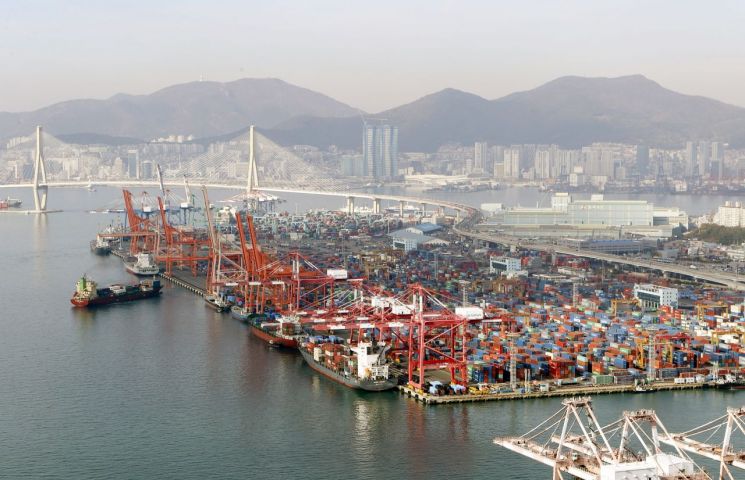
[Asia Economy Reporter Moon Chaeseok] The government announced the 'FTZ 2030 Innovation Strategy' on the 20th, which links Free Trade Zones (FTZ) with regional key industries and encourages companies to return to domestic operations (U-turn).
The goal is to increase export value from $2.56 billion (based on this year) to $10 billion and employment from 29,972 people (based on this year) to 50,000 by 2030.
The Ministry of Trade, Industry and Energy held a '50th Anniversary Ceremony' at Masan FTZ from 1:30 p.m. on the same day and unveiled the innovation strategy.
The ceremony was attended by Minister Sung Yun-mo of the Ministry of Trade, Industry and Energy, Governor Kim Kyung-soo of Gyeongsangnam-do, Mayor Heo Seong-su of Changwon, among others. Prime Minister Chung Sye-kyun delivered a video congratulatory message.
FTZ as a Hub for Regional Key Industries... Strengthening Tax and Subsidy Support
The core of the 'innovation strategy' announced by the Ministry of Trade, Industry and Energy is to link FTZs with regional key industries.
The plan is not to use FTZs merely as 'export channels' but to develop them into 'advanced export and investment attraction hubs' and 'manufacturing and logistics convergence centers.'
First, the site area, currently 34.7 million square meters, will be expanded to 49.7 million square meters by 2030.
An 'FTZ Investment Attraction Support Group' will be established and operated together with local governments where FTZs are located, related organizations (KOTRA, Korea International Trade Association, Korea Chamber of Commerce and Industry, etc.), and the private sector (financial institutions, etc.).
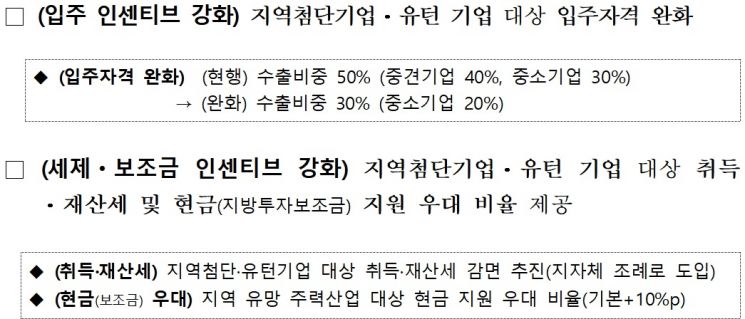
Entry qualifications will be relaxed and tax and subsidy benefits strengthened for local advanced companies and U-turn companies, drawing attention.
Currently, only companies with an export ratio of 50% (medium-sized = 40%, small and medium-sized = 30%) are eligible for entry, but the threshold will be lowered to 30% (small and medium-sized = 20%) going forward.
Through local government ordinances, acquisition tax and property tax will be reduced for local advanced and U-turn companies.
When providing local investment subsidies, a rate 10 percentage points higher than the basic rate will be applied preferentially to promising regional key industries.
Improving Permits and Approvals Regulations, Building Logistics Centers... Strengthening Export Capabilities
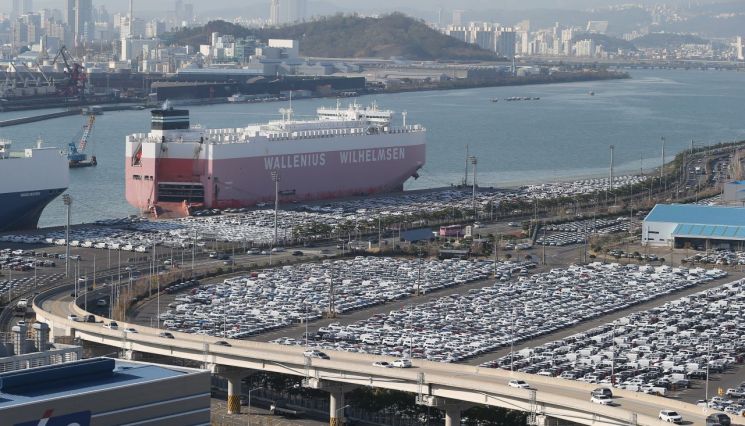
Various permits, export, and procurement regulations that companies have appealed to be lifted will be eased. Dedicated regulatory officers will be appointed to take responsibility for and improve regulations in new industry sectors.
Additionally, ▲allowing entry for manufacturing and processing industries of 63 agricultural, forestry, and livestock product concession items ▲simplifying cargo inventory management ▲introducing special customs law systems such as import declaration before arrival ▲relaxing conditions for the sale of long-term abandoned cargo in FTZs will be implemented.
Through the establishment of the 'FTZ Innovation Support Center' and 'FTZ Smart Logistics Center,' the innovation of resident companies will be indirectly supported.
To strengthen companies' export capabilities, ▲a comprehensive export package linked across ministries will be created (in-depth diagnosis), ▲commercialization rates will be increased (prototypes, certification), and ▲export performance will be expanded (market development).
Furthermore, the Ministry of Trade, Industry and Energy, Ministry of Land, Infrastructure and Transport, and Ministry of Oceans and Fisheries will jointly establish and operate the 'FTZ Council' to enhance policy momentum.
Achieving FTZ Exports of $10 Billion, Investment of $5 Billion, and Employment of 50,000 by 2030
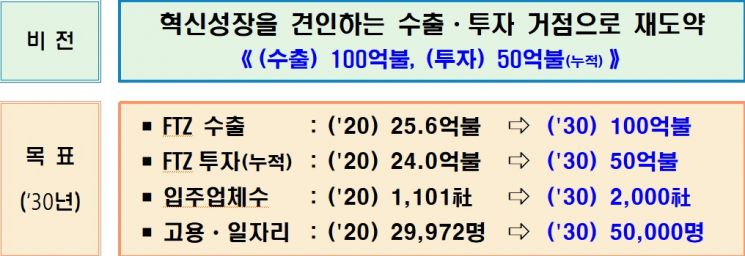
Through the innovation strategy, the Ministry of Trade, Industry and Energy announced plans to achieve $10 billion in exports and $5 billion in investment attraction in FTZs by 2030. The number of resident companies will increase from the current 1,101 to 2,000, aiming to achieve employment of 50,000.
The ministry diagnosed that due to changes in conditions such as the spread of Free Trade Agreements (FTA) and investment contraction, the effectiveness of tariff suspensions has decreased, and investment advantages have diminished. Therefore, the role of FTZs as export hubs has weakened.
Ultimately, it was viewed that ▲synergy with regional key industries has weakened, ▲export and innovation capabilities are insufficient, and ▲incentives are mainly directed toward foreign-invested companies, creating a vicious cycle.
Conversely, the ministry believes that these weaknesses can be overcome through this 'innovation strategy.' This is why export, investment, and employment targets have been set high.
The ministry explained, "With the spread of the non-face-to-face economy due to the COVID-19 shock, global investment and demand for digital infrastructure and advanced products such as semiconductors, 5G, and artificial intelligence (AI) are expected to expand."
It added, "It is also an opportunity to attract digital and advanced industries linked to key industries such as intelligent and digital industries in Masan, eco-friendly automobiles in Ulsan, and new energy industries in Daebul."
Prime Minister Chung Sye-kyun said, "The Masan FTZ, called the 'Miracle of Happo Bay,' greatly contributed to overcoming the 1990s foreign exchange crisis," and added, "We will faithfully implement the 'innovation strategy,' which was prepared for the first time jointly by related ministries, to transform FTZs into export and investment hubs."
The Prime Minister emphasized, "Once again, FTZs are expected to play a leading role in overcoming the economic crisis triggered by COVID-19 and in driving a new leap forward."
Meanwhile, at the ceremony, the Ministry of Trade, Industry and Energy awarded 28 meritorious persons, including Park Su-hyun, CEO of Daesin Metal.
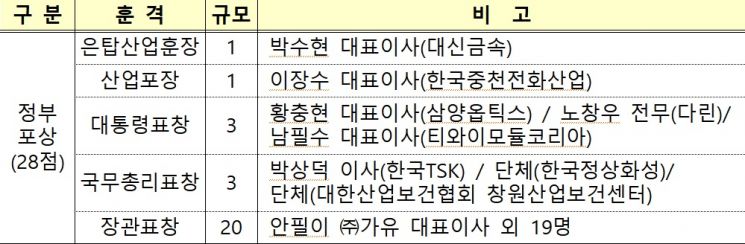 Masang FTZ 50th Anniversary Government Award Recipients. (Source: Ministry of Trade, Industry and Energy)
© The Asia Business Daily(www.asiae.co.kr). All rights reserved.



















