Urgent Need to Resolve Power Supply Issues... Challenges in Developing Green Hydrogen and Carbon Capture Technologies
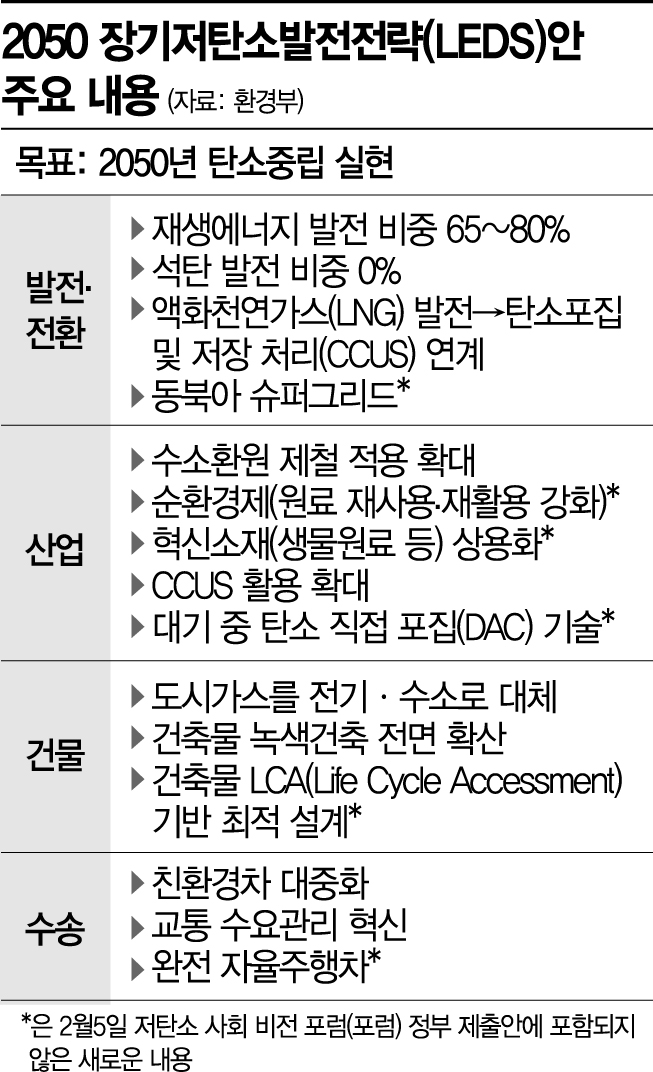
[Asia Economy Reporter Moon Chaeseok] The government is considering a plan to expand the share of renewable energy generation to up to 80% over the next 30 years to achieve carbon neutrality by 2050, while reducing the share of coal-fired power generation to 'zero (0)'. It also presented a plan to reduce greenhouse gas emissions by 24.4% compared to 2017 by 2030. However, the government has not presented concrete implementation measures to realize these aggressive goals.
The Ministry of Environment and the National Assembly Climate Change Forum disclosed the '2050 Long-term Low Carbon Development Strategy (LEDS)' and the '2030 National Greenhouse Gas Reduction Target (NDC)' containing these details at a public hearing held at the National Assembly Members' Office Building on the 19th. The government plans to submit an official report to the United Nations (UN) after deliberation at the Cabinet meeting in December, following the public hearing and opinion collection process.
According to the Paris Agreement signed in 2015, each country must submit LEDS and NDC to the UN by the end of 2020. President Moon Jae-in officially announced the 'realization of carbon neutrality by 2050' on the 28th of last month. The report to be submitted to the UN is expected to contain the government's roadmap to achieve this, drawing significant attention.
According to the government's disclosed plan, to realize carbon neutrality by 2050, the share of renewable energy generation will be expanded to 65-80% by 2050. At the same time, the share of coal-fired power generation will be reduced to 0%. Considering that the share of renewable energy generation was only 5.2% last year, while coal-fired power generation accounted for 40.4%, this is a very aggressive target.
Moreover, this target is higher than the 60% renewable energy share and 4.4% coal-fired power share proposed by the Low Carbon Society Vision Forum to the government in February. Along with this, the government also announced plans to link liquefied natural gas (LNG) power generation with carbon capture, utilization, and storage (CCUS) technology and to introduce the Northeast Asia Supergrid.
An official from the Ministry of Environment explained, "The 2050 renewable energy and coal power shares presented at the public hearing are one of several possible scenarios and are not finalized figures. We plan to prepare refined 2050 carbon neutrality scenarios (multiple options) considering policy performance evaluation, technological development, and other factors."
On the same day, the government also presented a reduction target to cut greenhouse gas emissions from 709.14 million tons in 2017 to 536 million tons by 2030. Some voices argue that achieving carbon neutrality by 2050 would be difficult with this level of reduction.
Meanwhile, 15 ministries including the Ministry of Strategy and Finance, Ministry of Trade, Industry and Energy, Ministry of Land, Infrastructure and Transport, Ministry of Foreign Affairs, Ministry of Environment, Ministry of Agriculture, Food and Rural Affairs, and the Office for Government Policy Coordination have formed an intergovernmental consultative body since March to prepare the LEDS government report to be submitted to the UN.
Experts unanimously said, "It is meaningful but there is a long way to go." Especially, there is a strong call for urgent measures to secure power supply and demand to realize the government's targets of expanding renewable energy share to 80% and reducing coal power share to 0%.
Raised Targets, Are They Achievable?
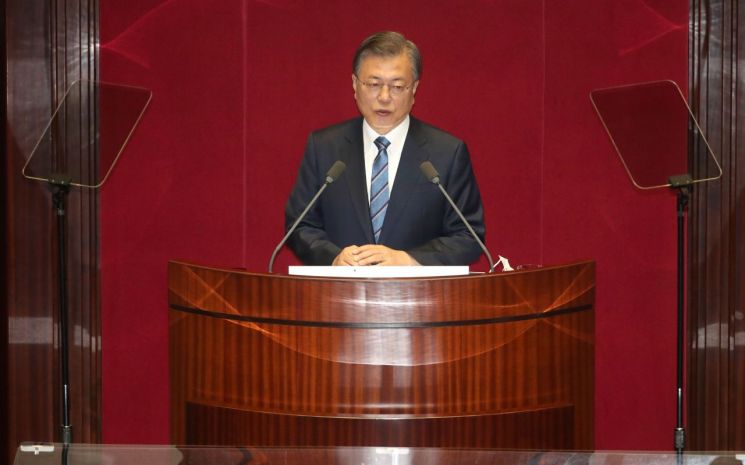 President Moon Jae-in declaring at the National Assembly policy speech on the 28th of last month, "We will move forward with the goal of carbon neutrality by 2050." (Image source=Yonhap News)
The additional LEDS review plan announced by the government at the public hearing this time contains much stronger content than the plan submitted by the Low Carbon Society Vision Forum to the government on February 5. This is because the timing to achieve a carbon-neutral society has been advanced from the original 2062 to 2050.
Carbon neutrality (net zero) does not mean zero carbon emissions. However, since carbon emissions must be reduced so that the sum of emissions and absorption equals '0', all technologies capable of reducing carbon must be mobilized to achieve the policy goal.
Therefore, the additional review plan newly includes ▲ securing direct air capture (DAC) technology for atmospheric carbon (industry) ▲ optimal design based on building life cycle assessment (LCA) (buildings) ▲ realization of fully autonomous vehicles (transportation). This is truly a goal that can only be realized through an 'industrial and social transformation.'
Existing measures have also been strengthened compared to the February submission. The level is much higher than the strongest scenario among the five scenarios in the February plan. Representative examples include ▲ expanding renewable energy generation share to 65-80% (power generation) ▲ reducing coal power share to 0% (power generation) ▲ expanding application of hydrogen reduction steelmaking (industry) ▲ expanding use of carbon capture and storage (CCUS) (industry) ▲ replacing city gas with electricity and hydrogen ▲ popularizing eco-friendly vehicles.
Among the newly proposed plans, the 'expansion of the Northeast Asia Supergrid' may be affected by inter-Korean relations, raising questions about its feasibility.
The Northeast Asia Supergrid is a mega new and renewable energy connection project that generates power by drawing clean energy such as wind and natural gas from Siberia and the Mongolian Gobi Desert and supplies it to neighboring countries such as Korea, China, and Japan. To connect the power grids of Russia and China by land rather than sea, North Korea must be persuaded.
Urgent Need for Green Hydrogen and Carbon Capture Technologies
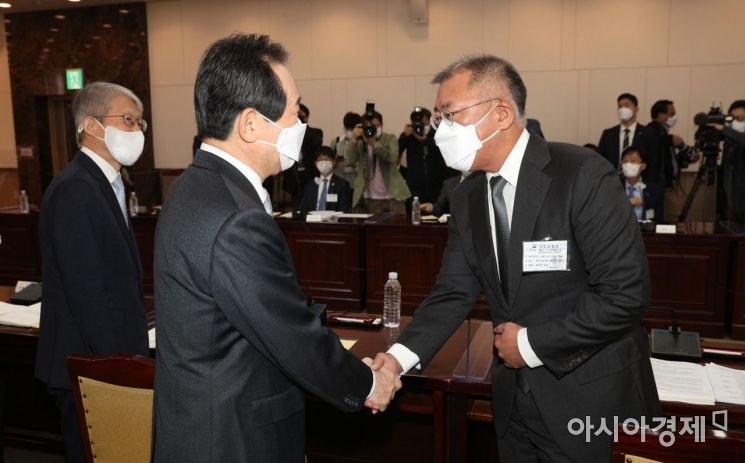 Prime Minister Chung Sye-kyun and Hyundai Motor Group Chairman Chung Eui-sun shaking hands at the '2nd Hydrogen Economy Committee' held on October 15 at the Government Seoul Office in Jongno-gu, Seoul. Photo by Kang Jin-hyung aymsdream@
To achieve carbon neutrality by 2050, the development of green hydrogen and carbon capture technologies is also urgent. The government has announced plans to grow the industry by introducing the world's first hydrogen power generation obligation system (HPS) by 2022, but domestic technology remains at the 'gray hydrogen' level. Gray hydrogen, produced from gas, makes it difficult to dramatically reduce carbon emissions.
Carbon capture technology is also a headache. The core is DAC technology that directly extracts carbon dioxide from the atmosphere using mechanical equipment, but it requires enormous energy and water.
In August, a research team led by Professor Andres Clarence of the Department of Systems and Environmental Engineering at the University of Virginia, USA, stated, "To keep the global temperature rise within 1.5 degrees Celsius above pre-industrial levels by 2050, global carbon emissions must be reduced to zero. Operating DAC devices for this would require 115% of the world's natural gas consumption and 35% of the water used for electricity generation."
'Report Submission Task' Completed, But...

Experts first emphasized the significance of fulfilling the promise made in the 2015 Paris Climate Agreement. According to the agreement, LEDS must be submitted to the United Nations (UN) within this year, so the first task has been accomplished. The government is expected to reflect the greenhouse gas reduction target (NDC) in the large '9th Basic Plan for Electricity Supply and Demand (9th Electricity Plan)' to be announced within this year.
There are still question marks over the adjustment of the greenhouse gas reduction target presented by the government on the day. The government did not raise the target to reduce greenhouse gas emissions from the current 709.14 million tons per year to 536 million tons by 2030. Although it is not a small amount, given that the goal has changed to '2050 carbon neutrality,' some point out that even this is too loose a target.
An energy sector expert pointed out, "It will be physically difficult to change the NDC for 2030 within this year." The government also conveyed only a general message in the additional LEDS review plan, stating, "We will accelerate social discussions and promptly promote the upward revision of the NDC."
© The Asia Business Daily(www.asiae.co.kr). All rights reserved.



















