Samsung Chairman Lee Kun-hee's Death Leads to Astronomical Samsung Family Inheritance Tax
Calls Grow to Revise World's Highest Inheritance Tax Rate That Forces Giving Up Corporate Management
[Asia Economy reporters Changhwan Lee and Dongwoo Lee] Since the passing of Samsung Chairman Lee Kun-hee, the enormous inheritance tax that Vice Chairman Lee Jae-yong and other family members must pay has come to light, reigniting controversy over South Korea's excessively high inheritance tax rates.
Due to the world's highest-level inheritance tax rates, some business owners are even giving up company management, increasing calls for tax system reform.
According to industry sources on the 18th, the value of shares held by Chairman Lee in major Samsung Group affiliates such as Samsung Electronics, Samsung Life Insurance, and Samsung C&T is estimated to be about 20 trillion won. Accordingly, the inheritance tax that Vice Chairman Lee and his family must pay amounts to approximately 12 trillion won. This is the largest inheritance tax in South Korean history.
As the massive inheritance tax Samsung must pay became known, the business community has repeatedly pointed out that South Korea's inheritance tax rate is excessively high compared to other countries, making corporate management difficult.
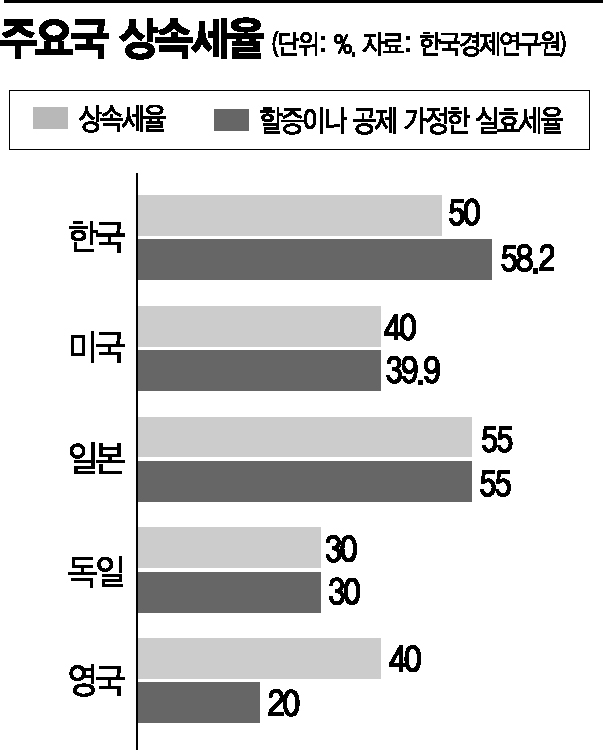
According to the Korea Economic Research Institute, South Korea's top inheritance tax rate is 50%, ranking second among OECD countries after Japan (55%). In South Korea, a 20% surcharge (for shares held over one year) is applied to the value of the largest shareholder's stock during business succession, which raises the top rate to 60%.
This is analyzed to be effectively the highest inheritance tax rate in the world. It is more than twice the OECD member country average of 25%. In contrast, the inheritance tax rates are around 40% in the United States and the United Kingdom, 30% in Germany, and 20% in the Netherlands. In Australia and Sweden, taxation is deferred until the inherited assets are disposed of, effectively resulting in zero inheritance tax.
Cases of Giving Up Management Rights Due to Excessive Inheritance Tax Are Increasing
There are also cases where management rights have been relinquished due to excessive inheritance tax. Unidus, a condom manufacturer, handed over management rights to a private equity fund in 2017 due to inheritance tax, and Lock&Lock, a container manufacturer, sold shares to a Hong Kong-based private equity fund in the same year. Three Seven, a nail clipper manufacturer, also transferred management rights from the largest shareholder in 2008 due to inheritance tax.
Although there is a business succession deduction system for small and medium-sized enterprises, the requirements are so strict that the number of cases and the amount utilized are very low. In particular, the requirement to maintain the industry, assets, and employment for 10 years after business succession is seen as a factor restricting adaptation and transformation in a rapidly changing economic environment.
Companies argue that business succession is not merely the inheritance of wealth but a means to contribute to national economic growth through the continuation of the company's existence, management philosophy, will, and job retention. Therefore, they claim that the government and political circles need to lower the inheritance tax rate.
Since advanced countries are also recently tending to lower inheritance tax rates, there are arguments that South Korea should also reduce the rate to lessen the burden. For example, Germany lowered the nominal inheritance tax rate for business succession from 50% to 30%.
Lee Kyung-sang, head of the Economic Research Department at the Korea Chamber of Commerce and Industry, said, "While the whole world is lowering inheritance tax rates, South Korea maintains one of the highest rates globally," adding, "Inheritance tax is more related to the necessity of business activities for corporate continuity than wealth accumulation, so policies to lower the top rate are needed."
© The Asia Business Daily(www.asiae.co.kr). All rights reserved.
![Clutching a Stolen Dior Bag, Saying "I Hate Being Poor but Real"... The Grotesque Con of a "Human Knockoff" [Slate]](https://cwcontent.asiae.co.kr/asiaresize/183/2026021902243444107_1771435474.jpg)











