KOSPI Breaks 2550, Approaching All-Time High
[Asia Economy Reporter Oh Joo-yeon] As the KOSPI surpassed 2550, moving one step closer to an all-time high, individual investors who had consistently been net buyers every month this year turned to net selling for the first time. It is interpreted that they have been realizing profits, having net sold more than 5 trillion won in the KOSPI market just this month.
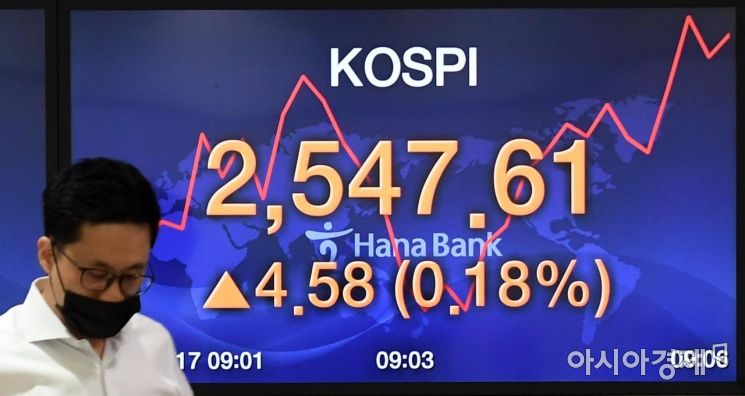 On the 17th, the status board in the dealing room of Hana Bank's headquarters in Jung-gu, Seoul, displayed the KOSPI and the KRW/USD exchange rate. On that day, the KOSPI opened at 2,544.12, up 1.09 points (0.04%) from the previous session. The KRW/USD exchange rate started at 1,107.0 won, down 2.3 won. Photo by Kim Hyunmin kimhyun81@
According to the Korea Exchange on the 17th, the KOSPI opened at 2544.12, up 0.04% (1.09 points) from the previous trading day, and recorded 2556.09 as of 9:51 a.m., breaking the previous high in just one day. This is the first time the KOSPI has risen above the 2550 level since February 2, 2018. Recently, the KOSPI has shown a steep upward trend, leading to expectations that it will surpass its all-time high. The all-time high of the KOSPI was 2607.10, recorded on January 29, 2018.
While foreigners have been net buyers of nearly 5 trillion won this month, individuals have net sold more than 5 trillion won. Individuals had continued net buying every month from January to October this year. In January, individuals started by purchasing stocks worth 4.48 trillion won in the KOSPI market, followed by 4.9 trillion won in February, totaling nearly 10 trillion won in net purchases over two months. Especially in March, when the COVID-19 pandemic caused the stock market to plunge, individuals bought as much as 11.19 trillion won worth of stocks, scooping up stocks that had experienced excessive declines.
The buying momentum of individual investors continued thereafter. Individuals steadily increased their holdings with 3.81 trillion won in April, 3.78 trillion won in May, 3.81 trillion won in June, and 2.24 trillion won in July. After the KOSPI reached the previous high level of 2450 in August and showed a correction, individuals expanded their buying scale, purchasing about 6.17 trillion won, nearly three times the previous month. In September and October, they net bought 4.97 trillion won and 1.27 trillion won respectively, accumulating a total of 46.6 trillion won worth of stocks over the past 10 months.
However, since the beginning of this month, except for two trading days, individuals have continued to sell every trading day. On a monthly basis, this is the first time this year that they have switched to net selling. From the 2nd to the 16th of this month, individuals sold stocks worth 5.4 trillion won. Although they had supported the index during this year's market downturn, earning the nickname "Donghak Ants," as the KOSPI approached not only the recent high but also the all-time high, it is interpreted that they are now realizing profits on stocks they had accumulated at low prices.
Although the scale of selling differs, the pattern of realizing stock profits when the market rises has continued in the past as well. During the 2017 bull market, individuals consistently showed net selling when the index rose. From April 21, 2017, when the KOSPI was at 2165.04, to July 21, when it rose to 2450.06, individuals net sold 1.9952 trillion won.
However, the buying momentum to increase holdings again whenever the index falls has become stronger than before. After the KOSPI reached 2450 in July 2017 and then fell to 2320 on September 6, individuals sold stocks worth 896.1 billion won, but in August this year, when the KOSPI dropped from a similar intraday level of 2450 to 2300, individuals net bought 1.6194 trillion won. Since then, whenever the market corrected from the previous high level, individuals have focused on scooping up stocks.
Expectations that the KOSPI will break its all-time high next year due to the normalization of economic activities following the use of COVID-19 vaccines, economic stimulus measures, and increased corporate earnings have led to continued demand to enter the market by seizing buying opportunities at low points.
Meanwhile, according to the Korea Financial Investment Association, investor deposits, which are standby funds for the stock market, decreased to 56.678 trillion won as of the 13th. On September 4, they reached an all-time high of 63.2582 trillion won.
© The Asia Business Daily(www.asiae.co.kr). All rights reserved.

















