[Asia Economy Reporter Kim Heung-soon] LG Uplus obtained approval from the Fair Trade Commission last November for its corporate merger with cable TV operator HelloVision. A month later, the Ministry of Science and ICT announced approval for the change of the largest shareholder and authorization for stock acquisition, finalizing the merger. The acquisition involved purchasing '50% +1 share' of HelloVision's stake for 800 billion KRW. At that time, HelloVision was valued at 1.6 trillion KRW, with about 4 million paid broadcasting subscribers, setting the per-subscriber value at approximately 400,000 KRW. Based on the stock acquisition amount, the per-subscriber value was about 200,000 KRW. About a year after the merger, how effective has LG Uplus's investment been? Industry insiders analyze that the combination of the two companies is producing successful synergy. This has also intensified the competition among telecom companies aiming to expand by acquiring cable TV operators put up for sale in the market.
"Increase in Subscriber Numbers and Business Diversification"
IPTV Performance Up 13.2% Year-on-Year
"Effects of Strengthened Negotiation and Sales Capabilities"
According to LG HelloVision on the 16th, as of the third quarter this year, HelloVision's cable TV subscribers numbered 4,152,000, an increase of more than 150,000 compared to before the merger with LG Uplus. During this period, the average revenue per user (ARPU) for cable TV subscribers was 7,139 KRW, and the digital cable TV ARPU was 9,460 KRW. When annualized, these amounts correspond to 85,668 KRW and 113,520 KRW respectively. These figures fall short of the per-subscriber value LG Uplus invested at the time of the merger.
Nevertheless, the operator claims that additional revenue and diverse businesses offset this. An LG Uplus official stated, "For popular latest video-on-demand (VOD) content, the payment per transaction is around 15,000 KRW, but among paid broadcasting subscribers, the number of those willing to pay extra to purchase desired content is increasing." According to LG Uplus, IPTV performance in the third quarter this year grew 13.2% year-on-year to 292.6 billion KRW, driven by increases in basic fees, VOD demand, and advertising revenue.
Another effect of the telecom and cable TV merger felt by the operator is strengthened negotiation power. A prime example is the negotiation with global online video service (OTT) Netflix, which was the first to partner with a domestic IPTV operator in 2018. An LG Uplus representative said, "When discussing contract terms with Netflix, having over 8 million subscribers now, including HelloVision, compared to the previous 4 to 5 million IPTV subscribers, gives us much stronger leverage at the negotiation table."
Additionally, "In small provincial cities where Uplus services have not yet expanded, cable TV subscriptions serve as a connection point to increase customer contact, providing more opportunities to recommend and sell other products such as rental services." In fact, LG HelloVision is strengthening its 'Hello Rental' business, which rents smart TVs, laptops, air purifiers, massage devices, and water purifiers. The number of subscribers to LG HelloVision's key business, the MVNO (Mobile Virtual Network Operator), also increased by 41.6% year-on-year to 1,469,000.
Telecom Companies Accelerate Additional Cable TV Mergers and Acquisitions
KT to Acquire Hyundai HCN
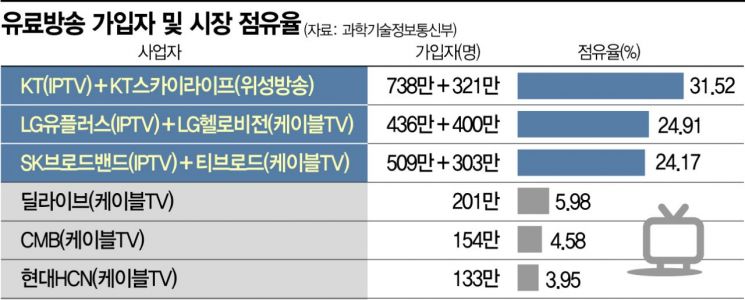
The effects of the telecom and cable TV merger have accelerated moves for additional mergers and acquisitions. The most active player is KT. Including satellite broadcasting KT Skylife subscribers, KT holds the top domestic paid broadcasting market share at 31.52%, and plans to acquire Hyundai HCN. Adding Hyundai HCN's market share (3.95%) would increase KT's share to 35.47%, widening the gap with competitors. The acquisition price is 491.1 billion KRW, with a per-subscriber value of about 370,000 KRW based on 1.33 million subscribers.
KT has also recently shown interest in acquiring D'Live, which holds a 5.98% market share (2.01 million subscribers). The bid price is reported to be around 700 billion KRW. SK Broadband, the third-largest player with a 24.17% market share, which acquired T-broad in April, and LG Uplus, the second-largest with a 24.19% share, could narrow the gap with KT if they acquire D'Live, but the high acquisition price is a significant obstacle.
Originally, D'Live's desired sale price was reported to be around 1 trillion KRW. An industry insider said, "Based on D'Live's asking price, the per-subscriber value is about 400,000 KRW, while KT's expected price is estimated around 300,000 KRW. Considering market conditions and previous merger results, it is expected that a fair price will be formed in the 300,000 KRW per subscriber range." Additionally, CMB, with a 4.58% market share (1.54 million subscribers), is also seeking additional sale targets.
© The Asia Business Daily(www.asiae.co.kr). All rights reserved.


















