Amid Capital Flows to Emerging Market Stocks, Korean Stock Market Stands Out
November's Highest Global Gains... Surpassing US Major Indices, China, and Taiwan Markets
Excellent COVID-19 Control and KRW-USD Exchange Rate Drop Boost Foreign Investor Interest
[Asia Economy Reporter Minwoo Lee] The KOSPI breaking through the 2,500 mark for the first time in two and a half years is analyzed to be due to the spreading positive sentiment of foreign investors toward the Korean stock market. Amid the flow of funds moving to emerging market stocks, the Korean stock market, which has strong COVID-19 quarantine measures, has been highlighted. Furthermore, with progress in COVID-19 vaccine development, expectations for economic recovery have grown, leading to predictions that a year-end rally may be possible.
According to the Korea Exchange on the 16th, as of 9:45 a.m., the KOSPI recorded 2,531.68, up 1.52% from the previous trading day. It has risen 10.07% since the beginning of this month. Since 2010, the KOSPI has only risen by double digits on a monthly basis twice: last April, when it was recovering from the crash caused by COVID-19, and this month. With the major shareholder threshold for capital gains tax remaining at 1 billion KRW, along with the resolution of uncertainties surrounding the U.S. presidential election and positive news such as Pfizer's development of a COVID-19 vaccine, attention has been drawn to the stock market. Additionally, the third-quarter earnings of companies announced on this day showed a favorable trend. Combined with optimistic domestic export forecasts, investors' expectations for economic recovery have been maximized.
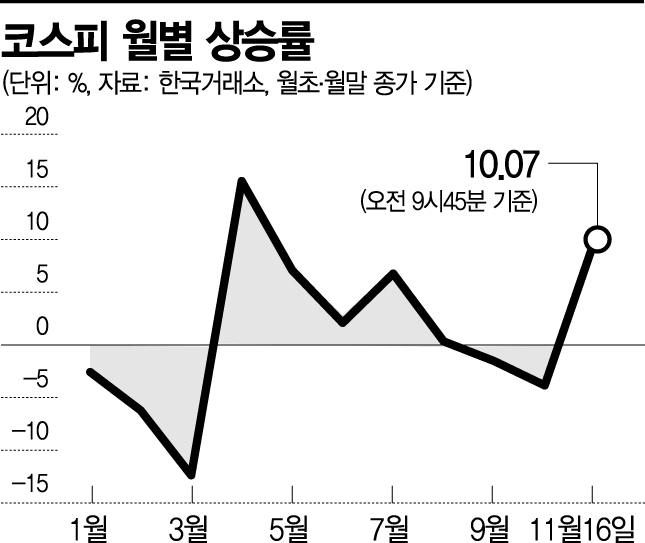
The domestic stock market's rate of increase stands out even when compared with major overseas countries. In Europe, although a clear upward trend has been seen this month, it had recorded significant negative returns since the beginning of the year. The Chinese and Taiwanese stock markets, which had higher returns than Korea from the start of the year until last month, rose by only 2.6% and 5.7% respectively this month. Regarding November's rate of increase, the KOSPI outperformed all three major U.S. indices: the Dow Jones Industrial Average (9.48%), the S&P 500 (8.3%), and the Nasdaq (7.95%). In other words, the domestic stock market is now rising the steepest among the world's major stock markets.
In particular, the recent upward trend has been led by foreigners. Since the beginning of this month, foreigners have net purchased stocks worth 4.3333 trillion KRW in the KOSPI market. This contrasts with the net selling of 27.8053 trillion KRW until last month this year. Researcher Kwanghyun Kim of Yuanta Securities analyzed, "This is because COVID-19 has been relatively well controlled, and the decline of the won against the dollar has increased the attractiveness of the domestic stock market."
The KOSPI is expected to continue its upward trend until the end of the year. Some even predict that the KOSPI could break through 3,000. Researcher Yujun Choi of Shinhan Financial Investment said, "The stock market has started to fluctuate sharply over the past two weeks, driven by the resolution of uncertainties following the U.S. presidential election, the possibility of a COVID-19 vaccine release, and growing expectations for economic recovery despite the resurgence of COVID-19. Since the relative strength of emerging market stocks compared to global stocks is still low, if the recent trend continues, the KOSPI could challenge an all-time high by the end of the year."
There is also analysis that for this upward trend to continue into next year, the liquidity-driven market must transition into an earnings-driven market. For this reason, the recently concluded Regional Comprehensive Economic Partnership (RCEP) is also considered a major positive factor. RCEP is the world's largest free trade agreement (FTA) involving 15 countries, including Korea, China, Japan, the 10 member countries of the Association of Southeast Asian Nations (ASEAN), Australia, and New Zealand. Researcher Hyoseok Lee of SK Securities explained, "Despite controversies over India's participation and China's role, it is meaningful that this agreement emerged in a situation where the East Asian region's role as a global production base is being highlighted after COVID-19, and the uncertainty over the U.S. presidency has not been completely resolved."
© The Asia Business Daily(www.asiae.co.kr). All rights reserved.
![Clutching a Stolen Dior Bag, Saying "I Hate Being Poor but Real"... The Grotesque Con of a "Human Knockoff" [Slate]](https://cwcontent.asiae.co.kr/asiaresize/183/2026021902243444107_1771435474.jpg)
















