Limited Edition Uniqlo Clothing Popular... Some Stores See Customers 'Lining Up' to Buy
"Aren't You Joining the Boycott of Japanese Products?" Criticism Arises
Complaints Also About Infringement on Personal Consumer Freedom
[Asia Economy Reporter Han Seung-gon] As people line up to buy limited edition Uniqlo clothing, controversy surrounding the boycott of Japanese products has flared up again.
In particular, seeing crowds flocking to Uniqlo, a brand considered a representative target of the boycott, some online communities have even issued harsh criticisms, calling them "dogs and pigs." On the other hand, there are counterarguments that the boycott cannot be forced and that it excessively infringes on individual consumer lifestyles.
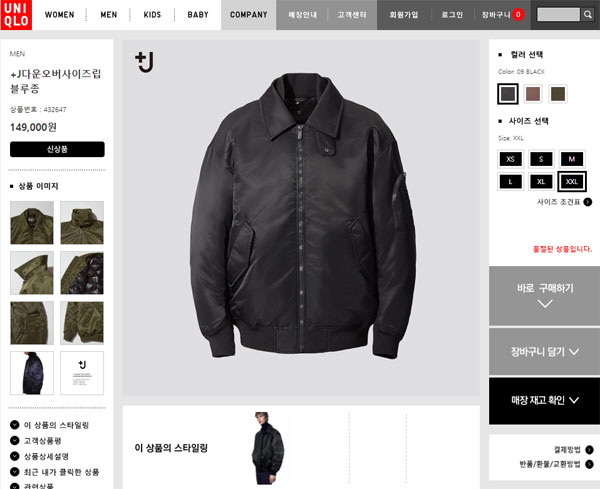
On the 13th, Uniqlo began selling the '+J' collection at its official online store, three Seoul stores including Myeongdong Central Branch, Lotte World Mall Branch, and Sinsa Branch, as well as three regional stores including Hyundai Department Store Pangyo Branch, Daegu Shinsegae Branch, and Busan Samjeong Tower Branch.
The +J (Plus J) collection is a collaboration product that Uniqlo has released annually since 2009 with the famous German designer Jil Sander. Due to this, some Uniqlo stores saw lines forming from early morning with people eager to purchase the items.
The reason for the popularity of the +J collection is that designer clothes can be purchased at prices ranging from 100,000 to 200,000 KRW. Similar events over the past 11 years have also seen buying frenzies and sold-out lines. Popular items such as the 'Oversized Rib Blouson' and 'Hybrid Down Oversized Parka' are sold out in all sizes.
However, some have issued harsh criticisms targeting these people, calling them "dogs and pigs." The criticism implies that the act of trying to buy Uniqlo clothes amid the boycott of Japanese products is unreasonable.
On the 4th, a similar criticism arose on an online community. A photo titled "Pigs Walking on Two Legs" was posted. The photo showed citizens lined up at a Uniqlo store to pay.
The poster criticized, saying, "It reminds me of George Orwell's novel Animal Farm," and "I can't believe I live in the same neighborhood as these dogs and pigs." This was a condemnation comparing citizens who do not participate in the boycott of Japanese products to "dogs and pigs."
Public opinion on the boycott of Japanese products is divided. Kim, a man in his 40s who works in an office, stated, "It's not just a simple boycott but a protest against a country that distorts our history."
He also emphasized, "It is a consumer rights movement with the will to 'correct history' beyond just a boycott." He added, "In the case of Uniqlo, the company’s CEO even mentioned that 'the boycott will soon end,' so the boycott should be even stronger. I find those lining up quite pathetic."
On the other hand, there are opposing views. There is criticism that the boycott of Japanese products is being effectively forced. Park, a man in his 30s working at a company, said, "The controversy over forcing the boycott seems like an old debate," and criticized, "I think it is an excessive infringement on individual consumer activities." He added, "Once the boycott becomes forced, it is no longer a boycott but a kind of social movement. I hope individual freedom is not infringed."
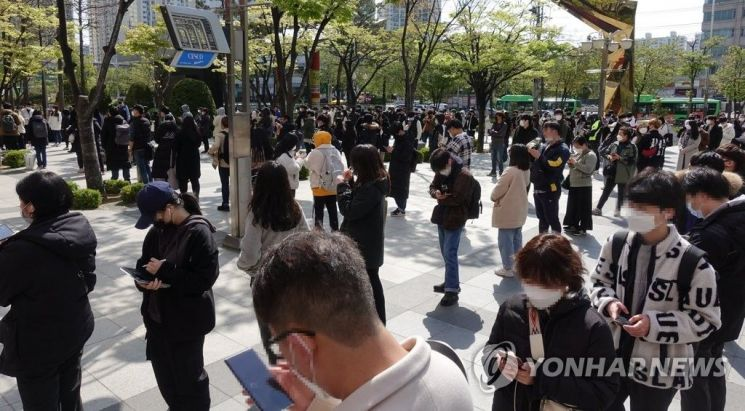 On the morning of April 23, citizens lined up in front of Sindorim Techno Mart in Guro-dong, Guro-gu, Seoul, to enter a lottery for purchasing the Nintendo Switch Animal Crossing edition.
 [Image source=Yonhap News]
This is not the first time there has been controversy over forcing the boycott of Japanese products. Similar to the long lines to buy Uniqlo clothing this time, in April at Techno Mart in Sindorim, Guro-gu, Seoul, long lines formed from early morning on weekdays to purchase the game 'Animal Crossing.'
At that time, the 'Animal Crossing' lottery event was scheduled to start at 10:30 a.m., but by 9 a.m., about 300 people had already gathered before the opening. Also, on some online shopping malls, 'Animal Crossing' was traded at more than twice the retail price, sparking a so-called 'Dongsoop' craze.
Additionally, the console game 'PS5' experienced some sold-out situations due to high popularity. In October, Sony Interactive Entertainment supplied additional PS5 units after a shortage during pre-orders.
The company announced on its official Twitter, "We plan to supply more PS5s for pre-orders," and "More PS5s will be available by the end of this year," showing that 'PS5' is also very popular like 'Animal Crossing.' However, even then, criticism arose asking why people were not boycotting Japanese products.
Experts say that while the boycott cannot be forced, they urge consumers to continue prudent consumption. Professor Seo Kyung-deok of Sungshin Women's University wrote on his Facebook, "The boycott can never be forced. I also respect individual choices," but added, "However, I hope we think once more. Last year, photos of people lining up in front of Uniqlo stores were shared in Japan, and Japanese netizens gave a lot of criticism and ridicule."
© The Asia Business Daily(www.asiae.co.kr). All rights reserved.
![Clutching a Stolen Dior Bag, Saying "I Hate Being Poor but Real"... The Grotesque Con of a "Human Knockoff" [Slate]](https://cwcontent.asiae.co.kr/asiaresize/183/2026021902243444107_1771435474.jpg)


















