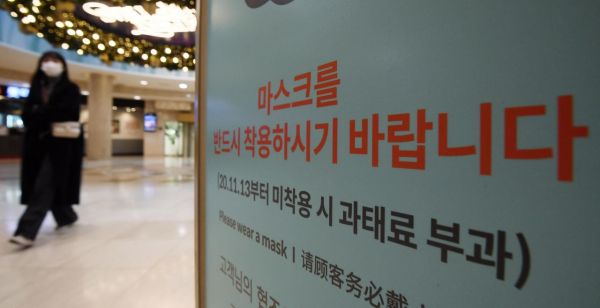
 On the 13th, when the mask-wearing mandate was fully enforced, related notices were installed at Lotte Department Store in Jung-gu, Seoul. Photo by Kim Hyun-min kimhyun81@
[Asia Economy Reporter Seungjin Lee] The performance report of the distribution industry for the third quarter of this year, affected by the novel coronavirus infection (COVID-19), has been released. With the spread of non-face-to-face consumption culture, home shopping continued its growth trend. Department stores, large supermarkets, and convenience stores, which saw a sharp decline in the second quarter, rebounded in the third quarter, but some still have not escaped the aftermath of COVID-19.
Avoided the Worst Second Quarter... But Disappointing Results
According to the distribution industry on the 14th, department stores, which recorded the worst-ever performance in the second quarter this year, all succeeded in rebounding in the third quarter. This was due to increased spending on luxury goods as overseas travel was blocked by COVID-19. Also, with more people staying at home, consumers looking to replace home appliances and furniture increased. On the other hand, clothing, a core product category of department stores, has not recovered in sales due to the atmosphere of refraining from going out, so the outlook for the fourth quarter is not bright.
Shinsegae recorded consolidated sales of 1.2144 trillion KRW and operating profit of 25.1 billion KRW in the third quarter of this year. Compared to the previous quarter, sales increased by 19.7%, and operating profit turned positive with an increase of 68.2 billion KRW. This improvement in performance was led by the recovery of large department store branches such as the Gangnam branch. The third-quarter sales of the department store business were 363.8 billion KRW, down 5.5% year-on-year but up 2.8% quarter-on-quarter, entering a recovery phase.
However, Shinsegae's third-quarter results decreased by 24.2% and 73.8%, respectively, compared to the same period last year, indicating that offline store sales are still sluggish due to the impact of COVID-19. In particular, the duty-free shop showed a recovery trend with a 52% increase quarter-on-quarter, but operating losses remained at 20.5 billion KRW, maintaining a deficit management status.
Lotte Department Store's third-quarter sales were 619 billion KRW, and operating profit was 78 billion KRW, down 15.5% and 25.2%, respectively, compared to the same period last year. However, this is hopeful compared to the first half of this year (January to June). In the first and second quarters, the decrease in operating profit compared to the same period last year was 74.6% and 98.5%, respectively.
Hyundai Department Store's department store division recorded third-quarter sales and operating profit of 430.5 billion KRW and 56.4 billion KRW, down 6% and 27.4%, respectively. Considering that the second quarter's department store sales and operating profit were 424.5 billion KRW and 26.2 billion KRW, down 10.3% and 62.5% year-on-year, the situation has greatly improved.
A department store industry official said, "Fashion sales, centered on women's clothing, are still not rebounding, and the sales damage up to the third quarter is so significant that it will take considerable time for a real recovery." He added, "However, with the easing of social distancing in the fourth quarter and large events such as Korea Sale Festa, consumer sentiment is expected to recover."
Convenience Stores and Large Supermarkets: Clearing Skies After Clouds
Emart recorded consolidated sales of 5.9077 trillion KRW and operating profit of 151.2 billion KRW in the third quarter of this year. Sales increased by 16.7% year-on-year, and operating profit increased by 30.1%. In particular, subsidiaries such as Traders, specialty stores, and Emart24, as well as Emart stores, saw significant increases in sales and operating profit.
By division, Emart's operating profit increased by 11.1% year-on-year, marking positive growth for the first time since the fourth quarter of 2017. The strategy to strengthen grocery and expand customer-centered stores, steadily implemented since last year, paid off. Traders recorded high growth with third-quarter sales up 27.9% year-on-year and operating profit up 83.2%.
Lotte Mart, which accelerated the closure of underperforming stores this year, succeeded in rebounding in the third quarter. Lotte Mart recorded an operating loss of 57.8 billion KRW in the second quarter due to the direct hit from COVID-19. However, by boldly closing underperforming stores, it posted an operating profit of 32 billion KRW in the third quarter, a 160.5% increase year-on-year. Including the Guro and Dobong branches closing on the 30th of this month and the Daegu Chilseong branch scheduled to close by the end of the year, Lotte Mart will have closed 12 stores.
Convenience stores, which saw a sharp decline in operating profit in the second quarter due to COVID-19, reduced the decline in the third quarter and approached last year's performance level. BGF Retail, which operates CU, recorded third-quarter operating profit of 63.7 billion KRW, down 1.7% year-on-year. Compared to the second quarter, performance greatly improved, with operating profit increasing by 19.2 billion KRW from 44.5 billion KRW in the second quarter.
A BGF Retail official explained, "The impact of COVID-19 peaked in the second quarter, with special stores and stores in provincial areas hit hard, but this was partially alleviated in the third quarter." He added, "In addition, store efficiency improvements and 'hit products' such as Peontorang and GomPyo beer drove the performance."
GS Retail, which operates GS25, also reduced the decline and started to rebound in the third quarter. GS Retail's third-quarter operating profit was 79 billion KRW, down 11.6% year-on-year. Compared to the second quarter, when operating profit plummeted 23.2% year-on-year, the decline was somewhat reduced. GS Retail analyzed that some costs increased due to management support funds for store owners amid the resurgence of COVID-19, and sales of low-margin tobacco and instant foods increased, affecting operating profit.
Longest Rainy Season Brings 'Clear Skies' for Home Shopping
The third quarter, when summer vacations and autumn outings increase, is traditionally considered an off-season for the home shopping industry. However, this year, due to the longest rainy season on record and the implementation of social distancing level 2.5 in the metropolitan area, consumers staying at home increased, resulting in good performance.
The third-quarter operating profits of the four major home shopping companies?CJ ENM Commerce Division (CJ O Shopping), GS Home Shopping, Hyundai Home Shopping, and Lotte Home Shopping?all exceeded 30 billion KRW. CJ O Shopping's operating profit was 42.4 billion KRW, up 44.2% year-on-year, and GS Home Shopping's separate basis operating profit was 38.3 billion KRW, up 94.3%. Hyundai Home Shopping's separate operating profit was 34.8 billion KRW, up 30.0%, and Lotte Home Shopping's separate operating profit was 30 billion KRW, up 18.7%.
Sales of traditionally high-margin product categories such as beauty, fashion, and travel were sluggish. However, the crisis was overcome by increasing the handling of food, living, baby and child, and health food categories, which saw increased demand due to COVID-19. Increasing the handling of high-margin products such as private brands (PB) also proved effective.
Growth in the mobile sector was also remarkable. GS Home Shopping's mobile shopping reached 629.2 billion KRW, up 15.7% year-on-year, driving the total transaction amount. GS Home Shopping's mobile shopping app recorded 38 million downloads excluding duplicates. CJ O Shopping's digital division sales also increased by 24.7% to 155.2 billion KRW.
© The Asia Business Daily(www.asiae.co.kr). All rights reserved.

















