69.2% of Job Seekers Prioritize Work-Life Balance Over Monetary Compensation
Employees Say "Even If Other Conditions Are Good, They Consider Quitting If Work-Life Balance Collapses"
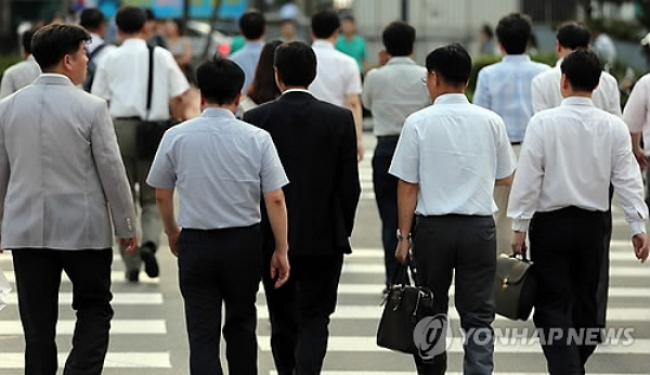
[Asia Economy reporters Han Seung-gon and Kim Young-eun] "Happiness lies in work-life balance.", "I think my life comes before money."
Recently, the number of office workers who value 'work and life balance (work-life balance)' has been increasing.
According to employment platforms JobKorea and Albamon, 2 out of 5 job seekers have experienced a change in their views on work. Among respondents, 39.1% answered that "their existing beliefs and values about work have changed since COVID-19."
On the other hand, 34.8% said "there was no significant change or impact," which was lower, and 26.1% said "their existing views on work have become more solid."
According to the survey, among 496 respondents, 69.2% answered that "after COVID-19, my health and work-life balance are more important than financial compensation." Conversely, only 30.8% felt that "financial compensation is more important than work-life balance."
Similarly, work-life balance was chosen as the most important value when selecting a workplace in the future.
26% of respondents chose "work-life balance: a life with evenings, ensuring a balance between work and life," followed by "economic compensation: sufficient financial rewards, satisfactory salary (22.2%)." Then came "stability: guaranteed employment stability to work steadily and long-term (13.3%)," and "sense of achievement in work: feeling rewarded by the work (8.9%)," among others.
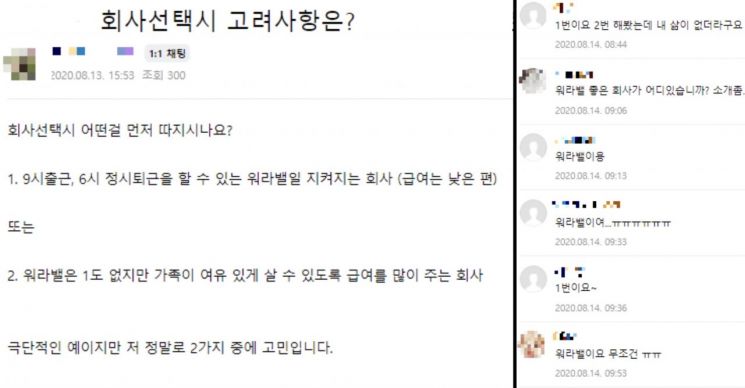
On an online community site for office workers, a post titled "Which would you choose: a company with low salary but preserved work-life balance vs. a company with no work-life balance but high salary?" was posted, and comments included responses such as "Work-life balance is absolutely the best," "After working for a long time, work-life balance seems more important than anything," and "I'm considering quitting because my company does not respect work-life balance at all," showing the importance placed on work-life balance.
Office worker Mr. Kim (50) said, "Due to the nature of my work, I do irregular shift work, and although I have been doing this for quite a long time, adapting to the daily changing lifestyle patterns is still difficult," adding, "If I can find a job again, I want to find a workplace with fixed commuting hours and time for myself after work."
Another office worker, Mr. Choi (25), said, "Recently, sudden increases in overtime and weekend work have made my days really tough because my days off are not guaranteed," adding, "The salary is not bad, and my colleagues are great, but if work-life balance continues to collapse like this, I am worried whether I can keep doing this job. Work is not everything in life, so I prefer to pursue working while living a life worth living."
Meanwhile, according to a 'Human Resource Management Policy Survey' by the recruitment platform Saramin on the 12th, companies attempting to change work-life balance are relatively few, contrary to the demands of office workers.
Among 309 domestic companies surveyed, the top priority in HR management policies since the COVID-19 era was "expansion of telecommuting and remote work (37.7%/multiple responses)." This was followed by "reduction of open recruitment and expansion of on-demand recruitment (33.5%)," "introduction of non-face-to-face methods in overall HR including recruitment (25.7%)," "regular personnel redeployment (25.1%)," "encouragement of casual dress and refresh leave (16.8%)," and "operation of radical evaluation and compensation systems (12%)." After these items, "strict adherence to work-life balance (11.5%)" ranked eighth.
In this regard, the Ministry of Employment and Labor announced that since last month, it will actively support the spread of flexible work environments and work-life balance work culture by holding contests to promote innovative cases related to work culture.
© The Asia Business Daily(www.asiae.co.kr). All rights reserved.