Coca-Cola Ready Bag Sold Out Frenzy After Launch
Queues for Online and Offline Purchases with Resale Phenomenon
Starbucks Limited Edition Goods Sell 30,000 Units in Two Days
Experts Say "MZ Generation Consumption Acts as a Kind of Play"
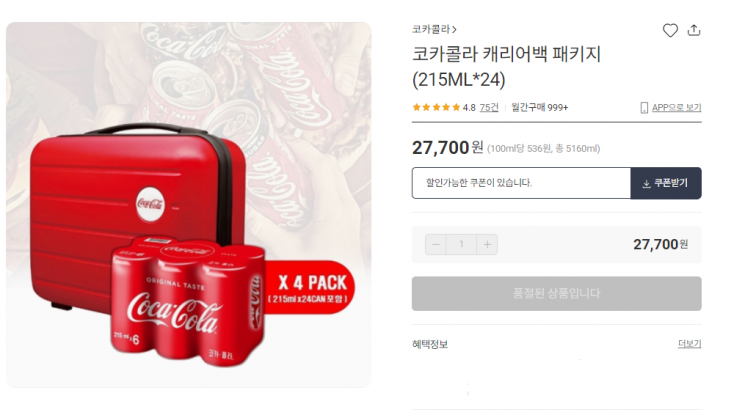 On the 12th, Coca-Cola Ready Bag sold on the online Lotte Mart Mall was sold out. Photo by Lotte Mart Mall capture
[Asia Economy reporters Han Seung-gon and Kim Young-eun] The field that was once hotly interested in the consumption of 'limited edition goods' is expanding beyond the fashion industry such as clothing and shoes to franchise cafes and the alcoholic beverage industry. As a result, consumer interest in purchasing limited edition goods is gathering attention. Experts interpret that the scarcity of limited editions raises consumer interest and that it is also consumed as a kind of play.
According to the industry on the 12th, 'Coca-Cola' released a limited edition ready bag. On that day, 'Coca-Cola Ready Bag' rose in the real-time search rankings on portal sites, proving consumer interest.
This product is a mini carrier bag package including 24 cans of 215mL cola and stickers, and it quickly sold out as soon as sales began. Not only was it sold out online, but buyers flocked to large supermarkets where stock varied by store, causing a sell-out situation.
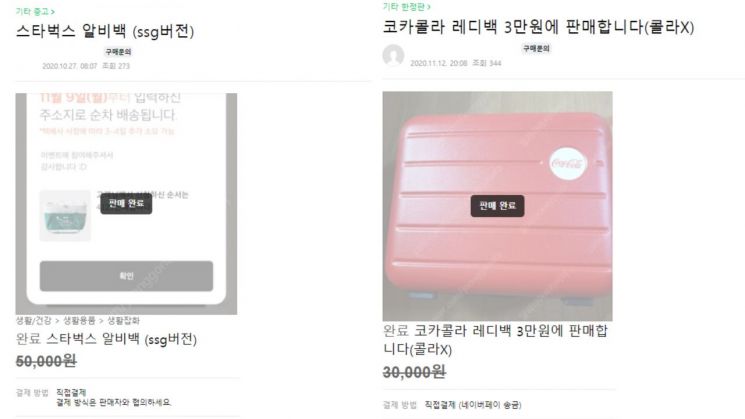
After the sell-out frenzy, posts appeared on secondhand trading sites offering to resell the product at prices higher than the regular price of 27,700 won. This is a resell phenomenon where limited edition goods with scarcity are bought and then resold at a high price.
Also, on online cafes and local communities, posts such as "There were people lining up before the opening, and they were all trying to buy the Coca-Cola Ready Bag. It was one per person, and now that it's sold out, I'm posting this so you don't make a wasted trip," and "I called around and went to several stores, but there is none. I really want to get one, so please sell me just one if you have it," continued to appear.
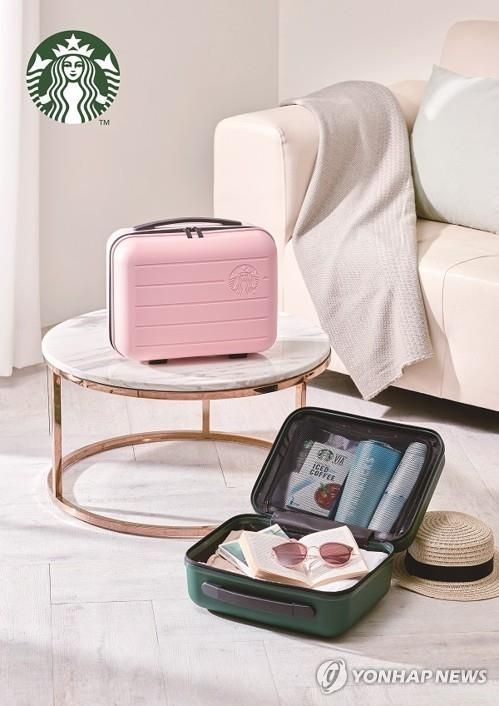
Earlier last month, Starbucks, a cafe industry famous for consistently releasing limited edition goods such as tumblers, towels, and diaries by season, released a limited edition insulated bag called the Ready Bag. More than 30,000 units were sold within two days, and the stock was quickly depleted.
Starbucks also held an event from June for a month where customers who purchased a total of 17 drinks, including seasonal beverages, received a limited edition Ready Bag on a first-come, first-served basis, and long lines formed in front of Starbucks stores nationwide from early morning.
In particular, at the Starbucks Yeouido branch in Seoul, a phenomenon occurred where one customer ordered 680 drinks to receive limited edition goods, showing the intense popularity of limited edition goods. Those who still could not get them traded the products on secondhand sites at prices two to three times higher than the regular price.
Among people purchasing goods, there is a public opinion survey result that they are willing to actively purchase as long as they can buy the goods, even if it means waiting for a long time to buy the product.
According to the '2020 Goods Trend' survey conducted by job search sites JobKorea and AlbaMon in August, 58.8% of respondents said they purchase goods because they like the feeling of owning limited edition products, and 50.2% responded that they are willing to invest time such as lining up early to buy goods.
The consumers of this limited edition goods craze range widely from students to office workers, but it seems to be causing a frenzy especially among the MZ generation, which has a developed consumer culture.
According to a survey conducted last month by the job search site 'Alba Heaven' targeting 1,698 people in their teens and twenties, 74.4% of respondents had experience consuming brand goods. Furthermore, 67.3% of respondents said they had made unplanned purchases because of goods.
Experts analyzed that among the consumption tendencies of the 'MZ generation,' 'gasimbi' (emotional cost-effectiveness) which values personal satisfaction over price, 'gajaembi' (fun cost-effectiveness) which pursues fun relative to price, 'value consumption,' and 'self-satisfaction' play important roles, and that it is characteristic for them to enjoy spending money or time on consumption in fields they like without hesitation.
The MZ generation refers to the combined group of Millennials born between 1980 and 2004 and Generation Z born between 1995 and 2004.
Professor Lee Eun-hee of Inha University’s Department of Consumer Studies said, "Consumers have a tremendous desire and enthusiasm for the very concept of limited edition goods," adding, "With the activation of SNS, especially among the MZ generation, consumption has gone beyond just functional consumption and has become a form of play."
She continued, "Posting on SNS about 'getting a great deal' on limited edition goods or sharing experiences like 'waiting for hours to get it' means that the process of consumption itself has become a medium of play and communication," explaining, "Therefore, enjoying buying the limited edition goods they want has become fun, and that consumer psychology has turned into a kind of play."
© The Asia Business Daily(www.asiae.co.kr). All rights reserved.



















