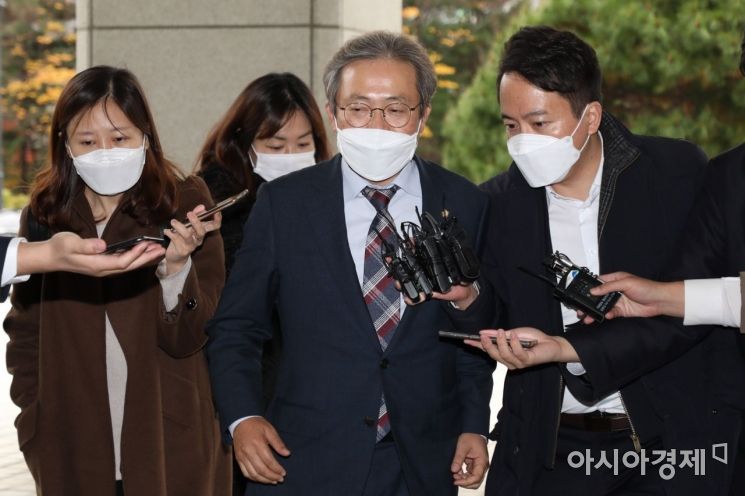
 On the 9th, during the on-site verification of the prosecution and Ministry of Justice's special activity expenses by the National Assembly's Legislation and Judiciary Committee, Song Ki-heon, a member of the Democratic Party of Korea, entered the Supreme Prosecutors' Office in Seocho-gu, Seoul. Photo by the National Assembly Press Corps
[Asia Economy Reporter Park Cheol-eung] Moves to relocate financial public institutions based in Seoul, such as the Korea Development Bank, Industrial Bank of Korea, and Export-Import Bank of Korea, to provincial areas are gaining momentum. With the by-elections next year and the 2022 presidential election approaching, the ruling party is leading the start of 'Season 2' of public institution relocations to the provinces.
According to the National Assembly on the 13th, Song Ki-heon, a member of the Democratic Party of Korea, has each proposed three bills to stipulate the head office locations of these banks in their respective articles of incorporation rather than by law. Currently, the law specifies that their head offices must be in Seoul, but these bills aim to loosen this restriction to provide legal support for relocation to provincial areas.
Song, who serves as the ruling party representative of the 'Bipartisan Assembly for Innovation and Enterprise City Development,' explained, "Although additional relocations of public institutions are planned, the current law specifies the head office location as Seoul. By allowing the head office to be determined by the articles of incorporation, we aim to alleviate overcrowding in the metropolitan area and contribute to balanced national development."
During the 20th National Assembly, bills to relocate the Korea Development Bank and Export-Import Bank to Jeonbuk and Busan, and the Industrial Bank of Korea to Daegu, were proposed by local district lawmakers but were discarded. Now, in the 21st National Assembly, bills for relocation have re-emerged. With the by-elections in April next year and the 2022 presidential election approaching, discussions are expected to accelerate. Democratic Party leader Lee Nak-yeon stated in his September 9th parliamentary negotiation group leader speech, "We will promptly promote the second phase of public institution relocations and the additional designation of innovation cities."
The Democratic Party's 'Balanced Development and Administrative Capital Completion Task Force' plans to announce relocation plans for some government organizations and public institutions within this month. A task force official said, "While major institutions like Korea Electric Power Corporation have largely moved out, financial institutions including the Korea Development Bank still remain," adding, "We will present plans for Season 2 of public institution relocations to the provinces." On the 11th, Task Force leader Woo Won-shik mentioned at a press conference, "We are reviewing various scenarios to promote regional development strategies, the administrative capital Sejong, and the global economic capital Seoul."
The National Balanced Development Committee is known to have been conducting detailed reviews for the second phase of public institution relocations. Since August, it has also been conducting external research titled 'National Balanced Development Strategy for Asia Financial Hub Policy after the Hong Kong National Security Law.' Since this proposes an Asia financial hub strategy from a balanced development perspective, it aligns with the relocation of financial public institutions to the provinces.
The Nuclear Safety and Security Commission, located in Seoul, has also become a 'hot potato.' When rumors of relocation to Sejong City surfaced, lawmakers from the Yeongnam region of the People Power Party and local governments jumped into the competition to attract it. Hwang Bo-seung-hee, a People Power Party lawmaker representing Busan, said, "The government is recently considering relocating the Nuclear Safety and Security Commission, located in Jongno-gu, Seoul, to Sejong City or Daejeon City, where the Ministry of Trade, Industry and Energy is located," and proposed a bill earlier this month to designate the relocation site within 30 km of locations where power reactors and related facilities are installed. Busan's Gijang County, Gyeongju City, and Ulsan City are known to be actively involved.
Meanwhile, at the Supreme Council meeting that day, Lee Nak-yeon said, "At the on-site Supreme Council meeting to review balanced development and regional issues, we listened to many proposals and requests. I hope the follow-up measures will be expedited," adding, "The most frequently raised issues were the creation of regional mega-cities and the construction of metropolitan railway networks."
He continued, "It is a bold vision that will enhance regional competitiveness and contribute to balanced development," and said, "It will require a significant budget. Although it is not an easy task, I hope the central party will devise support measures."
© The Asia Business Daily(www.asiae.co.kr). All rights reserved.
![Clutching a Stolen Dior Bag, Saying "I Hate Being Poor but Real"... The Grotesque Con of a "Human Knockoff" [Slate]](https://cwcontent.asiae.co.kr/asiaresize/183/2026021902243444107_1771435474.jpg)
















