2.1043 Trillion KRW in Mortgage Loans Secured by Housing Subscription Savings at 5 Major Banks
Over 18% Increase Compared to One Year Ago
[Asia Economy Reporter Park Sun-mi] Choi Jun-hyuk (45, pseudonym), whose business suffered due to the novel coronavirus disease (COVID-19) situation and whose finances became tight, needed urgent funds and tried to get a personal loan. However, he decided to utilize the money dormant in his Housing Subscription Savings account and applied for a loan. The applied loan interest rate was 1.91% per annum. With about 14.42 million KRW in the account, he was eligible for a loan up to the limit of 13.6 million KRW.
The scale of loans secured by Housing Subscription Savings is rapidly increasing. This is interpreted as a result of more people needing urgent funds due to the prolonged COVID-19 crisis, as well as a social atmosphere that encourages investment even by 'debt investment (debt-to-invest)' or 'pulling together all resources (Yeongkkeul)'.
According to the banking sector on the 12th, as of the end of October, the outstanding balance of loans secured by Housing Subscription Savings at five major commercial banks?KB Kookmin, NH Nonghyup, Shinhan, Woori, and Hana?recorded 2.1043 trillion KRW. Maintaining a rapid monthly increase, this is more than an 18% rise compared to 1.7732 trillion KRW a year ago.
Loans secured by Housing Subscription Savings fall under deposit-secured loans. Borrowers can receive 90-95% of the saved amount, and since only the principal is used as collateral, taking out a loan does not affect the subscription function. As the number of Housing Subscription Savings subscribers has exploded, it has become difficult to win new apartment subscriptions without a high score. Consequently, there is a growing trend of postponing account cancellation and only withdrawing the saved money for use.
Housing Subscription Savings Subscribers Surpass 25 Million
More Than Half of the Total Population 'Subscribed'
According to the Korea Real Estate Agency’s Subscription Home subscription account status, as of the end of September, the number of nationwide Housing Subscription Savings subscribers reached 25,127,182, surpassing 25 million for the first time, which is half of South Korea’s total population.
Subscribing to Housing Subscription Savings and receiving a new home is perceived as an opportunity to secure a home at a price lower than the surrounding market price, leading to a continuous increase in subscribers. If the 'debt investment' and 'Yeongkkeul' atmosphere continues, the scale of loans secured by Housing Subscription Savings is also expected to increase.
Unlike the past when interest rates were unreasonably high, the current interest rates, which are not significantly different from general deposit-secured loans and personal loans, are also one of the reasons for increased utilization.
Interest Rates Similar to General Deposit-Secured Loans and Personal Loans
Banks Apply Rates Around 1.9~2.3%
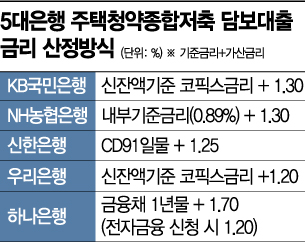
In 2014, the interest rates on loans secured by Housing Subscription Savings at banks were around 4-5%, which was criticized for being more than 1 percentage point higher than the general deposit-secured loan rates of about 3% per annum at that time. However, the current interest rate calculation method for loans secured by Housing Subscription Savings has changed, with KB Kookmin Bank and Woori Bank applying a method of adding a 1.2-1.3% margin to the COFIX rate.
NH Nonghyup Bank sets loan interest rates by adding 1.30% to an internal base rate (0.89%), Shinhan Bank adds 1.25% to the 91-day CD rate, and Hana Bank adds 1.20-1.70% to the 1-year financial bond rate as margins.
The five major banks apply loan interest rates around 1.9-2.3% per annum, which is similar to personal loan interest rates formed at 2-2.5% for credit grade 1. For general deposit-secured loans, the interest rate is set by adding 1.0%-1.25% to the deposit interest rate, and considering that current bank deposit rates are around 0.5-1%, the levels are comparable.
An official from a bank said, "Due to concerns about excessive debt increase, financial authorities have imposed measures to limit the total increase in personal loans across banks to around 2 trillion KRW per month. As a result, for the time being, the demand for loans from customers needing urgent funds is likely to expand from personal loans to deposit-secured loans, especially those secured by Housing Subscription Savings." The official also added, "There is also a perception that taking out loans secured by saved money is more advantageous for credit management than taking personal loans, which may increase demand among those needing urgent funds."
© The Asia Business Daily(www.asiae.co.kr). All rights reserved.

















