[Asia Economy Reporter Seulgina Jo] Laws that have been vigorously promoted to prevent reverse discrimination between global IT giants like Netflix and Google and domestic companies are turning out to be a series of false starts. The "Netflix Free Riding Prevention Act (Amendment to the Telecommunications Business Act)," which is set to be enforced in a month, has been reduced to a patchwork as key provisions are being deleted one by one following the disclosure of detailed enforcement ordinances. The "Google Gapjil Prevention Act," which was the biggest issue in this year's National Assembly audit, has become uncertain even for the approval of the integrated bill by the standing committee in just over a month. There are painful criticisms that the institutional foundation for fair industrial development is being shaken by lobbying from global companies.

Netflix Act, Major Measures to Be Deleted?
According to the Ministry of Science and ICT and the industry on the 12th, concerns have been raised that the enforcement ordinance of the amendment to the Telecommunications Business Act, which imposes service stability obligations on global content providers (CPs) such as Netflix and YouTube (Google), has retreated ahead of the Regulatory Reform Committee review scheduled for the 13th. Key measures originally discussed are being deleted or relaxed.
The draft enforcement ordinance announced for legislative notice last September included a provision (Article 4 of the enforcement ordinance) requiring value-added telecommunications service providers, who are subject to the law, to submit an annual report on the implementation status of service stability measures to the government. However, the recent revised version ahead of the Regulatory Reform Committee review confirmed that this regular data submission obligation has been deleted. Another key measure under pressure for revision is the selection criteria for entities subject to the law and the provision requiring global CPs to notify in advance when changing traffic routes in consultation with telecommunications carriers.
The problem is that this provision is an essential measure to check the implementation status of network stability obligations. Even though the existing enforcement ordinance has been criticized for its "20 million KRW fine" being a slap on the wrist, if key measures are deleted, it will inevitably become more difficult to secure the effectiveness of the legal system.
Currently, instead of Article 4 being deleted, it is likely that the Ministry of Science and ICT will request data submission from operators retrospectively if service failures or interruptions occur. However, in this case, operators can refuse to submit data, and there is a fundamental problem that the Ministry cannot grasp the situation at all until actual user damage occurs. An industry insider pointed out, "As the enforcement ordinance becomes a patchwork, the beneficiaries will be the global CPs."
Google Gapjil Prevention Act Also Losing Momentum
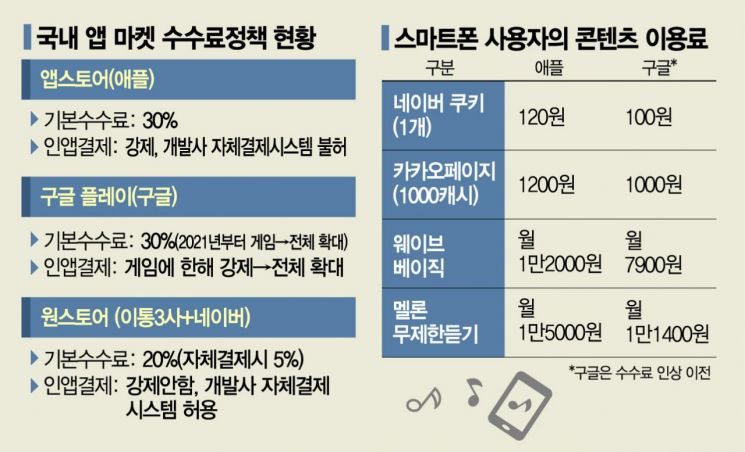
The Google Gapjil Prevention Act, which arose when Google formalized its intention to force its own payment method through its app market Google Play and take a 30% commission on sales, is also stagnating.
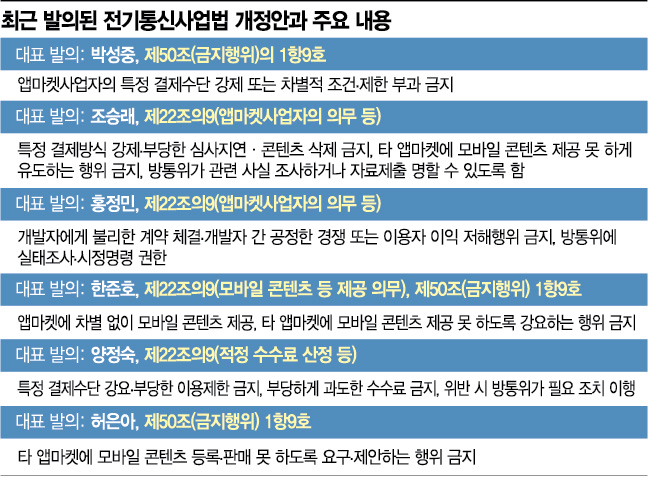
The National Assembly's Science, ICT, Broadcasting and Communications Committee (Science Committee) unusually held a second subcommittee during last month's National Assembly audit period and agreed to pass the amendment to the Telecommunications Business Act to prevent this, but it was ultimately scrapped. Some speculate that Google persuaded National Assembly members, mainly from the opposition party, by deploying large law firms, creating opposition to the amendment. Park Seong-jung, the People Power Party's floor leader who proposed the related bill, also put the brakes on citing the possibility of "hasty processing."
Behind the rapidly changing atmosphere, there are suspicions of lobbying and pressure from the U.S. Embassy and law firm Kim & Chang, which represents Google. During meetings with members of the Science Committee, conversations reportedly included mentions that the bill might violate the Korea-U.S. Free Trade Agreement (FTA) and implied trade pressure.
Google Korea showed an arrogant attitude against our system during the last National Assembly audit by stating that "if the amendment is passed, the business model may change," but in the end, the National Assembly surrendered. Assemblyman Han Junho of the Democratic Party criticized, "Google is coercing domestic game developers to express opinions favoring itself."
If Google enforces the in-app payment and 30% commission policy starting next year, not only will the burden on app developers increase, but price hikes for major content such as webtoons and music will also be inevitable. The Korea Startup Forum urged prompt passage of the amendment in a statement yesterday, saying, "Google's unfair practices shrink the entire content industry in our country and threaten the interests and survival of related industry workers."
To prevent the gapjil of global IT giants who evade network usage fees and tax obligations by exploiting legal blind spots despite their overwhelming market influence, it is most important to establish legal grounds for regulation and secure enforcement power. Professor Choi Kyung-jin of Gachon University Law Department suggested, "The most important thing in regulating overseas operators is sustainability," adding, "The government must consistently maintain a regulatory stance to protect our people and industry and make overseas operators recognize this."
These are not the only cases where enforcement power does not reach global IT giants, causing controversy over reverse discrimination against domestic companies. Even the so-called n-bang Prevention Act mandates crackdowns on illegal filming materials for companies like Naver, but Telegram cannot even be monitored. Also, foreign IT giants registered as limited liability companies have limits in taxation because their exact sales are unknown. Google filed an objection with the Tax Tribunal after the National Tax Service imposed a 600 billion KRW corporate tax surcharge earlier this year.
© The Asia Business Daily(www.asiae.co.kr). All rights reserved.

![User Who Sold Erroneously Deposited Bitcoins to Repay Debt and Fund Entertainment... What Did the Supreme Court Decide in 2021? [Legal Issue Check]](https://cwcontent.asiae.co.kr/asiaresize/183/2026020910431234020_1770601391.png)