[Asia Economy Reporter Joselgina] "I knew this would happen."
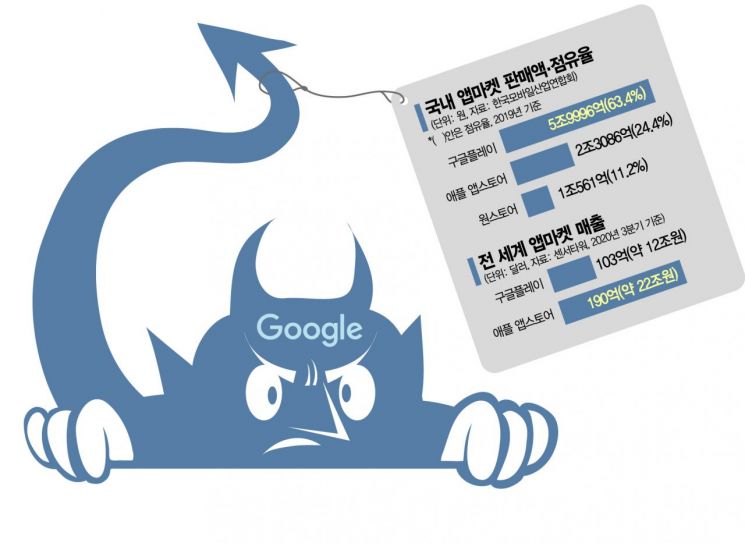
The so-called 'Google Gapjil Prevention Act (Amendment to the Telecommunications Business Act),' which was pushed forward in response to Google's unilateral increase in fees as the king of the application ecosystem, is struggling to gain traction. This contrasts sharply with the unified voice of both ruling and opposition parties during the national audit just a month ago, when they called for the government, National Assembly, and industry to join forces to curb the tyranny of dominant market players. Some voices painfully point out that the institutional foundation for fair industrial development is being shaken by lobbying from global corporations.
According to the National Assembly and industry on the 12th, the National Assembly's Science, ICT, Broadcasting and Communications Committee (hereafter, the Committee) unusually held a second subcommittee during last month's audit period and agreed to pass the amendment to the Telecommunications Business Act aimed at preventing abuse by app market operators, but it was ultimately scrapped. During the process of discussing an integrated bill at the Committee level, conflicting interests inside and outside the industry surfaced, and combined with the audit disruption and political strife, the momentum has effectively dissipated.
The timing for Google's mandatory in-app payment and 30% app commission is fast approaching, but if things continue as they are, there are even concerns that the bill's passage within this year, which both ruling and opposition parties had agreed upon, may be difficult. An industry insider said, "Information that Google is conducting legislative prevention activities targeting lawmakers through the prestigious law firm Kim & Chang has already spread widely," pointing to the rapidly changing political atmosphere recently centered on the opposition party. Google's revised commission policy will apply to new apps from January 20 next year and to existing apps from October next year. This is expected not only to increase the burden on app developers but also to lead to price hikes in major content such as webtoons and music, adversely affecting tens of millions of users.
◆Why did the unified voice of ruling and opposition parties fade after calling for passage?
Previously, there were a total of seven amendments to the Telecommunications Business Act proposed around the audit period, focusing on preventing abuse by app market operators. There is virtually no disagreement on the principle that the abuse by app market giants, who use their overwhelming market share to force specific payment methods, should not lead to the destruction of the app ecosystem. Among the lawmakers who proposed the bills, the differences lie only in whether to focus on immediate issues such as forcing specific payment methods or to use this incident as an opportunity to fundamentally block unfair practices by app market giants and create a market structure that prevents such behavior.
However, the atmosphere changed drastically in the past month. During the process of preparing an integrated bill centered on the proposed bills, controversy arose that the Google Gapjil Prevention Act might harm innocent small and medium-sized developers, and even Park Seong-jung, the floor leader of the People Power Party who proposed the related bill, put the brakes on the discussion, citing concerns about 'hasty processing.' Cho Seung-rae, the floor leader of the Democratic Party, criticized Park, the bill proposer, for mentioning hasty processing, saying, "Did you submit the bill without careful consideration after advice?" and urged, "You should rather withdraw the bill."
Behind the sudden change in atmosphere are suspicions of lobbying and pressure from the U.S. Embassy and the law firm Kim & Chang representing Google. It has been confirmed that both sides moved quickly against the National Assembly's Committee recently. During meetings with Committee members, conversations reportedly included mentions that the bill might violate the Korea-U.S. Free Trade Agreement (FTA) and hinted at trade pressure. A National Assembly official said, "As bills related to app markets poured in mainly from the ruling party, the strategy is to persuade the opposition party to stall."
Another ruling party official said, "It is true that we feel regret and frustration toward some lawmakers who changed their stance after raising their voices together that this is an issue that must be addressed," and expressed frustration, saying, "Shouldn't we find alternatives and discuss together?" The Committee's atmosphere, which escalated to a disruption during last month's audit, is also evaluated to have fueled this further.
Earlier, Google Korea's explicit mention of the possibility of changing its business model if the law is enforced during the audit testimony has also heightened industry vigilance. An industry insider said, "The possibility of changing the business model is indirect pressure aimed at the industry, not the National Assembly."
Democratic Party lawmaker Han Jun-ho emphasized the will to pass the law, saying, "Many opinions that appear to be from the industry recently are actually Google's opinions," and added, "(Although they do not openly say it due to watching Google's stance,) even small and medium-sized developers I have met directly say the Gapjil Prevention Act is reasonable. I hope the National Assembly and government will stand up against this." Earlier, Han had also revealed evidence at the audit that Google coerced domestic game developers to express opinions siding with it.
◆Half-hearted public hearing sparked industry backlash
Controversy also raged around the public hearing held on the 9th. The IT and startup sectors, which are directly hit by Google's commission policy changes, were excluded, and there was no concrete testimony or discussion about the mandatory in-app payment.
Before the public hearing, as the opposition party's stance rapidly changed and the attendance list was disclosed, industry insiders sighed, saying, "I knew this would happen." One insider lamented, "There is a limit to what the game industry, where in-app payment has already been introduced, and indie game developers who mainly earn advertising revenue rather than in-app sales can say."
The witnesses on the day were Kim Hyun-gyu, vice chairman of the Korea Mobile Game Association, and lawyer Jung Jong-chae from the law firm Jungbak, recommended by the Democratic Party; and Professor Lee Byung-tae from KAIST Graduate School of Techno Management and Cho Dong-hyun, CEO of indie game developer Super Awesome, recommended by the People Power Party. While lawyer Jung pointed out that "forcing payment methods by a monopoly operator is a clear unfair practice" and "tying sales is prohibited," Professor Lee argued, "Although it is a monopoly or oligopoly position, there is no basis for unfair trade practices." Evaluations of the 30% commission also differed.
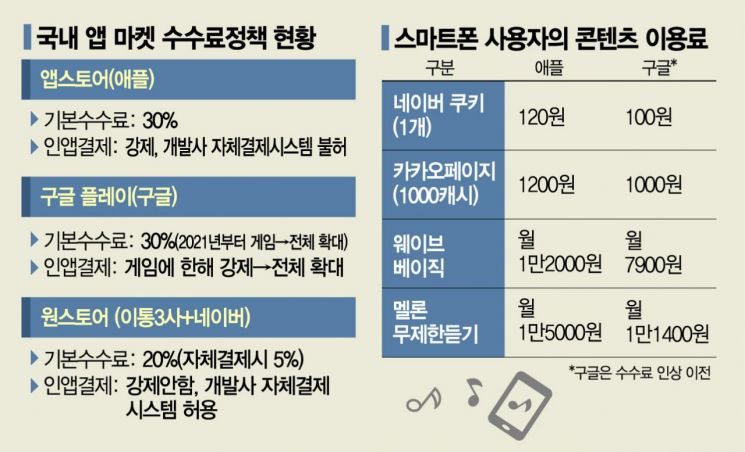
Google's explanations and clarifications regarding the commission policy changes were also not specifically verified or discussed at this hearing. Google currently states that only about 1%, or around 100 apps, in Korea are affected by this policy change. However, Vice Chairman Kim said, "It will be much more than 100."
It is estimated that more than 100,000 creators are involved in apps related to areas where price increases are inevitable, such as music and webtoons. Given the platform's characteristic of distributing revenue on a fixed ratio basis, a decrease in creators' income and an increase in content prices are inevitable. In the case of music, where a 70:30 revenue split is typically applied, Google takes 30% as an in-app payment commission, reducing the creator's income from 70 won to 49 won per 100 won of sales.
An anonymous insider pointed out, "There was no mention at the public hearing of Google's suspected anti-market competitive behavior, which the industry has kept quiet about until now." In recent years, controversies have arisen in the domestic game industry that Google, which virtually dominates the app market, implicitly sanctions developers by limiting first-page (featured) exposure if they enter both Google Play and domestic app markets simultaneously.
Moreover, the industry's resentment is strong against Google's self-praise mentioning the success of the Japanese market with Line Manga and Piccoma to justify the commission policy change, claiming it is "thanks to the convenience of Google in-app payment." This is criticized as belittling the service's unique features and the developers' efforts.
During the hearing, Professor Lee said, "The National Assembly sides with certain large corporations," which raised voices. In response, lawmaker Cho rebutted, "If you think about it the other way, (the opposing argument) is protecting Google."
◆Promised to stop app market giants' commission abuse but...
The problem is that if things continue like this, the original intention to curb the unilateral tyranny of app market giants and revitalize competition in the app ecosystem will inevitably be broken. January, when Google has announced the policy application, is just around the corner. Existing app developers have a deadline until the end of September, but even that is a short period. The Committee is scheduled to hold a plenary session next week.
The Korea Startup Forum urged prompt passage of the amendment in a statement the day before, saying, "Google's unfair practices are shrinking the entire content industry in our country and threatening the interests and survival of related industry workers." Industry insiders worry that if the government and National Assembly fail to properly respond to Google's enforcement of app commissions, which was the biggest issue at the audit, the unilateral tyranny of global operators leveraging market dominance will intensify.
Professor Choi Kyung-jin of Gachon University's Department of Law suggested, "The most important thing in regulating overseas operators is sustainability," and added, "The government must consistently maintain a regulatory stance to protect our people and industry and make overseas operators recognize this."
© The Asia Business Daily(www.asiae.co.kr). All rights reserved.


















