Heo Gijun, CEO of Bplus Lab
Developed Symptom Inquiry Service 'Eodi Apa'
Linked with Bumin Hospital App for Analysis
[Asia Economy Reporter Choi Dae-yeol] One hour wait, three minutes consultation. This reality, which one might have experienced at least once in a large hospital, succinctly illustrates the complex problems of our healthcare system. It is difficult to improve these unfavorable conditions not only for patients but also from the doctors' perspective. Attempts to fix this reality by adjusting the medical delivery system that guides patients to appropriate medical institutions based on their condition or disease, and by revising health insurance fees, have been ongoing. However, it is not easy to change the entrenched practices developed over several years in a short time.
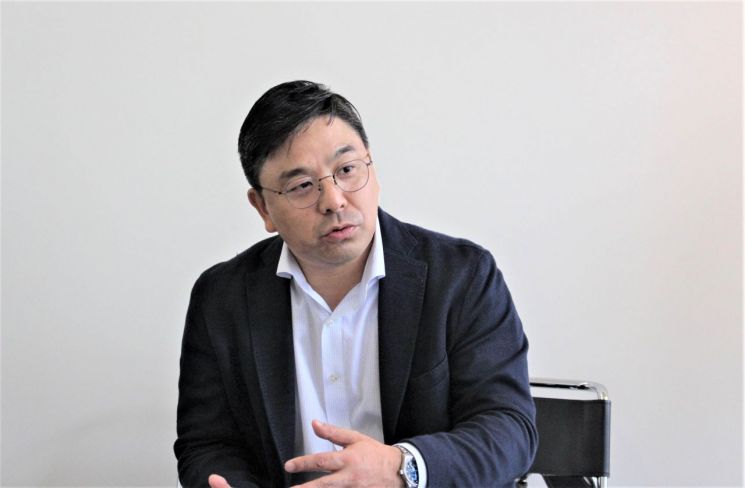
Heo Ki-jun, CEO of Bplus Lab, which developed the AI-based medical questionnaire service application (app) "Eodi Apa," believes that if it is difficult to immediately extend consultation time, it is better to conduct more efficient consultations within a short time. If patients can inform their symptoms or simple information before coming to the hospital, even a brief face-to-face consultation with the doctor can be more detailed. Heo explained, "It is a system that enables basic medical examination before the patient visits the medical institution and a concept where the hospital reaches out to the patient first."
The app developed by this company is characterized by algorithmizing various clinical symptoms from the perspective of not only patients but also frontline clinical medical staff to improve accuracy. Currently, it predicts 65 main symptoms such as dizziness and about 750 corresponding diseases, but it is expected to predict up to 300 main symptoms and 1,800 diseases. The key is how much the information entered by the app user matches the actual diagnosis identified during the medical consultation.
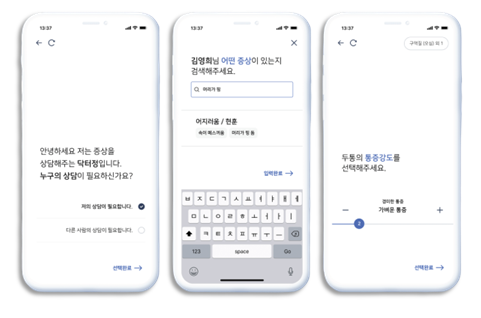
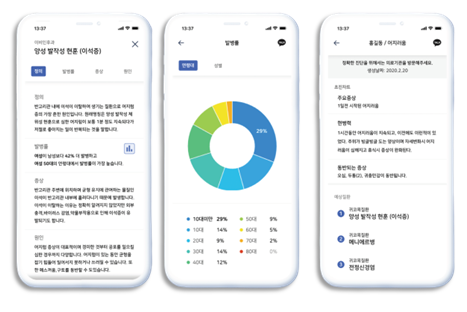 AI-based medical inquiry service app 'Eodiapa 2.0' screen. When symptoms are entered, it provides the expected diagnosis.
 To this end, the app will integrate the initial consultation chart with the electronic medical records (EMR) of Bumin Hospital, which is visited by more than 200,000 people annually, combined with AI technology, to analyze how much it matches the clinical diagnosis by actual medical staff. Heo said, "We plan to launch the service so that it can be applied within Bumin Hospital by the end of this month, and afterward, by expanding the network to primary care institutions, we can improve accuracy."
In Korea, services that connect specific or nearby medical institutions based on simple clinical symptoms or desired medical departments already exist. According to Heo, the focus is on providing accurate medical information rather than these intermediary platform-type services. Many specialists reside within Bumin Hospital to meticulously refine the questionnaire items, which is part of this background.
Heo said, "ADA, developed in Germany, is widely used not only in Berlin but also across Eastern Europe and Africa, and in China, the number of users of apps providing accurate medical information is steadily increasing. Although the medical community tends to be conservative and reluctant to readily accept new ICT, interest will grow because it provides value not only to patients but also to medical staff."
Heo has a strong local medical institution network, having spent a long time in China promoting new businesses in the healthcare field. This is why the medical institution reservation platform "Jiankang160," used by 200 million people (based on MAU) around Shenzhen, China, is interested in this app. Heo said, "Since remote medical care was legalized in China four years ago, various startups utilizing vast medical data have emerged. Korea can also showcase competitive medical apps by leveraging its world-class clinical capabilities and advancing AI-based initial medical questionnaires."
© The Asia Business Daily(www.asiae.co.kr). All rights reserved.



















