Executives Including Holding Company Officers and Deputy Heads of Major Banks Among 100 Personnel Changes
Financial Association Chairman 'Gwanpia' Trend... Chairman Kim Tae-young's Term Ends on 30th
Former Financial Commissioners Choi Jong-gu and Lim Jong-ryong, Former Lawmaker Min Byung-doo Among Candidates
Shin Yong-gil, Life Insurance Association Chairman's Term Ends Next Month 8th... Former Government Officials Strongly Expected
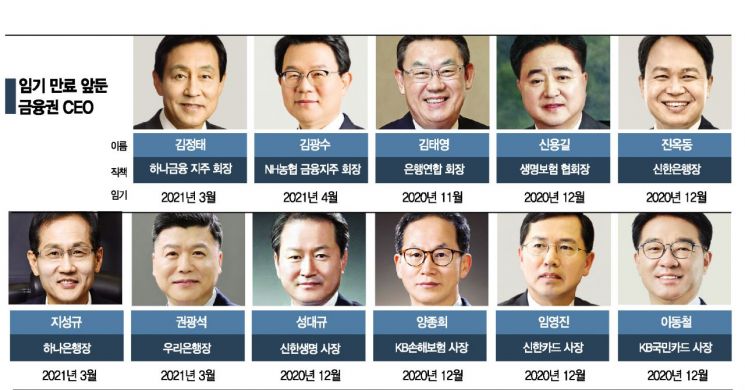
[Asia Economy Reporter Kangwook Cho] Starting next month, a major personnel shakeup is expected to sweep through the financial sector. Including heads of financial associations and holding companies, as well as presidents of banks, insurance, and card companies whose terms expire by the first half of next year, there are about 50 top executives (CEOs) in the financial sector facing term completion. When adding holding company executives, deputy heads of major banks, and full-time audit committee members, the number of CEOs and executives with expiring terms easily exceeds 100. Amid various pressing issues surrounding the financial sector next year?such as deteriorating bank profitability under the ultra-low interest rate environment in the post-COVID-19 era and digital innovation driven by competition with big tech?this wave of change coupled with a 'generational shift' and accumulated personnel demands could literally trigger a 'personnel typhoon.'
According to the financial sector on the 9th, this personnel reshuffle is expected to be influenced by rapidly changing trends such as competition with big tech, the rise of untact (contactless) finance, performance results, and the need for long-term management plans. In particular, ahead of the next appointment of financial association heads, there is a strong wave of 'Gwanpia' (a portmanteau of 'bureaucrat' and 'mafia') controversy. After the Sewol ferry disaster, efforts to eradicate Gwanpia led to private sector leaders largely taking association head positions, but this trend reversed 180 degrees after the Moon Jae-in administration took office. It is seen as coinciding with the urgent need for 'competent' association heads who can protect the industry amid intensified government regulations and political interference.
Despite 'Gwanpia' Controversy, 'Competent' Financial Association Heads Are Desperately Needed
For example, the term of Kim Tae-young, chairman of the Korea Federation of Banks, ends on the 30th of this month. Potential successors include former Financial Services Commission Chairmen Choi Jong-ku and Im Jong-ryong, and former Democratic Party lawmaker Min Byung-doo. The Federation of Banks, which held its first nomination committee meeting on the 26th of last month, plans to select a shortlist in the third week of this month and appoint the final candidate around the fourth week. There is also a possibility of an unexpected figure emerging.
The term of Shin Yong-gil, chairman of the Life Insurance Association, also ends on the 8th of next month. Given that private sector leaders have held the chairman position consecutively twice, it is known that this time a government (bureaucrat) official is likely to be appointed. Names such as former Financial Services Commission Chairman Jin Dong-soo, former Financial Supervisory Service Governor Jin Woong-seop, and Insurance Training Institute Director Jeong Hee-soo are being discussed. Earlier, on the 5th, the term of Kim Yong-duk, chairman of the General Insurance Association, ended, and Jeong Ji-won, current chairman of the Korea Exchange, has been nominated as his successor. He is expected to be officially appointed after a general meeting vote on the 13th.
Will Kim Jung-tae of Hana Financial and Kim Kwang-soo of NH Nonghyup Financial Be Reappointed?
Among the five major financial holding companies, attention is focused on whether Kim Jung-tae, chairman of Hana Financial, and Kim Kwang-soo, chairman of NH Nonghyup Financial, whose terms expire in March and April next year respectively, will be reappointed, following the successful third term of KB Financial Group Chairman Yoon Jong-kyu.
Kim Jung-tae, who has already served two consecutive terms (three terms in total), is reportedly signaling, directly or indirectly, that he will not seek another term. Currently 68 years old, even if Kim Jung-tae seeks reappointment, Hana Financial’s internal governance rules stipulate that he cannot serve beyond the age of 70, allowing only one more year of service. Hana Financial is expected to hold a nomination committee meeting around January next year to select the next chairman. Among the three vice chairmen?Ham Young-joo, Lee Jin-guk, and Lee Eun-hyung?Ham and Lee Jin-guk are considered candidates.
Kim Kwang-soo has already been reappointed once this year. Since the launch of Nonghyup Financial in 2012, no chairman has been reappointed more than once. Former chairman Kim Yong-hwan also served only one reappointment. Given Nonghyup Financial’s preference for bureaucrat leaders, the financial sector expects another bureaucrat to be appointed this time as well.
The term of Kim Tae-oh, chairman of the regional financial holding company DGB Financial Group, also expires in March next year. Kim will be 67 years old next year, and according to DGB Financial’s internal governance rules, a chairman cannot be appointed or reappointed after turning 67.
Terms of Bank Presidents Jin Ok-dong, Ji Sung-kyu, and Kwon Kwang-seok Also Expire... Reappointment Favored
Regarding bank presidents, the reappointment of Shinhan Bank President Jin Ok-dong, whose two-year term ends at the end of this year, is a key issue. Jin is credited with achievements such as revamping key performance indicators (KPIs) and strengthening digital capabilities, and considering the special circumstances of COVID-19, there is a strong view inside and outside the banking sector that he is likely to continue his term.
The terms of Hana Bank President Ji Sung-kyu and Woori Bank President Kwon Kwang-seok expire at the shareholders’ meetings in March next year. Ji is evaluated to have established a solid position with steady performance since his appointment last year, but the fate of Chairman Kim Jung-tae is a variable. However, given the typical 2+1 term system, reappointment is highly likely.
Kwon, appointed for a one-year term in March this year, is also favored for reappointment due to the short term. Woori Bank’s executive nomination committee has stated it will review Kwon’s performance over the year before deciding on term extension.
Earlier, KB Kookmin Bank President Heo In effectively secured a third term and will serve until the end of next year. Recently, Korea Citibank appointed Yoo Myung-soon as acting president, becoming the first female bank president, and DGB Daegu Bank President Lim Seong-hoon took office last month. Sh Suhyup Bank has nominated current senior vice president Kim Jin-gyun as the next bank president candidate for a two-year term. For regional banks, the terms of Busan Bank President Bin Dae-in, Gyeongnam Bank President Hwang Yoon-chul, Jeonbuk Bank President Lim Yong-taek, Gwangju Bank President Song Jong-wook, and Jeju Bank President Seo Hyun-joo all expire in March next year.
Insurance and Card Company CEOs Also Face Mass Term Expirations... Performance Is the Issue
Among eight card companies, the terms of presidents at five companies?Shinhan, KB Kookmin, Hyundai, Woori, Hana, and BC Card?expire before March next year. Shinhan Card President Lim Young-jin, KB Kookmin Card President Lee Dong-cheol, and Woori Card President Jung Won-jae, all of whom were candidates for holding company chairmanships, will finish their terms in December. BC Card President Lee Dong-myeon, appointed this year, is highly likely to be reappointed. Hana Card President Jang Kyung-hoon’s term ends in March next year.
In the insurance industry, the terms of 13 CEOs will expire consecutively starting at the end of this year. These include KB Insurance CEO Yang Jong-hee, Shinhan Life CEO Sung Dae-gyu, Orange Life CEO Jung Moon-guk, KB Life CEO Heo Jung-soo, and Nonghyup Life CEO Hong Jae-eun, all finishing next month. Additionally, the terms of Meritz Fire CEO Kim Yong-beom, DB Insurance CEO Kim Jung-nam, Mirae Asset Life CEO Byun Jae-sang, Hanwha Life CEO Yeo Seung-joo, Korean Re CEO Won Jong-kyu, and Samsung Fire CEO Choi Young-moo expire by March next year. However, the industry leans toward personnel decisions prioritizing organizational stability amid increased financial market volatility post-COVID-19 and the upcoming adoption of International Financial Reporting Standard (IFRS-17).
Along with the expiration of top executives’ terms, a large number of executives at major financial holding companies and banks are also subject to movement. At the four major commercial banks?KB Kookmin, Shinhan, Woori, and Hana?about 60 executives excluding outside directors are known to have terms expiring at the end of this year. Additionally, the terms of auditors such as Ju Jae-sung of KB Kookmin Bank and Heo Chang-eon of Shinhan Bank, as well as full-time audit committee members at commercial banks, are also ending consecutively. Inside and outside the financial sector, there is significant expectation of large-scale personnel shifts, especially at Shinhan and Hana Banks, coinciding with CEO appointments at major affiliates.
A financial sector insider said, "It is premature to make assumptions about term extensions or replacements, but considering the CEO appointments at major affiliates, a significant reshuffling of positions in the financial sector is expected. In special circumstances like the current COVID-19 situation, ultimately, performance and crisis management will determine the fortunes of reappointments and replacements."
© The Asia Business Daily(www.asiae.co.kr). All rights reserved.

![Clutching a Stolen Dior Bag, Saying "I Hate Being Poor but Real"... The Grotesque Con of a "Human Knockoff" [Slate]](https://cwcontent.asiae.co.kr/asiaresize/183/2026021902243444107_1771435474.jpg)















