Variables in 'Environmental Dispatch' such as Coal Total Quantity System, HPS, and Electricity Fee Fuel Cost Linkage... Government Remains Silent
[Asia Economy Reporter Moon Chaeseok] It has been confirmed that the Ministry of Environment sent an official letter on April 28th last month to the Ministry of Trade, Industry and Energy regarding the approval of the strategic environmental impact assessment for the 9th Basic Plan for Electricity Supply and Demand (Electricity Plan). The Electricity Plan, which contains projections of installed capacity and power generation by energy source and supply-demand plans for the next 15 years, is expected to be announced as early as this year.
The Electricity Plan is a statutory plan that must be established every two years. The 9th Electricity Plan was supposed to be announced last year, but the process was extended beyond the year due to the addition of the strategic environmental impact assessment, which includes 'environmental dispatch' measures such as greenhouse gas reduction.
After procedures such as 'government proposal confirmation → report to the National Assembly's Trade, Industry, Energy, Small and Medium Business Committee → confirmation and announcement by the Electricity Policy Deliberation Committee,' the final plan is likely to be announced within this year at the earliest.
The Higher Law is the 'Greenhouse Gas Reduction Roadmap'
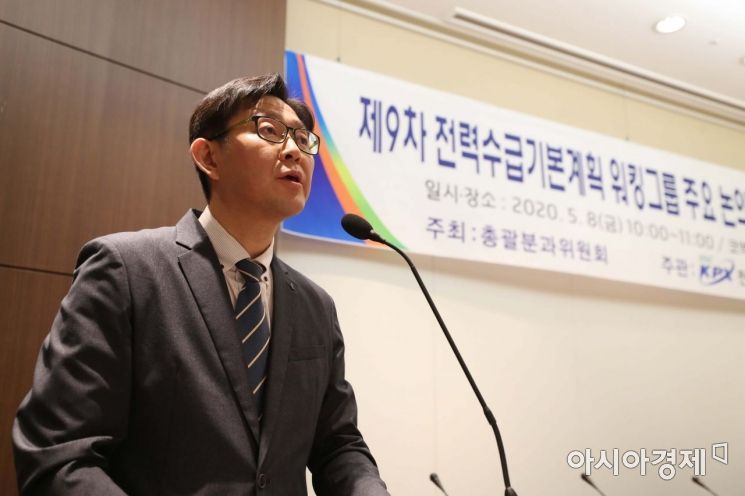 On May 8th, at COEX in Gangnam-gu, Seoul, Professor Yoo Seung-hoon from the Department of Energy Policy at Seoul National University of Science and Technology, who serves as the chair of the General Subcommittee, is speaking at the briefing on the main discussion results of the 9th Basic Plan for Electricity Supply and Demand Working Group. Photo by Moon Ho-nam munonam@
The Ministry of Environment and the Ministry of Trade, Industry and Energy unanimously stated that the core of the strategic environmental impact assessment is the 'Greenhouse Gas Reduction Roadmap.' The key points are ▲achieving a maximum power demand of 104.2GW by 2034, aiming for a 12.5% reduction in maximum power demand compared to baseline demand ▲reducing fine dust emissions from the power generation sector from 18,600 tons last year to 9,500 tons by 2030, a 49% reduction ▲achieving the 2030 greenhouse gas emission target (reducing 24.4% from 709 million tons in 2017 to 536 million tons) ▲reducing coal power generation and expanding renewable energy.
The Ministry of Environment requested revisions twice from the Ministry of Trade, Industry and Energy, which is the maximum number of legally allowed requests for supplementation. Typically, the Ministry of Trade, Industry and Energy prioritizes '15 years of power supply stability' when drafting the Electricity Plan, but the Ministry of Environment's strategic environmental impact assessment acted as a kind of guideline emphasizing the inclusion of environmental considerations.
It is known that the Ministry of Environment repeatedly conveyed to the Ministry of Trade, Industry and Energy the need to ensure consistency between the reduction targets in the revised Greenhouse Gas Reduction Roadmap and the 9th Electricity Plan.
'Interest in Whether the Scope of 'Environmental Dispatch' Will Expand'
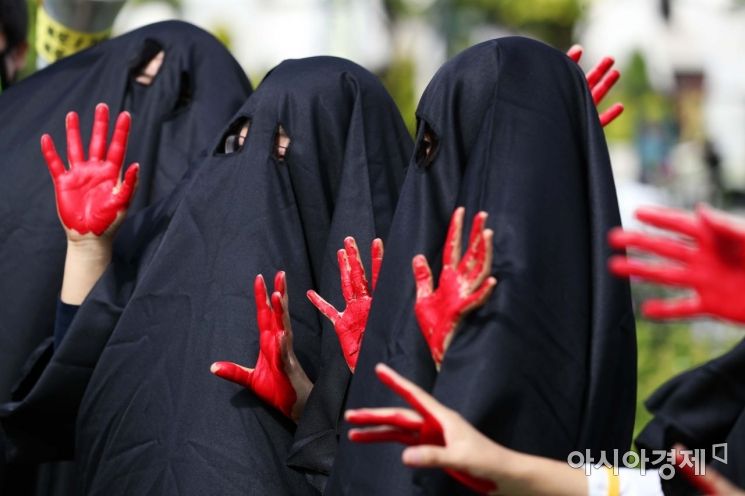 Officials from the Climate Crisis Emergency Action held a press conference on "Global Climate Action Day" at Gwanghwamun Square in Jongno-gu, Seoul, on September 25, performing a demonstration urging the strengthening of climate disaster safety nets and the suspension of overseas coal power investments. Photo by Moon Honam munonam@
Some in the energy industry had expected that the scope of 'environmental dispatch' demanded by the Ministry of Environment would be limited to the degree of coal reduction based on the benchmark method (BM) for greenhouse gas emission efficiency and emission allowances.
However, new variables have emerged, such as the introduction of the coal total volume control system in 2022, the mandatory hydrogen power generation system (HPS), and the possibility of introducing a fuel cost linkage system for electricity rates (which may be announced at the Korea Electric Power Corporation board meeting at the end of November or December).
Summarizing opinions inside and outside the government, the draft of the 9th Electricity Plan was already released in May, and since it is a statutory plan updated every two years, it is generally considered difficult to significantly increase environmental dispatch just before the announcement.
It is also known that the ruling party, including Kim Seonghwan, chairman of the Green New Deal subcommittee of the Democratic Party's 'Future Transition K-New Deal Committee,' who proposed the Power Purchase Agreement (PPA) Act in July, has been consistently conveying messages to the government that distributed power generation measures should be included in the 9th Electricity Plan, making it difficult to predict the outcome.
Regarding this, a Ministry of Trade, Industry and Energy official told Asia Economy, "Nothing has been finalized yet, so there are limitations to what can be specifically said."
The May draft included ▲power demand forecast models and maximum power demand ▲consideration of energy demand management system introduction ▲standard reserve margin ▲number and power generation of decommissioned power plants ▲plans to achieve greenhouse gas emission targets ▲transmission and substation facility plans ▲measures to activate distributed power generation.
© The Asia Business Daily(www.asiae.co.kr). All rights reserved.
![Clutching a Stolen Dior Bag, Saying "I Hate Being Poor but Real"... The Grotesque Con of a "Human Knockoff" [Slate]](https://cwcontent.asiae.co.kr/asiaresize/183/2026021902243444107_1771435474.jpg)


















