Seoul Rises 0.17% Last Month
Highest Increase in 2 Years
Mokdong Hyundai Hyperion 137.36㎡
Price Up 550 Million KRW in 3 Months
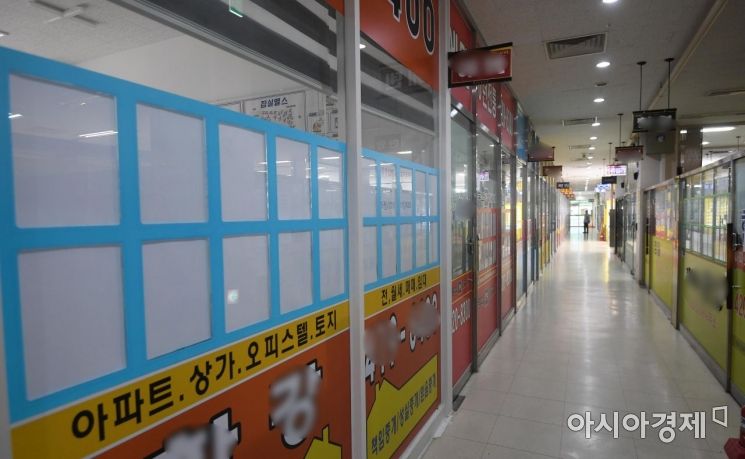
[Asia Economy Reporter Donghyun Choi] "Even if the officetel owner asks for too high a jeonse price, what can we do since it rents out quickly anyway." (Representative of A Real Estate Agency in Mokdong, Yangcheon-gu)
The jeonse crisis that started with apartments in Seoul has spread to officetels. With finding apartment jeonse already like threading a needle, the autumn moving season and school district demand have combined to make officetel jeonse prices skyrocket as well.
According to the Korea Real Estate Board's 'Officetel Price Trend Survey' on the 6th, last month Seoul officetel jeonse prices rose by 0.17%, the highest increase in two years since October 2018 (0.18%). The average jeonse price in Seoul surpassed 200 million KRW for the first time in September and recorded 200.44 million KRW in October.
The upward trend in Seoul officetel jeonse prices is even more pronounced when looking at actual transaction data. According to the Ministry of Land, Infrastructure and Transport's real transaction price system, two officetel jeonse contracts over 1 billion KRW were made in Seoul last month. There were also 11 transactions between 600 million and 1 billion KRW. A 137.36㎡ (31st floor) unit at Hyundai Hyperion in Mokdong, Yangcheon-gu, was leased for 1.75 billion KRW on the 29th of last month. The same size unit was leased for 1.2 billion KRW (30th floor) on July 22. This means the price rose by a whopping 550 million KRW within three months of the implementation of the Housing Lease Protection Act, which includes the contract renewal request right and the rent ceiling system. A representative from B Real Estate in Mokdong said, "Parents swept up apartment jeonse in the new town and other areas of Mokdong, and now they are scrambling to find officetels with multiple rooms. Large officetels are so rare that even if prices are raised by 300 million to as much as 500 million KRW, they rent out quickly."
The situation is similar in Gangnam areas with high school district demand, such as Daechi-dong. A 26.72㎡ officetel in Nonhyeon I-Park, Nonhyeon-dong, Gangnam-gu, was leased for 400 million KRW last month, up 50 million KRW from three months ago. During the same period, a 54.55㎡ unit at Seocho Central I-Park in Seocho-dong, Seocho-gu, also saw a 50 million KRW increase in jeonse price over three months. A representative from C Real Estate in Daechi-dong said, "Because the rent ceiling and contract renewal request rights limit rent increases during the contract period, there is a phenomenon where prices jump significantly when signing new contracts. Even brokers who receive commissions find this situation regrettable."
The rise in officetel jeonse prices is spreading beyond Seoul and the metropolitan area to the provinces. Last month, officetel jeonse prices rose by 0.19%, 0.08%, and 0.17% in the metropolitan area, provinces, and nationwide, respectively, marking the largest increase this year. Except for Gwangju (-0.03%), all metropolitan cities saw increases. In particular, Ulsan rose by 0.62% last month, a 5.2-fold increase compared to the previous month.
The problem is that if jeonse prices rise to exceed sale prices, it becomes difficult for landlords to return the jeonse deposit to tenants even if they sell the property, resulting in 'empty jeonse' cases that cause significant tenant damage. Unlike apartments in Seoul, where the jeonse-to-sale price ratio is around 50%, officetels exceeded 83% last month. The metropolitan area (84.46%) and provinces (80.62%) have long surpassed 80%, and Sejong City is approaching 91%. The national average also reaches 83.89%.
When jeonse prices surge, there are also restrictions on subscribing to the Korea Housing & Urban Guarantee Corporation (HUG) jeonse deposit insurance. To subscribe to this insurance, moving-in registration is mandatory, and the average lower sale price of listings on KB Kookmin Bank's real estate market as of the application date must be higher than the jeonse deposit. Many officetels located near Seoul subway stations or business districts currently exceed this standard. An industry insider said, "Problems are not apparent during a rising real estate market, but if sale prices start to decline, cases where landlords cannot return jeonse deposits even after selling will increase sharply. The government needs to prepare more thorough tenant protection measures."
© The Asia Business Daily(www.asiae.co.kr). All rights reserved.
![Clutching a Stolen Dior Bag, Saying "I Hate Being Poor but Real"... The Grotesque Con of a "Human Knockoff" [Slate]](https://cwcontent.asiae.co.kr/asiaresize/183/2026021902243444107_1771435474.jpg)
















