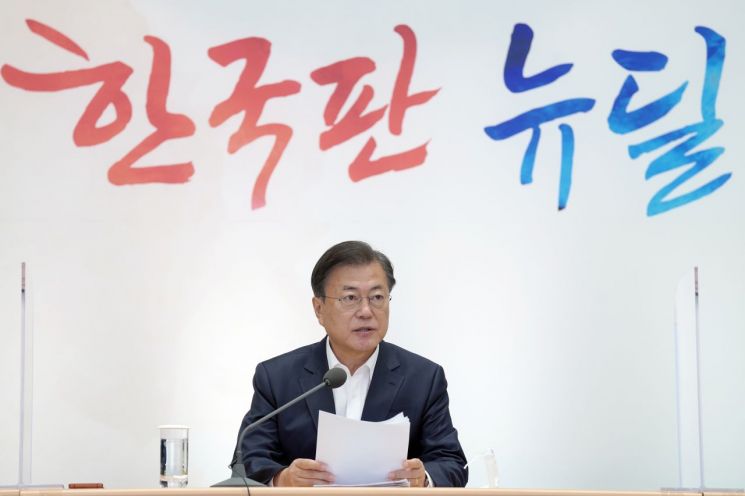
[Asia Economy Reporter Eunmo Koo] Private New Deal funds launched in line with the government’s ‘Korean New Deal Policy’ have not shown remarkable performance in their early stages. The government pursued the policy with the goal of fostering promising industries known as ‘BBIG (Bio, Battery, Internet, Game)’ and providing stable investment destinations. However, during the productization process, the index was composed mainly of a few large-cap and growth stocks, leading to concerns that the funds are easily exposed to volatility when the market undergoes corrections.
According to fund rating agency FnGuide on the 6th, there are a total of eight New Deal-related funds, including five Exchange-Traded Funds (ETFs). Among them, TIGER KRX BBIG K-New Deal recorded a 1.6% return from its listing on the 7th of last month until the day before. Although the return dropped to as low as -6.1% based on closing prices after listing, it rebounded by 7.7% over four trading days this month, partly recovering from the sluggish performance thanks to the sharp rise of beneficiary stocks related to the U.S. presidential election. Similarly, TIGER KRX Bio K-New Deal and TIGER KRX Secondary Battery K-New Deal, which had been recording negative returns, surged more than 10% this month, turning positive.
On the other hand, TIGER KRX Game K-New Deal (-4.1%) and TIGER KRX Internet K-New Deal (-3.0%) still underperform compared to the KOSPI (2.0%). Besides ETFs, funds investing in BBIG also show poor performance. The NH-Amundi 100-Year Enterprise Green Korea Fund, which invests in companies related to 5G communications, secondary batteries, hydrogen, and electric vehicles, posted only a 0.3% return since its launch last month. KB Korea New Deal Fund (2.9%) and Samsung New Deal Korea Fund (-4.5%) also have not shown notable results.
The main reason these funds are struggling is that they were launched after the related stocks had already surged sharply in the short term. Companies included in the BBIG K-New Deal index, such as those in secondary batteries and bio sectors, saw their stock prices rise significantly for three to four months following the spread of COVID-19, linked to U.S. tech stocks. Amid intensified debates over short-term valuation burdens, the U.S. presidential election and subsequent tech stock corrections have contributed to the poor performance.
Jonghyup Kim, head of the Strategy Operation Team at Kiwoom Asset Management, evaluated, “No matter how good a stock is, buying it cheaply is important. The recent sluggishness is due to New Deal index-related products being listed after prices had risen too much from their lows, preventing investors from buying at low prices.”
Although still in the early stages of launch, criticism is emerging as the immediate performance falls short of expectations. It is argued that the government’s intention to foster promising industries was distorted during the productization process. The government announced the New Deal policy and encouraged the launch of related funds to nurture promising industries and provide stable investment options for the public. However, in the process of creating indices and funds, practical issues related to product viability led to a concentration on large-cap and growth stocks.
Although these are government-linked policy projects, from the perspective of the financial investment industry planning and launching the indices and funds, sales aspects cannot be ignored. Conditions favorable for popularity, such as ‘large-cap stocks’ and ‘around 10 stocks,’ were reflected in the process. When a small number of stocks are included in the index and fund with high weights, these stocks become sensitive during market corrections, exposing the fund to the risk of large declines. In fact, the BBIG ETFs track five ‘KRX K-New Deal indices’ developed by the Korea Exchange, most of whose constituent stocks are highly volatile growth stocks.
Sungin Jung, head of the ETF Strategy Team at Korea Investment Management, said, “Since this is a policy product aimed at supporting a specific sector, the index should have been composed to benefit the entire industry.” He added, “Even if product viability was somewhat compromised, it would have been better to expand the number of stocks to include not only top KOSPI stocks but also lower-tier KOSDAQ stocks.” Kim also pointed out, “From a risk management perspective, compared to indices that hold many stocks and thus have good risk diversification, the New Deal indices have relatively fewer constituent stocks, so their movements may differ from representative indices, which should be noted.”
Of course, there are not many negative views regarding the outlook for K-New Deal funds. This is because most sectors and stocks included in the K-New Deal index are promising companies related to new technologies that will drive future growth. Jongjin Moon, a researcher at Kyobo Securities, said, “Earnings forecasts for companies included in the K-New Deal index are continuously being revised upward.” He advised, “Digital and eco-friendly industries, identified as investment targets in the K-New Deal index, are not one-off themes but global trends, so it is necessary to continuously track companies in these industries with a long-term perspective.”
© The Asia Business Daily(www.asiae.co.kr). All rights reserved.

















