Porter and Bongo EV Domestic Cumulative Sales Surpass 10,000 Units
Subsidy Policy for 25,000 Electric Cargo Vehicles Next Year
Cumulative 36,000 Units by Year-End... Arrival of 30,000 Electric Cargo Vehicle Era
[Asia Economy Reporter Suyeon Woo] The electric vehicle (EV) models of livelihood trucks Porter and Bongo, used by self-employed workers for their business, have surpassed 10,000 units in cumulative domestic sales. Thanks to the government's eco-friendly vehicle promotion policies, the electric cargo vehicle market, which rapidly grew to 10,000 units this year, is expected to easily exceed 30,000 units in cumulative sales next year.
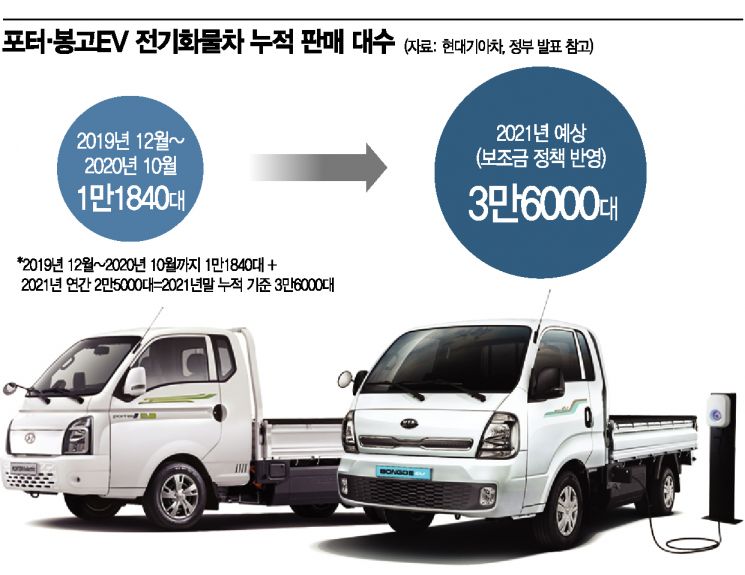
According to Hyundai Kia Motors on the 5th, since their launch in December last year until October this year, the cumulative domestic sales of Porter and Bongo EVs reached 11,840 units, surpassing 10,000 units. Porter EV sold 7,747 units, and Bongo EV sold 4,093 units, with Porter EV leading in sales volume. The sales of small electric trucks, which were only about 5,000 units in the first half of this year, grew to 10,000 units in the second half due to additional budget allocations for electric cargo vehicle subsidies.
Because electric vehicles have higher prices than conventional internal combustion engine vehicles, the government leads the promotion of eco-friendly vehicles by providing subsidies. Therefore, until economies of scale are secured to lower prices, the size of the electric vehicle market inevitably depends on the scale of subsidy support.
In the case of Porter EV, the retail price exceeds 40 million KRW, but with the national subsidy (18 million KRW) and local government subsidy (9 million KRW based on Seoul), buyers can purchase the electric vehicle at about 13 million KRW, which is cheaper than the internal combustion Porter. Considering fuel costs, taxes, and other vehicle maintenance expenses, electric cargo vehicles are much more economical.
The rapid surpassing of 10,000 units in Porter and Bongo EV sales this year is also thanks to their excellent economic efficiency. These models have a driving range of 211 km per charge, which is shorter than general passenger electric vehicles but sufficient for small trucks that frequently operate short distances. Additionally, since these are livelihood vehicles used frequently, converting small trucks to electric vehicles greatly enhances environmental improvement effects.
The government is closely monitoring the eco-friendliness of such electric commercial vehicles and plans to expand subsidies in this sector. Last month, the government announced through the 'Future Vehicle Expansion and Market Preemption Strategy' that it will provide subsidies for 25,000 electric cargo vehicles next year. The national subsidy per vehicle will be 16 million KRW, which is 2 million KRW less than this year, but the number of beneficiaries is expected to increase.
Considering this subsidy policy, the number of Porter and Bongo EVs running on domestic roads by the end of next year is expected to increase to about 36,000 units, ushering in the '30,000 electric cargo vehicle era.' If additional budget allocations are made next year and subsidy amounts increase, distribution could expand to over 40,000 units.
Furthermore, the fact that Korea GM's Damas and Labo, the only competitors in the light commercial vehicle market, are scheduled to be discontinued in the first quarter of next year is favorable for Porter and Bongo EV. An industry insider said, "As Porter and Bongo EV absorb the existing demand for Damas and Labo, the eco-friendly era in the 1-ton cargo vehicle market is expected to be accelerated," adding, "The market size will also be determined by the scale of subsidies, which play an absolute role in the initial market expansion."
© The Asia Business Daily(www.asiae.co.kr). All rights reserved.

















