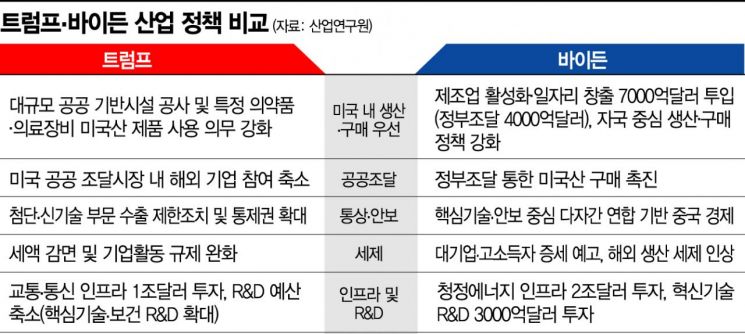
[Asia Economy Reporter Kim Hyewon] Analysts are increasingly predicting that regardless of whether President Donald Trump or Democratic candidate Joe Biden wins the U.S. presidential election this year, the country will accelerate its decoupling from China under an unwavering America-first policy. However, while Trump focuses relatively more on tax cuts and deregulation for domestic industry revitalization, Biden emphasizes fiscal spending, prompting calls for South Korea to adopt comprehensive industrial policy responses considering corporations, trade, technology, and security.
According to the Korea Institute for Industrial Economics and Trade and KOTRA Washington Trade Center on the 2nd, common keywords permeating the domestic industrial sector regardless of the election outcome are accelerated decoupling from China and changes in value chains (supply chains) centered on the U.S. Both candidates are judged unlikely to return to free trade policies.
First, if President Trump is re-elected, the U.S.-China tech cold war and trade disputes are expected to intensify, while Biden is also likely to check China through cooperation with allied countries. Therefore, it is advised to seek local market entry by leveraging South Korea’s reflexive benefits from U.S. China containment, expanded infrastructure investment, and the trend of favoring domestic companies. KOTRA diagnosed, "Since decoupling of the U.S. and Chinese economies is impossible, our companies must create niche opportunities through strategies such as technology investment, investment entry, and mergers and acquisitions (M&A) based on analysis of the materials, parts, and equipment value chain."
Regarding support for new technologies to foster advanced industries, Biden plans a more comprehensive expansion of government research and development (R&D). Biden intends to invest approximately $300 billion in new R&D funds for artificial intelligence (AI), quantum and high-performance computing, 5G and 6G, new materials, clean energy, and semiconductors.
By industry, both candidates have pledged to secure stable supply chains including manufacturing functions in the semiconductor sector and to expand infrastructure support for domestic production in the battery sector. Both candidates plan to strengthen antitrust regulations on the recently emerging platform companies, but stronger regulatory policies are expected if Biden wins.
Demand for expanding domestically produced goods in sectors closely related to public procurement is also expected to grow. The Korea Institute for Industrial Economics and Trade pointed out, "To expand opportunities for domestic companies in major government procurement projects, offshore entry into the U.S. market should be considered an essential strategy."
On the same day, Hyundai Research Institute estimated that if Biden wins rather than Trump’s re-election, the pressure for South Korea’s economic growth rate to rise would increase by 0.1 to 0.4 percentage points. The pressure for South Korea’s total export growth rate to rise due to the U.S. economic rebound was seen to increase from an average of 0.6 to 2.2 percentage points annually. Hyundai Research Institute analyzed the impact on South Korea based on Moody’s recent forecast of U.S. economic growth according to the election outcome.
Hyundai Research Institute also diagnosed, "As global trade imbalance issues persist, regardless of which candidate wins, the U.S. is expected to continue policies to secure manufacturing competitiveness and expand exports," adding, "South Korea’s imports from the U.S. may increase." Furthermore, since Biden emphasizes eco-friendly policies and has made strengthening regulations on the information technology (IT) industry a core pledge, if he wins, related corporate entries in pharmaceuticals, semiconductors, electric vehicles, and renewable energy are expected to increase.
© The Asia Business Daily(www.asiae.co.kr). All rights reserved.

















