Post-US Presidential Election Defeat: Election Manipulation Attacks
Antitrust Lawsuits and Biden Allegation Report Blocks Also Follow One After Another
[Asia Economy Reporter Kwon Jae-hee] As the U.S. presidential election approaches, one of the IT giants, Facebook, is reaching a peak of tension. Although it was at the center of fake news controversies in the last election, this time it is receiving negative evaluations from both the Democratic and Republican parties regarding information provision, leading to interpretations that it will face backlash after the election.
On the 1st (local time), Brian Wieser, Global Business President of media agency GroupM, told major foreign media that Facebook is currently under attack from both the Democratic and Republican parties. He said, "Facebook has taken measures to prevent fake news, but if the Democrats win, the Republicans will claim that Facebook manipulated the election in favor of the Democrats." He added, "Conversely, if the Republicans win, the Democrats will claim that Facebook manipulated the news to favor the Republicans." In particular, Facebook drew the ire of the Republicans by not allowing the publication of the New York Post report raising suspicions about Hunter Biden, son of Democratic presidential candidate Joe Biden, regarding Ukraine.
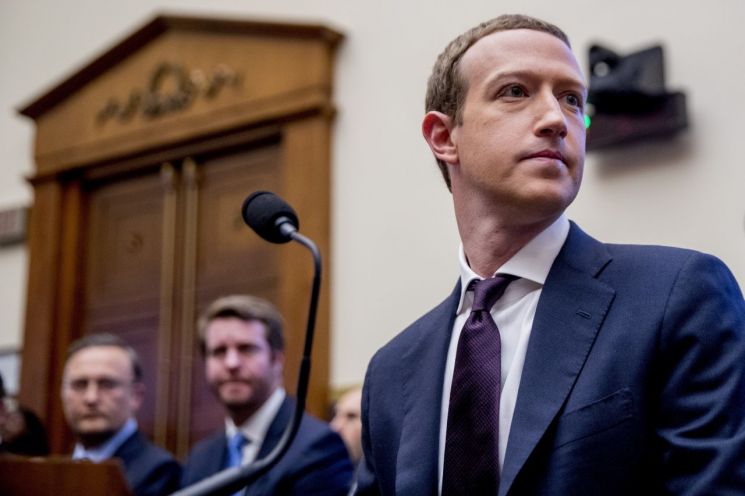
Facebook's crisis came as it changed its platform content policies. CEO Mark Zuckerberg has consistently argued, "Facebook is apolitical, and the platform should not be the arbiter of truth." Unlike Twitter, Facebook's consistent stance was not to intervene in the content distributed on its platform.
However, amid criticisms that Facebook is a hotbed of fake news and the rise of platform operator responsibility following incidents like George Floyd's case, Facebook shifted from its previous stance and announced a new position. In an interview with Axios, a U.S. political media outlet, last month, Zuckerberg stated, "We must do everything we can to reduce violence or unrest related to this election." To avoid political attacks expected after the election, Facebook banned new political ads starting from October 27, one week before the election, and declared a ban on all political ads from November 3, the election day. The industry expects Facebook's measures to continue for about a week, considering the unprecedented scale of mail-in voting that could affect the counting results.
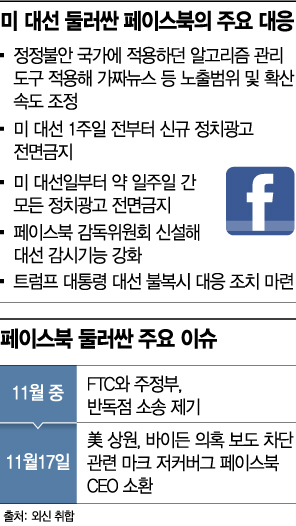
Facebook is also showing more caution in judging fake news. It recently launched an independent Oversight Board, granting it the authority to determine whether content posted on Facebook is fake and to delete such content. To this end, it has prepared measures to adjust the exposure range and spread speed of inciting violence, fake news, and sensational posts by utilizing algorithm management tools previously applied in countries with political instability such as Sri Lanka.
Despite these efforts, it is expected to be difficult to avoid negative consequences after the election. The U.S. federal and state governments are reportedly planning to file antitrust lawsuits against Facebook this month. The Federal Trade Commission (FTC) antitrust lawsuit decision against Facebook will be made by majority vote among five commissioners, including Chairman Joseph Simons, with three Republicans and two Democrats. On the 17th, the U.S. Senate has announced plans to summon CEO Mark Zuckerberg along with Twitter CEO Jack Dorsey over blocking reports on the Biden controversy.
Molly McCue, CEO of consulting firm Piana Strategy, pointed out, "Social media currently holds a more important position than any other form of information-gathering media," adding, "Facebook boasts an enormous scale and network effect, and considering this influence, Facebook has failed to prevent the platform from becoming a tool for manipulation, confusion, and violence."
© The Asia Business Daily(www.asiae.co.kr). All rights reserved.

















