Social Distancing Level 5 Revision Plan to Take Effect from the 7th
Applying Past Major Large-Scale Outbreak Cases
Adjusting Distancing Levels Based on New Confirmed Cases + Auxiliary Indicators
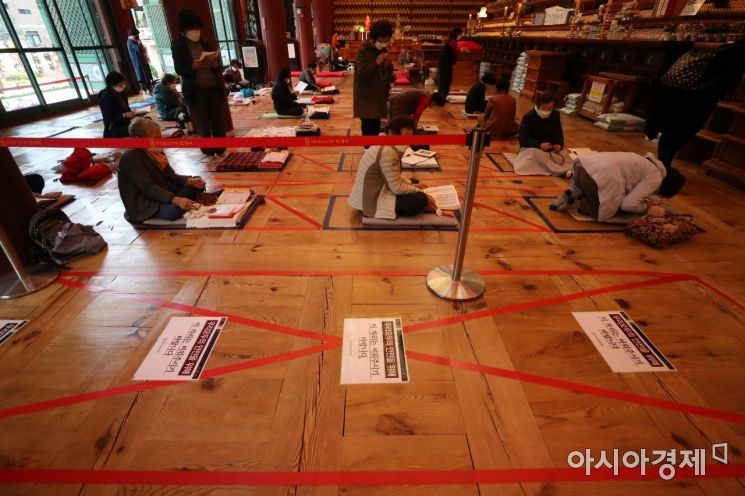 On the 14th, ahead of the 2021 College Scholastic Ability Test, parents of examinees and Buddhist devotees are praying for high scores and success in university admissions at Jogyesa Temple in Jongno-gu, Seoul, while observing social distancing measures to prevent COVID-19. Photo by Moon Honam munonam@
[Asia Economy Reporter Choi Dae-yeol] As the quarantine authorities subdivide the current three-level social distancing system into five levels, the rationale behind this is sustainability. The existing measures failed to properly reflect facility characteristics or epidemic patterns, and the uniform measures increased fatigue among frontline citizens and economic agents, making it difficult to sustain the current distancing measures for a long period.
Since we must fight the virus with 'primitive weapons' such as social distancing and mask-wearing until the end of next year when the COVID-19 vaccine becomes available, this revision of the distancing system is a means to harmonize quarantine and daily life. The experience of enhancing response capabilities through various situations, such as the large-scale Shincheonji Church cluster infection in Daegu and Gyeongbuk, the Itaewon club outbreak, and cluster outbreaks from churches and rallies, also influenced this decision.
If the five-level distancing system, which will be applied from the 7th, had been applied during the Shincheonji-related outbreak in February to March, a 2.5-level measure would have been possible. The outbreak peaked from late February to early March. On February 29, the number of domestic community infection cases alone was 909, the highest number during the domestic COVID-19 phase, and the average daily new confirmed cases for the week around that day were about 596.
Applying the newly revised criteria for each distancing level, a 2.5-level measure is likely to be applied when the daily average of new cases exceeds 400-500 or when the number of cases doubles daily. At this time, all key management facilities except restaurants and cafes and indoor sports facilities will be suspended (gathering ban), and other facilities will have restrictions on operating hours or the number of users. No gatherings of 50 or more people indoors or outdoors are allowed, and at workplaces, telecommuting for more than one-third of employees is recommended.
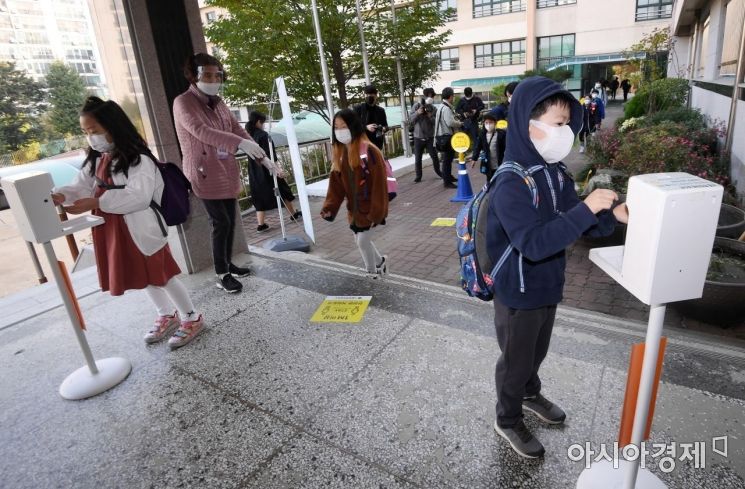 On the 19th, when in-person classes for kindergarten, elementary, middle, and high schools nationwide were expanded following the adjustment to Level 1 social distancing, children at Munbaek Elementary School in Geumcheon-gu, Seoul, were sanitizing their hands as they attended school. Photo by Hyunmin Kim kimhyun81@
Nationwide outbreak with 800-1000+ daily cases leads to escalation to Level 3
For outbreaks like the Itaewon club with dozens of cases per day, Level 1 applies
However, this is based solely on new cases and does not consider other auxiliary indicators such as the proportion of elderly patients aged 60 or older in the affected group, regional (area) outbreak patterns, hospital bed capacity for patient treatment, or the proportion of cases with unknown infection routes. If the quarantine authorities judge comprehensively from various indicators that the response capacity is sufficient, they may ease the measures somewhat compared to these. If the majority of patients are young, as in the Shincheonji cluster infection, or if the outbreak is limited to a specific region, the level may not be raised to 2.5. The authorities expect that, following the large-scale Shincheonji outbreak, awareness of COVID-19 has increased, and with adherence to basic quarantine rules such as mask-wearing and distancing, a sudden surge in cases like before is unlikely.
When an outbreak centered in the metropolitan area flared up around mid-August holidays, church services, and urban rallies, Level 1.5 or Level 2 could be applied. At that time, sporadic cluster infections caused daily new cases to exceed 400 (434 local infections on August 27), and during the peak surge, the weekly average daily cases were about 331.
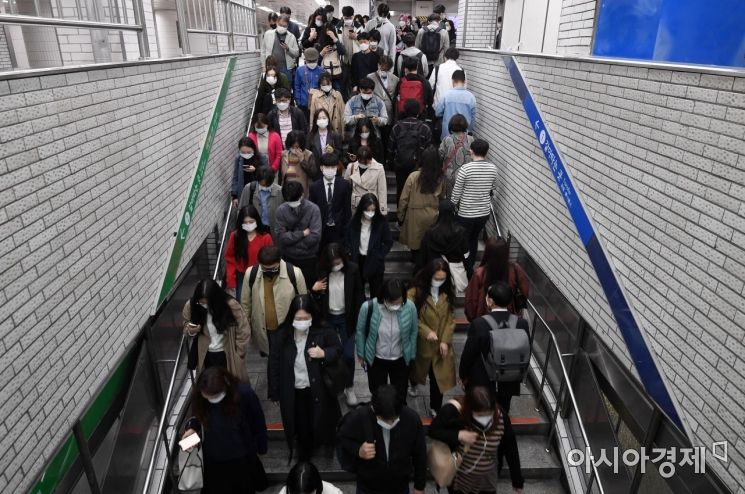 On the 13th, when the mandatory mask-wearing policy for public transportation and medical institutions began, citizens were seen walking with masks on at Sindorim Station in Guro-gu, Seoul. From this day, mask-wearing is mandatory for users and workers of public transportation and medical institutions, as well as attendees of gatherings. Additionally, mask-wearing can be enforced in other facilities depending on the social distancing level. After a one-month grace period, fines will be imposed starting from the 13th of next month. Photo by Kim Hyun-min kimhyun81@
Based on new cases, if there are 100 or more cases in the metropolitan area or 30 or more in other regions, Level 1.5 applies; if these numbers double or if there are 300 or more new cases nationwide, it is considered the start of a nationwide outbreak and can be escalated to Level 2. At Level 2, only entertainment facilities such as clubs, karaoke bars, emotional pubs, colatecs, and hunting pubs are subject to gathering bans. Door-to-door sales facilities, karaoke rooms, and indoor performance venues can operate while observing quarantine rules, such as limiting the number of people before 9 p.m.
If an outbreak of the scale of the Itaewon club in mid to late May occurs, the current Level 1 distancing can be maintained. At that time, due to inadequate initial epidemiological investigations, new confirmed cases increased between late May and early June, but the daily average was less than 40. Considering that Level 1 distancing with a concept of daily life quarantine applies when the metropolitan area has fewer than 100 cases and other regions have 10-30 cases, the authorities believe that even if a similar cluster infection occurs, it can be managed as usual. At Level 1, measures mainly restrict the number of users in key management facilities.
© The Asia Business Daily(www.asiae.co.kr). All rights reserved.



















