Haenam Sollasido Solar Power Plant Report
297 MWh Produced in 3 Hours of Operation
Production, Charging, and Substation Possible at Once
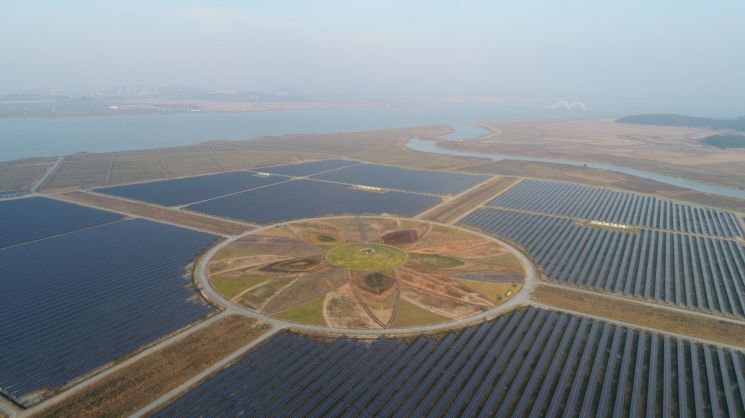 A panoramic view of the solar panels at the 'Solar City Solar Power Generation Facility Complex' located in Guseong-ri, Sanim-myeon, Haenam-gun, Jeollanam-do. (Photo by Korea Energy Information & Culture Foundation)
[Asia Economy Reporter Moon Chaeseok] On the 30th of last month, heading toward late autumn, I visited the 'Solar City Solar Power Generation Facility Complex' in Guseong-ri, Sanim-myeon, Haenam-gun, Jeollanam-do. The Solar City complex, completed in March, is composed of a 98 MW solar power complex and a 306 MW energy storage system (ESS) power generation complex on a site of 1,584,000㎡ (480,000 pyeong). As the largest solar power generation facility complex in Korea, it had such a large scale of panels that it was impossible to capture all at once. This site produces 129 GWh of electricity, enough to supply 26,875 households in the nearby Haenam-gun and Yeongam-gun areas (based on a household using 400 kWh per month).
The Solar City complex has a system capable of 'production, charging, and transformation' all at once. It manages 22,900 V electricity in its own electrical room and transfers it to KEPCO through a substation. As of 12:44 PM, the output of the photovoltaic (PV) system was 77.073 MW. From around 9:40 AM, the facility operated for about three hours, generating 297 MWh of power. The ESS battery was 62.2% charged. Kim Dongha, the site manager of Solar City Solar Power Generation Project, explained, "The electricity generated by the solar power facility first goes into the ESS," adding, "It is expected to complete 90% charging around 2 PM." The outdoor ESS is charged and managed up to 90% according to the Ministry of Trade, Industry and Energy's 'Renewable Portfolio Standard (RPS) management operation guidelines.'
All ESS units in the Solar City complex are composed solely of Samsung SDI products, and the facility is operated by dividing it into 20 buildings. Distributing ESS management by building is the first of its kind in Korea. Each building manages an ESS capacity of 15,773 kWh. A total of 9 million ESS 'cells' are densely packed with electricity. To prevent thermal runaway, the temperature inside the ESS buildings is maintained at a certain level, and 'racks' are installed dispersed across multiple buildings. Each rack contains 25 modules assembled from cells. Manager Kim said, "Regardless of the season, we maintain about 20 degrees Celsius," and explained, "In case of fire, the structure is designed to consume and extinguish the fire inside the building, and components such as the power conversion system (PCS) are installed outside the building."
Officials of the Solar City complex acknowledged that '100% localization' is difficult due to the price difference between Chinese and domestic parts. The overall localization rate of parts in the complex is 92%, but solar modules are 60%. They use modules from the Chinese company JinkoSolar (JINKO) and the domestic company Hansol Technics. The usage amounts are 58.1 MW (59%) from JinkoSolar and 40.3 MW (41%) from Hansol Technics. Manager Kim explained, "It was not easy to receive 260,000 units of 100 MW solar modules domestically within the construction deadline set at the beginning of the project," adding, "We first received modules from Hansol Technics and supplemented the shortage with Chinese products."
© The Asia Business Daily(www.asiae.co.kr). All rights reserved.
![User Who Sold Erroneously Deposited Bitcoins to Repay Debt and Fund Entertainment... What Did the Supreme Court Decide in 2021? [Legal Issue Check]](https://cwcontent.asiae.co.kr/asiaresize/183/2026020910431234020_1770601391.png)















