Application for RE100 Membership on the 2nd, Plans to Procure 100% Electricity from Eco-Friendly Renewable Energy
SK Chairman Chey Tae-won Emphasizes Accelerating 'ESG Management'... SK's Future Competitiveness Expected to Strengthen
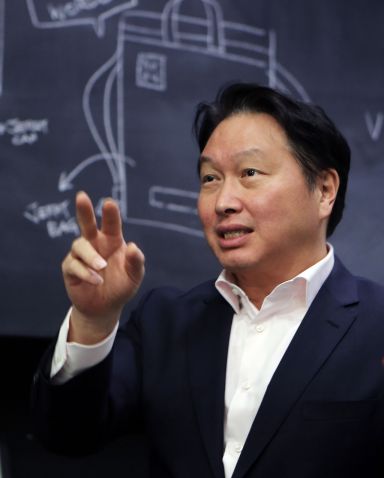
[Asia Economy Reporter Hwang Yoon-joo] Eight SK Group affiliates will become the first in Korea to join 'RE100.' With this membership, SK Group is accelerating the implementation of the environmental (Environment) aspect of 'ESG (Environmental, Social, and Governance) management,' which Chairman Chey Tae-won emphasized last month at the CEO seminar as one of the future growth strategies.
According to SK on the 1st, eight companies?SK Inc., SK Telecom, SK Hynix, SKC, SK Siltron, SK Materials, SK Broadband, and SK IT Technology?will submit their application to the Korea RE100 Committee on the 2nd. Affiliates not eligible for membership, such as SK E&S, SK Energy, and SK Gas, plan to set their own goals equivalent to RE100 and expand their use of renewable energy.
SK Innovation's battery business cannot join this time due to company-level membership conditions but will set and implement goals identical to RE100, considering demands from global electric vehicle OEMs and institutional investors.
'RE100' stands for 'Renewable Energy 100%.' It means that companies commit to sourcing 100% of their electricity consumption from renewable energy sources such as wind and solar power by 2050. It was launched in 2014 by The Climate Group, a multinational non-profit organization based in London, UK. As of October, 263 companies worldwide, including Google, Apple, GM, and IKEA, have joined.
Chairman Chey has consistently emphasized ESG as one of the key elements to fundamentally innovate the group's business. At the 2018 group CEO seminar, he urged the preparation of concrete strategies such as technology development for eco-friendly transition. At the CEO seminar held last October, he also ordered all affiliates to steadily pursue eco-friendly efforts tailored to their respective businesses. In September, he expressed his intention to make ESG a new axis of corporate management through an email sent to all employees.
Once the eight SK companies submit their applications, final membership will be confirmed after review by The Climate Group. After joining RE100, they must submit an implementation plan within one year and undergo annual progress evaluations, increasing their use of renewable energy to 100% by 2050.
The eight companies plan to increase their renewable energy usage through various methods the government is preparing to implement. These include 'third-party PPA (Power Purchase Agreement),' where renewable energy producers contract with Korea Electric Power Corporation (KEPCO) to supply renewable energy; and the 'Green Tariff System,' where paying a premium to KEPCO for electricity purchases is recognized as renewable energy use. Equity investment is also expected to be a key method. Investing in renewable energy power generation projects can be recognized as using renewable energy.
With this membership, SK Group is expected not only to secure trust as a 'global top-tier ESG practice company' from the market and society but also to take a step ahead in responding to strengthened supply chain management by global companies in the US and Europe. Additionally, as the European Union (EU) considers introducing a 'carbon border tax' (imposing tariffs on imported products with high carbon emissions), the international community is tightening eco-friendly regulations. For Korea, which heavily depends on overseas trade, adopting low-carbon and eco-friendly management like RE100 is essential to strengthen national export competitiveness.
Meanwhile, SK Group has been expanding eco-friendly businesses and activities even before joining RE100. In September, SK E&S was selected as the developer of a solar power generation complex the size of Yeouido (2.64 million square meters or 800,000 pyeong) on the Saemangeum reclaimed land. The generation capacity reaches 200 megawatts (MW). SK E&S plans to increase its domestic and overseas renewable energy generation capacity to 10 gigawatts (GW) by 2030.
SK Telecom is reducing power consumption by utilizing New ICT technologies such as BEMS (Building Energy Management System), AI, and Cloud, and plans to actively promote renewable energy generation by installing solar power facilities on rooftops of offices and exchange stations nationwide where installation is possible. SK Construction has completed and is operating hydrogen fuel cell power plants in Hwaseong and Paju, Gyeonggi Province, which generate electricity by reacting hydrogen and oxygen.
Lee Hyung-hee, Chair of the SV Committee of the SK SUPEX Council, said, "It is meaningful that Korean companies are now actively participating in the eco-friendly trend to reduce carbon emissions to solve global issues such as abnormal climate," adding, "We hope this will serve as a small foundation for expanding the domestic renewable energy market and fostering new growth industries such as energy solutions."
© The Asia Business Daily(www.asiae.co.kr). All rights reserved.

















