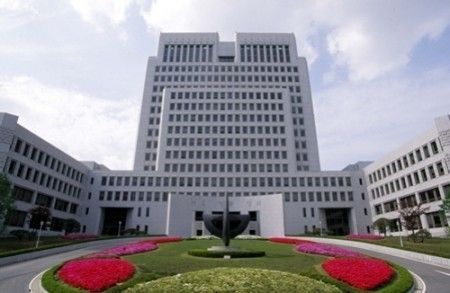
[Asia Economy Reporter Baek Kyunghwan] The Supreme Court has ruled that the existence of a lien on a building sold at auction must be determined by each unit.
On the 1st, the Supreme Court's 3rd Division (Presiding Justice Min Yusook) announced that it overturned the lower court's ruling, which had dismissed the depositor's lawsuit, in the appeal case filed by the Korea Deposit Insurance Corporation against construction contractor A and others to confirm the non-existence of a lien, and remanded the case to the Busan High Court with a partial ruling in favor of the plaintiff.
Haesol Savings Bank, which is under bankruptcy management by the Korea Deposit Insurance Corporation, auctioned off a building with a mortgage in August 2012 after a company failed to repay its loan.
However, Mr. A claimed a lien for unpaid construction costs of 520 million won for the 4th and 5th floors of the building, and Mr. B claimed a lien for 350 million won for the 2nd and 3rd floors. A lien is the right to retain someone else's property or securities until a debt is repaid.
The first trial court acknowledged that they had posted lien notices on the building but found insufficient evidence that the lien was continuously exercised until the start of the auction. The real estate status investigation report prepared by the auction officer did not include any information that the lien was exercised through notices after the auction procedure began.
The second trial court recognized the liens of Mr. A and Mr. B, stating that the real estate status investigation report cited by the first trial court contained some inaccuracies and was therefore unreliable.
The Supreme Court's judgment differed again. It found that the lower court erred in dismissing the entire lawsuit to confirm the non-existence of the lien without specifically examining the subject of the lien exercise. The court stated, "The lower court recognized the lien as valid for the entire property, including parts that the construction contractors claimed they did not possess themselves," and added, "It is necessary to further examine the parts occupied by the construction contractors."
© The Asia Business Daily(www.asiae.co.kr). All rights reserved.
![Clutching a Stolen Dior Bag, Saying "I Hate Being Poor but Real"... The Grotesque Con of a "Human Knockoff" [Slate]](https://cwcontent.asiae.co.kr/asiaresize/183/2026021902243444107_1771435474.jpg)











