Presentation of 'Care Workers Survey' Results at Korean Federation of Trade Unions Forum
Disability Activity Support Workers "Job Stability Guarantee, Wage Increase Needed"
Calls for Expanding Publicness of Care Work Including Social Service Agency Act Passage
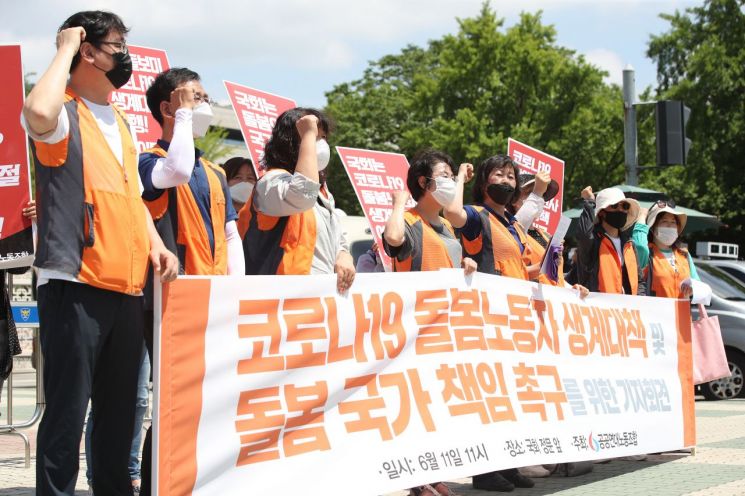
[Asia Economy Reporter Kim Bo-kyung] A survey revealed that the most necessary factor to create a work environment where childcare workers want to work is 'salary increase.' For care workers, the most difficult task was found to be 'emotional labor.'
The Central Research Institute of the Korean Confederation of Trade Unions held a discussion forum titled 'The Reality of Care Workers, Policies, and the Tasks of Labor Unions' at the Korean Confederation of Trade Unions Hall on the 30th.
Yoon Jeong-hyang, senior research fellow at the Korea Labor and Society Institute, who presented at the forum, announced the results of a survey on care workers including childcare workers, disability activity support workers, and care workers.
According to the survey, the top policy needed to create a work environment where childcare workers want to work was 'raising salary levels (31.8%),' followed by 'expanding support for assistant teachers and administrative staff (20.4%),' and 'guaranteeing a 40-hour workweek (16.6%).'
Regarding the use of break time by disability activity support workers, 40% of respondents answered that they 'do not use it,' and 24% responded that they 'stop the device but continue working.'
The policies needed to create a work environment where disability activity support workers want to work were tied for first place with 'job stability guarantee' and 'raising salary levels,' each accounting for 27.1%. The third was 'improving social evaluation of activity support workers (14.6%).'
For care workers, 54.5% answered that the most difficult task was 'emotional labor.' The proportion who said that household finances become difficult when taking time off due to user circumstances was 60.8%.
The top policy needed to create a work environment where care workers want to work was 'guaranteeing employment stability (36.9%),' followed by 'introducing a monthly salary system (26.3%),' and 'realizing the grievance handling system (14.4%).'
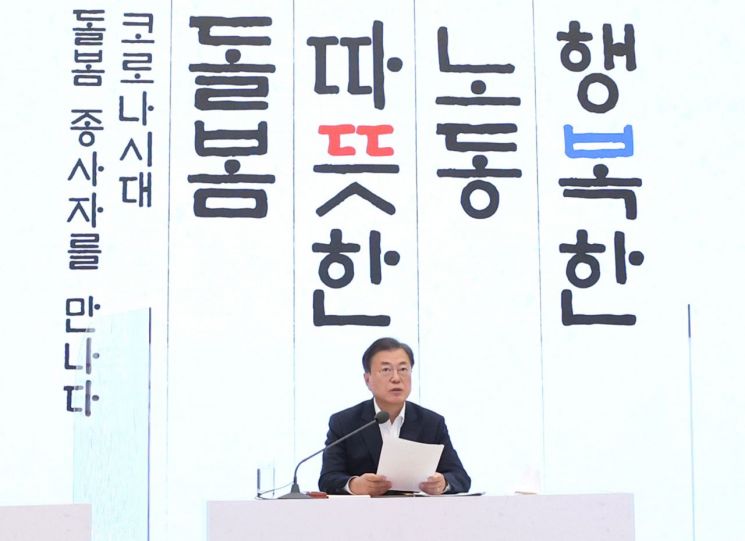
Professor Ahn Hyun-mi of Chung-Ang University’s Department of Social Welfare stated in her evaluation on whether the Social Service Agency is becoming an alternative to solving chronic problems in childcare services, "The Social Service Agency has advantages such as employment stability, retirement guarantee, and the possibility of dispatching substitute and specialized personnel compared to private consignment, but it was confirmed that the workload has increased due to separate evaluations and institutional inspections."
Professor Ahn also presented the immediate tasks as ▲passing the Social Service Agency Special Act ▲developing and spreading a leading public childcare operation model.
The final presenter, Professor Lee Eun-joo of Soonchunhyang University’s Department of Social Welfare, explained the role of the Social Service Agency in building a community-centered care system by comparing the Seoul Social Service Agency and the Daegu Social Service Agency to highlight regional disparities.
Professor Lee pointed out, "Services such as two-person service and customized service were discussed at the planning stage but face limitations in operation," and added, "The act of linking costs to proving the performance of social services is still being carried out by local governments."
In the subsequent discussion, Professor Yoon Ja-young of Chungnam National University’s Department of Economics stated, "A public organization like the Social Service Corporation managing information on service demand and supply, directly employing personnel for efficient matching, and resolving issues with fees and private consignment methods is a key task."
Before the forum, Kim Hyun-jung, executive vice chairman of the Korean Confederation of Trade Unions, emphasized in his opening remarks, "Care work is essential labor that maintains the community in emergencies," and added, "Now, these workers must be able to enjoy their rights as legitimate workers and receive appropriate treatment."
© The Asia Business Daily(www.asiae.co.kr). All rights reserved.


















