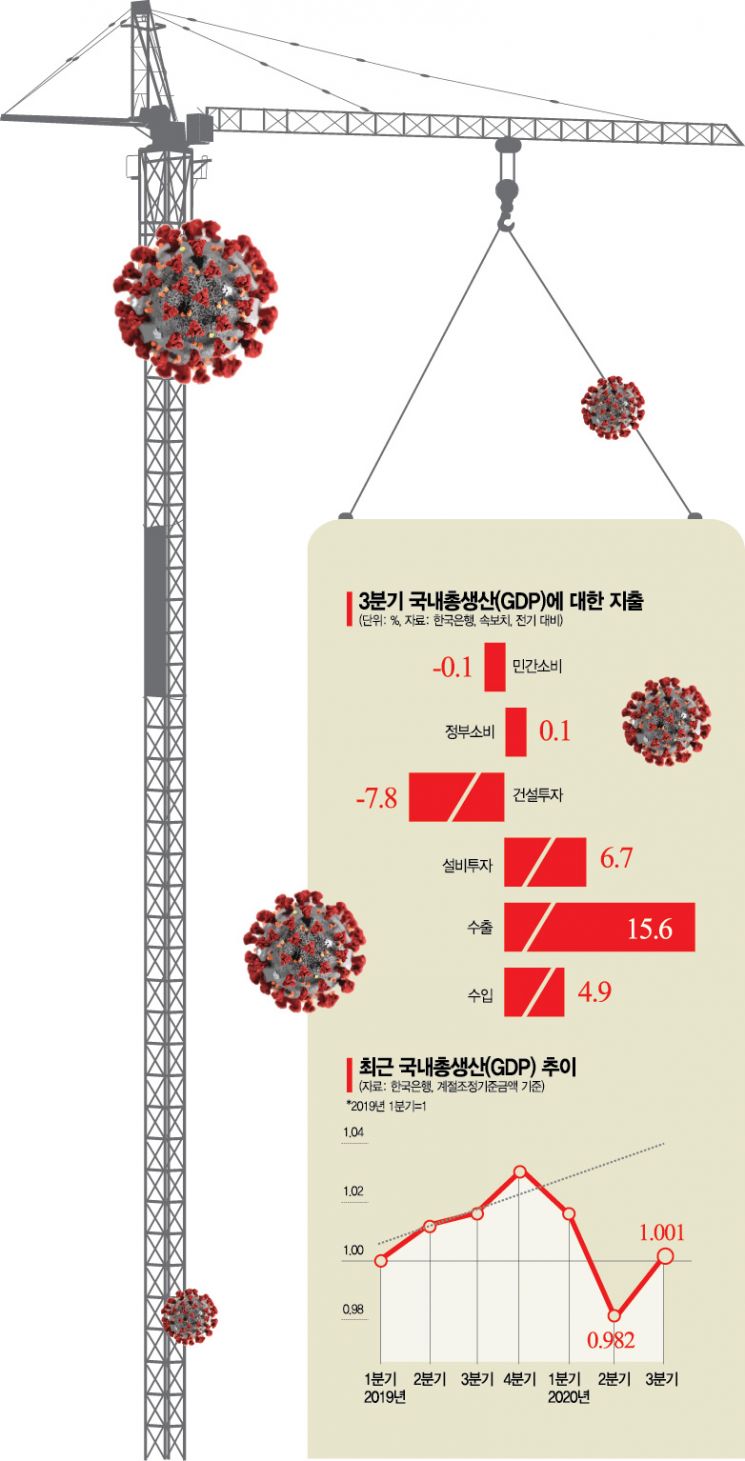
[Asia Economy Reporter Kim Eun-byeol] Major countries including South Korea, the United States, and Europe are emerging from the recession caused by the COVID-19 pandemic. However, economic experts evaluate that the rebound in the third quarter gross domestic product (GDP) reflects the significant decline in GDP in the second quarter, and it will take time for the economy to recover to pre-COVID-19 levels. In particular, the recent resurgence of COVID-19 in the U.S. and Europe is also considered a point of caution.
GDP Level Has Not Recovered to Previous Levels
According to the Bank of Korea on the 31st, the third quarter GDP was 456.8635 trillion won, which is 97.5% of the 468.8143 trillion won recorded in the fourth quarter of last year before the COVID-19 outbreak.
Based on the Bank of Korea Economic Statistics Department’s estimate, which set the seasonally adjusted GDP amount of the first quarter of last year as 1, the third quarter GDP this year remains at about 1.001, similar to the first quarter of last year. It still falls far short of the pre-COVID-19 GDP growth trend line. Park Yang-su, head of the Bank of Korea Economic Statistics Department, explained, "When considering a V-shaped rebound, it is necessary to see if it rises sharply compared to the growth trend line," adding, "There is still hesitation in calling it a V-shaped rebound."
The situation is similar in the U.S. On the 29th (local time), the U.S. Department of Commerce’s Bureau of Economic Analysis (BEA) announced that the third quarter GDP growth rate was 33.1% (annualized), the highest since statistics began in 1947. However, the GDP level (annualized) was $18.58 trillion (approximately 21,000 trillion won), still below the $19.25 trillion recorded in the fourth quarter of last year.
The Eurozone (19 EU member countries using the euro) third quarter GDP (preliminary) was estimated to have increased by 12.7% compared to the previous quarter. The GDP of all 27 EU member countries was also estimated to have increased by 12.1% quarter-on-quarter. However, according to Eurostat, the EU’s statistical office, GDP remains negative compared to the same period last year. The Eurozone’s third quarter GDP fell by 4.3% year-on-year, and Germany’s GDP decreased by 4.2% year-on-year.
Consumption and Business Sentiment Rebounded... Employment and Investment Recovery, COVID-19 Resurgence Are Variables
Although sentiment indices surveyed among consumers and businesses have rebounded simultaneously, it remains uncertain whether economic agents can continue to utilize this for investment or production. According to the Bank of Korea’s Business Survey Index (BSI) results, the October all-industry business condition BSI was 74, up 10 points from the previous month. This is the largest improvement in perceived business conditions in over 11 years.
The BSI is a statistic that surveys entrepreneurs’ judgments and forecasts on current business conditions; if negative responses outnumber positive ones, the index falls below 100. This survey, conducted from October 14 to 21, included 2,823 companies.
Consumer sentiment, which had frozen due to COVID-19, also improved significantly this month. The October Consumer Confidence Index (CCSI) rose sharply, marking the largest increase since 2009, the year after the financial crisis. The CCSI was 91.6, up 12.2 points from the previous month. This is the largest increase in 11 years and 6 months since April 2009, when it rose 20.2 points.
However, economic experts analyze that it is premature to say the economy has recovered to pre-COVID-19 levels based solely on economic indicators.
Kim Dae-jin, head of the Bank of Korea Corporate Statistics Team, evaluated, "While the manufacturing BSI has reached the long-term average level, the non-manufacturing sector remains low, so the overall industry average is below the long-term average, making it premature to conclude that the economy has recovered to pre-COVID-19 levels." He also explained, "Since COVID-19 is still ongoing, the impact depends greatly on how each country responds, so uncertainty remains high."
Professor Son Seong-won of Loyola Marymount University and CEO of SS Economics pointed out, "Although this was the shortest recession on record, it does not mean the economy has returned to a healthy growth trajectory." He added, "In particular, in the U.S., stimulus measures are delayed, and with the resurgence of COVID-19, the future outlook is bleak." He further noted, "It may take years, not months, for the employment market to return to previous peak levels. Temporary layoffs are turning into permanent dismissals, and job creation will become more difficult going forward."
© The Asia Business Daily(www.asiae.co.kr). All rights reserved.

















